
Dengue worldwide overview
Situation update, September 2026
Since the beginning of 2026, and as of September 2026, over two million cases of dengue and over 1 000 dengue-related deaths have been reported globally, according to information from publicly available sources. This is a decrease compared with the same period in 2025.
An overview highlighting trends in different countries/territories is presented below, based on publicly available information from official sources and reports from different regions. The summarised country/territory trends are based on data availability at the time the report was prepared; more detailed analyses are therefore only provided for countries/territories with sufficient data.
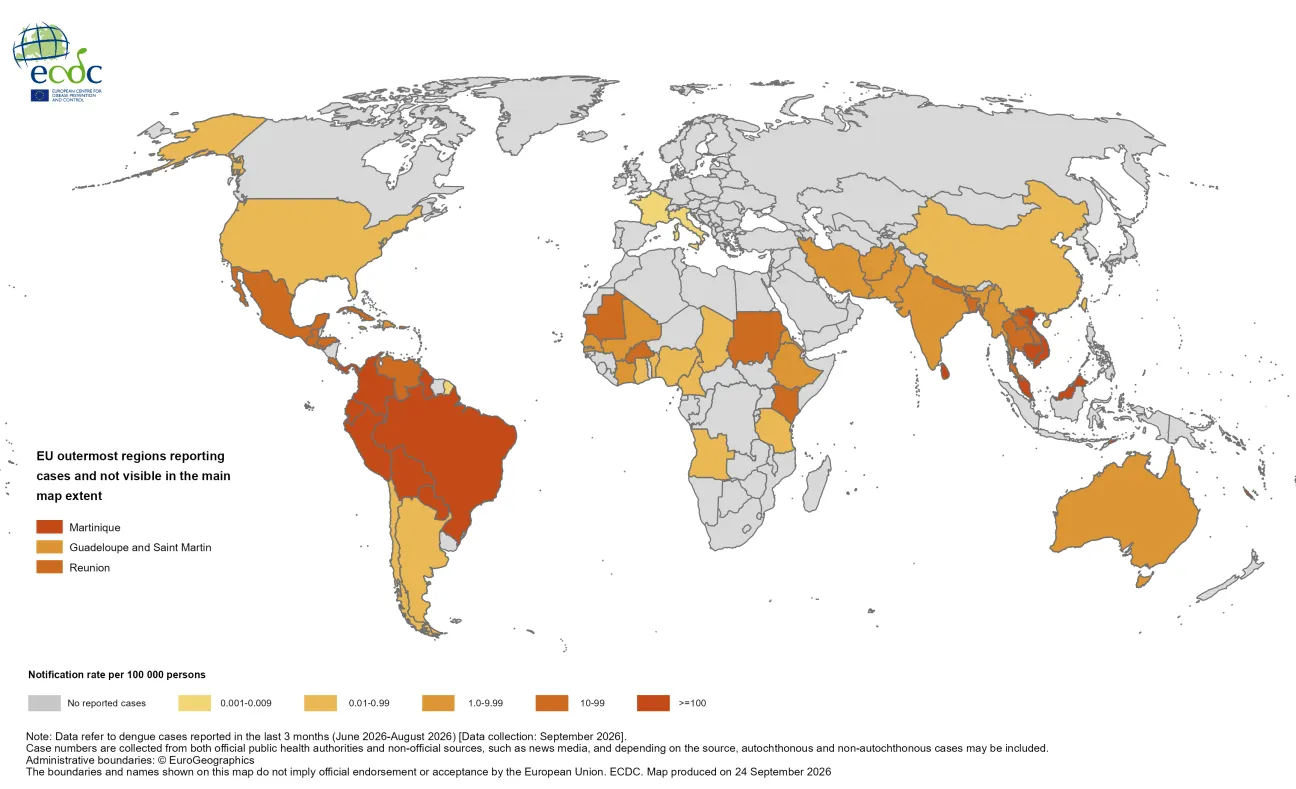
Three-month dengue virus disease case notification rate per 100 000 population, June to August 2026
EU/EEA
Since the beginning of 2026, and as of September 2026, France and Italy have reported locally acquired dengue transmission. For more information on locally acquired dengue cases reported in the EU/EEA, excluding France's outermost regions, please visit the dedicated ECDC website.
For the EU/EEA's outermost regions, a summary of recent trends is as follows:
- Martinique, Guadeloupe and Saint Martin: In Martinique, dengue activity remained low as of early September 2026. The epidemiological situation was stable with isolated clusters. From 31 August to 6 September 2026, eight confirmed dengue cases were reported. In Guadeloupe, dengue circulation also remained low, with sporadic cases. In Saint Martin, no confirmed dengue cases were identified during the previous four weeks, and the situation has remained calm since May 2026. (Santé publique France, Dengue aux Antilles. Bulletin du 10 septembre 2026).
- La Réunion: Dengue transmission remained at a low level, with sporadic cases only. A total of 341 confirmed dengue cases were reported since the beginning of 2026 and as of 30 August. According to the bulletin published on 18 September 2026, dengue activity remains low with sporadic cases and no evidence of sustained dengue transmission (Surveillance sanitaire à La Réunion. Bulletin du 4 septembre 2026; Surveillance sanitaire à La Réunion. Bulletin du 18 septembre 2026, Surveillance sanitaire à La Réunion. Bulletin du 25 septembre 2026).
- French Guiana: Dengue activity remained low as of 13 September 2026 (Santé publique France, Chikungunya et dengue en Guyane. Bulletin du 17 septembre 2026).
Americas
In the Americas, as of week 35 2026 (ending 30 August), 1 658 783 dengue cases have been reported; of these, 30% were laboratory confirmed, according to the WHO PAHO
report published on 25 September 2026. The current number of reported cases is 57% lower than during the same period in 2025 and 64% lower than the five-year average. While all four serotypes have been reported in the region to date in 2026, their distribution varies across the different PAHO countries (Report on the epidemiological situation of dengue in the Americas). In 2026, and as of week 36, most cases have been reported by Brazil (1 294 963), Colombia (79 304), Bolivia (58
628), Peru (55 943), and Mexico (50 819) (Dengue: analysis by country - PAHO/WHO | Pan American Health Organization; accessed 28 September 2026).
South-East Asia
According to the WHO South-East Asia Region Epidemiological Bulletin, 19th edition, 23 September 2026 and earlier 2026 bulletins, dengue has been reported in Bangladesh, Bhutan, India, Maldives, Myanmar, Nepal, Sri Lanka, Thailand and Timor-Leste since July 2025.
For South-East Asia, a summary of available information on epidemiological trends is as follows:
- Bangladesh: Bangladesh has experienced an increase in dengue activity since early July 2026. Between 14 and 20 September, 10 135 suspected cases were reported, 10% more than
- between 7 and 13 September (9 247) and 1.6 times the number reported in the corresponding week of 2025 (3 940). Thirty-five dengue-related deaths were reported in week 38, compared with 32 in week 37. (WHO South-East Asia Region Epidemiological Bulletin, 19th edition, 23 September 2026; Bangladesh DGHS Health Emergency Operations Centre Dengue Dashboard).
- India: India reported increasing dengue activity during the first half of 2026, at levels comparable to 2025. As of August 2026, 46 670 cases were reported, while 49 553 were reported during the same period in 2025 (WHO South-East Asia Region Epidemiological Bulletin, 19th edition, 23 September 2026).
- Maldives: The most recent country-specific information identified in the SEARO bulletins was published on 3 June 2026. More than 100 cases had been reported weekly since January, with week-to-week fluctuations, and the weekly totals exceeded the expected seasonal baseline. More than 2 900 cases had been reported by week 21 (ending 24 May), above the level observed during the same period in 2025 (WHO South-East Asia Region Epidemiological Bulletin, 11th edition, 3 June 2026; WHO SEAR Epidemiological Bulletins).
- Nepal: Dengue activity shows an increasing trend since May 2026. In August 2026, 1 776 cases were reported, which is a 93.5% increase compared with the 918 cases reported in July (WHO South-East Asia Region Epidemiological Bulletin, 19th edition, 23 September 2026).
- Sri Lanka: Sri Lanka has reported a high dengue burden in 2026. As of 27 September, 100 127 cases had been reported. July was the peak month, with 29 964 cases, followed by 10 155 cases in August and 4 637 cases between 1 and 27 September. The Western Province accounted for 52.5% of reported cases, with Gampaha and Colombo the most affected districts (Sri Lanka National Dengue Control Unit, Daily Update, 27 September 2026; WHO South-East Asia Region Epidemiological Bulletin, 19th edition, 23 September 2026).
- Thailand: Thailand continues to report seasonal dengue transmission, with fluctuating weekly activity. Available 2026 reports indicate that cumulative activity remained below the corresponding level in 2025, despite increases reported earlier in the year. From 14 to 20 September, 560 cases were reported, which is 48% less compared with the cases reported the week before and 47% less compared with the cases reported the same week in 2025 (WHO South-East Asia Region Epidemiological Bulletin, 19th edition, 23 September 2026; WHO SEAR Epidemiological Bulletins).
- Timor-Leste: Monthly cases have decreased since April and as of July in Timor-Leste; 83 cases were reported in June compared with 126 in May. Although cumulative activity was higher than during the corresponding period in 2025, the trend had been decreasing after increases earlier in the year (WHO South-East Asia Region Epidemiological Bulletin, 14th edition, 15 July 2026).
Western Pacific Region
In the WHO Western Pacific Region, dengue transmission continues to be reported by several countries and territories, according to WHO WPRO Dengue Situation Update #754 (17 September 2026). Cambodia, Malaysia and Viet Nam report increasing trends compared with previous years, with some fluctuations.
For the Western Pacific Region, a summary of available information from the WHO WPRO report and national surveillance systems on ongoing trends are summarised as follows:
- Cambodia: High dengue activity continues to be reported in Cambodia. As of 6 September 2026, a total of 85 920 dengue cases, including 104 deaths, have been reported. This is a 120% increase compared with the same period in 2025 (39 063 cases). A sustained increasing trend was recorded since week 23 with a slight decrease in week 36. Overall, according to the WHO report, transmission remained well above the epidemic threshold (WHO WPRO Dengue Situation Update #754: 17 September 2026).
- China: Overall, 836 dengue cases were reported in August 2026 in China, compared with 1 120 cases in July 2026. The number of cases reported in August 2026 remained under the levels observed during the same period in 2025, representing a 50.9% decrease compared with August 2025 (1 702 cases) (WHO WPRO Dengue Situation Update #754: 17 September 2026).
- Indonesia: A decreasing trend in dengue activity continues to be reported in Indonesia. As of August 2026, a cumulative total of 79 144 cases and 214 deaths have been reported nationwide. The monthly number of reported cases has steadily decreased since January 2026, with 67 cases (no deaths) reported in August (WHO WPRO Dengue Situation Update #754: 17 September 2026).
- Laos: Overall, 263 dengue cases were reported in Laos between 6 and 12 September 2026, compared to 269 cases the previous week. Cumulatively, 4 577 cases have been reported in 2026 as of 12 September. This is a 44.1% decrease compared with the 8 193 cases reported during the same period in 2025 (WHO WPRO Dengue Situation Update #754: 17 September 2026).
- Malaysia: Elevated dengue transmission was reported in Malaysia, despite recent decreases in case numbers. In epidemiological week 34 (23–29 August 2026), 2 585 new dengue cases and two deaths were reported. Weekly case numbers have shown an overall increasing trend since week 12 and remain above both 2025 levels and the five-year median. As of week 34, a cumulative total of 63 752 cases and 60 deaths have been reported in 2026 (WHO WPRO Dengue Situation Update #754: 17 September 2026).
- Singapore: A total of 87 dengue cases were reported between 30 August and 5 September 2026 in Singapore. Although overall dengue activity remains relatively low, the number of cases reported this year so far is 70.6% higher than in the same period in 2025 (51 cases). Cumulatively, 2 265 dengue cases have been reported in 2026 as of 10 September (WHO WPRO Dengue Situation Update #754: 17 September 2026).
- Viet Nam: Increases in dengue activity have been reported in Viet Nam. From 31 August to 6 September 2026, 7 061 cases were reported. This is a 7.6% increase compared with the average from the previous four weeks. As of 6 September, 115 967 cases and 16 deaths have been reported nationwide in 2026, a 41.7% increase compared with the same period in 2025 (81 841 cases). The southern region is the most affected areas, with approximately 73% of all reported cases (WHO WPRO Dengue Situation Update #754: 17 September 2026).
- French Polynesia: Low dengue activity was reported in French Polynesia. One new dengue case was reported between 31 August and 6 September 2026. Since the beginning of 2026, 38 confirmed dengue cases have been reported (WHO WPRO Dengue Situation Update #754: 17 September 2026).
- New Caledonia: Two additional dengue cases were reported in New Caledonia between 31 August and 6 September 2026, bringing the cumulative total for 2026 to 2 234 cases. Weekly case numbers have remained low in recent weeks, indicating continued declining transmission following the earlier outbreak. Most cases reported in 2026 (2 229 cases) were locally acquired (WHO WPRO Dengue Situation Update #754: 17 September 2026).
Africa
According to the Africa CDC Epidemic Intelligence Report of 30 August 2026, a total of 4 170 cases have been reported on the continent from the Central African Republic (1), Kenya (1 583), Mali (2 308), Mauritania (110), Nigeria (95) and Senegal (73).
Note: the data presented in this report originate from both official public health authorities and non-official sources, such as news media, and depending on the source, autochthonous and non-autochthonous cases may be included. Data completeness depends on the availability of reports from surveillance systems and their accuracy, which varies between countries. All data should be interpreted with caution and comparisons, particularly across countries, should be avoided due to under-reporting, variations in surveillance system structure, different case definitions from country to country and over time, and use of syndromic definitions.
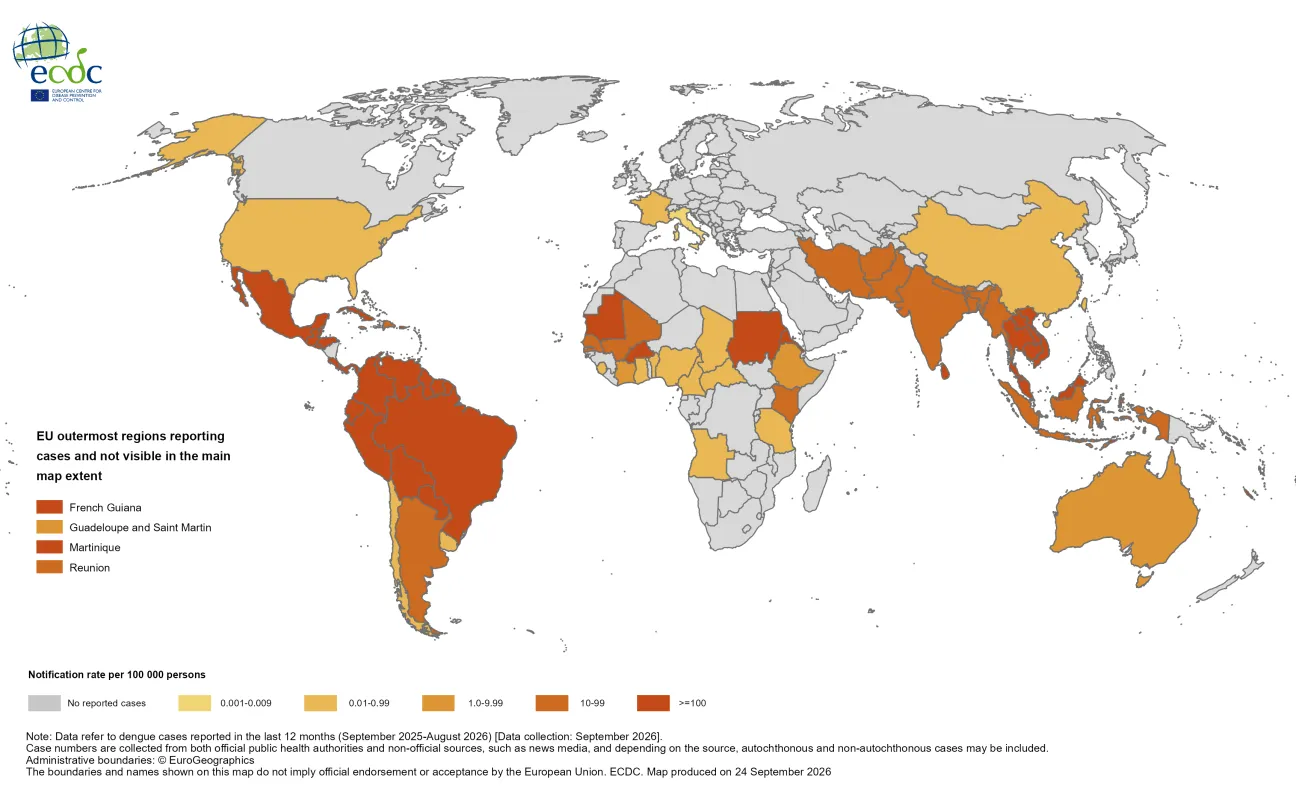
Twelve-month dengue virus disease case notification rate per 100 000 population, September 2025 to August 2026
ECDC assessment

The likelihood of onward transmission of dengue virus in mainland Europe is linked to importation of the virus by viraemic travellers into receptive areas with established and active competent mosquito vectors (e.g. Aedes albopictus and Aedes aegypti).