
Cholera worldwide overview
Monthly update as of 28 September 2026
Since 26 August 2026 and as of 28 September 2026, 46 153 new cholera cases, including 140 new deaths, have been reported worldwide.
New cases have been reported from Afghanistan, Angola, Bangladesh, Congo, DRC, Haiti, Mozambique, Pakistan, Somalia, Yemen and Zambia.
The five countries reporting the most cases are Afghanistan (34 378), DRC (8 505), Yemen (1 885), Angola (748) and Congo (299).
New deaths have been reported from Afghanistan, Angola, Congo, DRC, Mozambique, South Sudan, Yemen and Zambia.
The five countries reporting the most new deaths are DRC (107), Yemen (13), Afghanistan (10), Angola (7) and Congo (5). In the previous reporting period (27 July to 26 August 2026), 42 717 new cholera cases, including 257 new deaths, were reported worldwide. In addition, 2 080 new cases were reported or collected retrospectively from before 26 August 2026.
Since 1 January 2026 and as of 28 September 2026, 249 136 cholera cases, including 1 970 deaths, have been reported worldwide. In comparison, since 1 January 2025 and as of 28 September 2025, 436 268 cholera cases, including 4 449 deaths, were reported worldwide.
Georgraphical distribution of cholera cases reported worldwide from July 2026 to September 2026
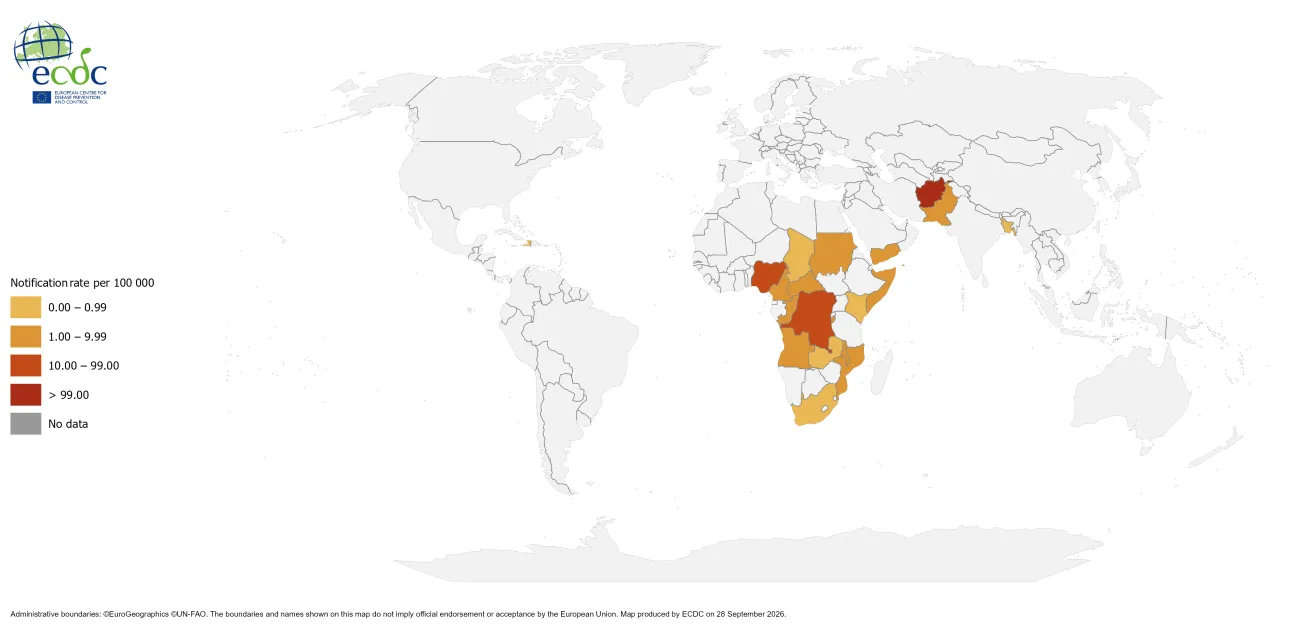
Since the last update, new cases and new deaths have been reported from:
Asia
Afghanistan:
Since 20 July 2026 and as of 14 September 2026, 34 378 new cases, including 10 new deaths have been reported. Since 1 January 2026 and as of 14 September 2026, 115 346 cases, including 55 deaths have been reported. In comparison, in 2025 and as of 15 September 2025, 129 325 cases, including 64 deaths, were reported.
Bangladesh:
Since 28 December 2025 and as of 31 August 2026, 24 new cases have been reported. Since 1 January 2026 and as of 31 August 2026, 24 cases have been reported. In comparison, in 2025 and as of 1 September 2025, 67 cases were reported.
Pakistan:
Since 6 July 2026 and as of 24 August 2026, 2 000 new cases have been reported. Since 1 January 2026 and as of 24 August 2026, 6 353 cases have been reported. In comparison, in 2025 and as of 21 July 2025, 14 760 cases were reported.
Yemen:
Since 29 June 2026 and as of 7 September 2026, 1 885 new cases, including 13 new deaths have been reported. Since 1 January 2026 and as of 7 September 2026, 7 328 cases, including 20 deaths, have been reported. In comparison, in 2025 and as of 8 September 2025, 76 347 cases, including 216 deaths, were reported.
Since 26 August 2026, no updates have been reported by: India, Myanmar/Burma, Taiwan and the Province of China.
Africa
Angola:
Since 9 August 2026 and as of 13 September 2026, 748 new cases, including 7 new deaths, have been reported. Since 1 January 2026 and as of 13 September 2026, 6 651 cases, including 127 deaths, have been reported. In comparison, in 2025 and as of 4 August 2025, 27 666 cases, including 773 deaths, were reported.
Congo:
Since 9 August 2026 and as of 13 September 2026, 299 new cases, including 5 new deaths, have been reported. Since 1 January 2026 and as of 13 September 2026, 988 cases, including 65 deaths, have been reported. In comparison, in 2025 and as of 4 August 2025, 187 cases, including 21 deaths, were reported.
Democratic Republic of The Congo:
Since 9 August 2026 and as of 13 September 2026, 8 505 new cases, including 107 new deaths, have been reported. Since 1 January 2026 and as of 13 September 2026, 41 687 cases, including 1 050 deaths, have been reported. In comparison, in 2025 and as of 8 July 2025, 32 456 cases, including 737 deaths, were reported.
Mozambique:
Since 9 August 2026 and as of 13 September 2026, 116 new cases, including 1 new death, have been reported. Since 1 January 2026 and as of 13 September 2026, 7 814 cases, including 66 deaths, have been reported. In comparison, in 2025 and as of 4 August 2025, 4 167 cases, including 43 deaths, were reported.
Somalia:
Since 9 August 2026 and as of 13 September 2026, 121 new cases have been reported. Since 1 January 2026 and as of 13 September 2026, 2 778 cases, including 1 death, have been reported. In comparison, in 2025 and as of 25 August 2025, 7 484 cases, including 9 deaths, were reported.
South Sudan:
Since 20 July 2026 and as of 13 September 2026, no new cases, including a retrospective correction of six deaths less, have been reported. Since 1 January 2026 and as of 13 September 2026, 457 cases have been reported. In comparison, in 2025 and as of 4 August 2025, 67 064 cases, including 1 142 deaths, were reported.
Zambia:
Since 9 August 2026 and as of 13 September 2026, 77 new cases, including 3 new deaths, have been reported. Since 1 January 2026 and as of 13 September 2026, 1 074 cases, including 19 deaths, have been reported. In comparison, in 2025 and as of 8 July 2025, 463 cases, including 9 deaths, were reported.
Since 26 August 2026, no updates have been reported by: Burundi, Cameroon, Central African Republic, Chad, Ethiopia, Kenya, Malawi, Namibia, Nigeria, Rwanda, South Africa, Sudan, United Republic of Tanzania or Zimbabwe.
Americas
Haiti:
Since 8 June 2026 and as of 3 July 2026, 80 new cases have been reported. Since 1 January 2026 and as of 3 July 2026, 722 cases, including 2 deaths, have been reported. In comparison, in 2025 and as of 23 June 2025, 2 496 cases, including 31 deaths, were reported.
ECDC assessment:
Cholera cases have continued to be reported in Africa and Asia, the Middle East, and the Americas.
In this context, although the likelihood of cholera infection for travellers visiting these countries remains low, sporadic importation of cases to the EU/EEA is possible.
In the EU/EEA, cholera is rare and primarily associated with travel to endemic countries. Since 2025, only events of locally acquired cholera cases are reported at the EU/EEA level; however, imported and locally acquired cholera cases are reported to the World Health Organization (WHO) on an annual basis. In 2024, 16 imported cases were reported by eight EU/EEA countries, while 12 were reported in 2023, 29 in 2022, two in 2021, and none in 2020. In 2019, 25 cases were reported in EU/EEA countries (including the United Kingdom). All cases had a travel history to cholera-affected areas.
Vaccination should be considered for travellers at higher risk of infection, such as emergency and relief workers who may be directly exposed. Vaccination is generally not recommended for other travellers. Travellers to cholera-endemic areas should seek advice from travel health clinics to assess their personal risk, and apply precautionary sanitary and hygiene measures to prevent infection. Such measures can include drinking bottled water or water treated with chlorine, carefully washing fruit and vegetables with bottled or chlorinated water before consumption, regularly washing hands with soap, eating thoroughly cooked food, and avoiding the consumption of raw seafood products.
Actions:
ECDC continues to monitor cholera outbreaks globally through its epidemic intelligence activities in order to identify significant changes in epidemiology and provide timely updates to public health authorities.
Reports are published on a monthly basis. The worldwide overview of cholera outbreaks is available on ECDC's website.
Read more
All updates on cholera

Cholera is an acute diarrhoeal infection caused by the bacterium Vibrio cholera of serogroups O1 or O139. Humans are the only relevant reservoir, even though Vibrios can survive for a long time in coastal waters contaminated by human excreta.