Key facts
- In 2024, approximately 160 000 chikungunya virus disease (CHIKVD) cases and 50 deaths were reported worldwide. A total of 17 countries reported CHIKVD cases from the Americas (11), Asia (5), and Africa (1). No autochthonous cases of CHIKVD were reported in Europe in 2024.
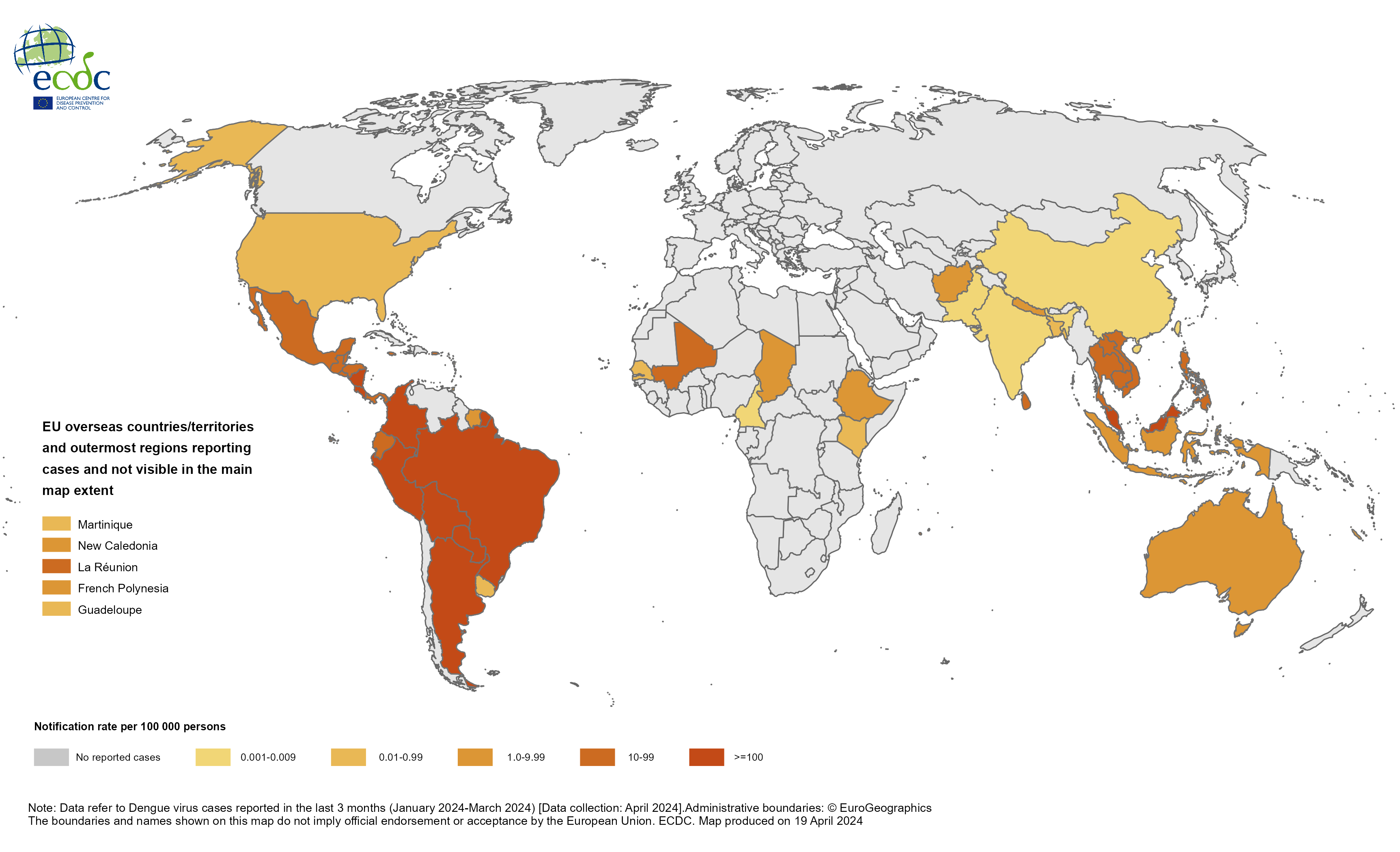
- Since the beginning of 2024, over five million dengue cases and over 2 000 dengue-related deaths have been reported globally. No autochthonous/non-travel-associated dengue cases have been reported in Europe in 2024.
- The current likelihood of local transmission events of chikungunya and dengue viruses occurring in areas where the vector is present in mainland EU/EEA is very low, as the environmental conditions are unfavourable for vector activity and virus replication in vectors.
- Doctors in the EU/EEA should be aware of the increased risk of dengue among travellers from affected countries presenting with compatible symptoms in order to ensure prompt diagnosis and clinical management of cases.
Overview
Chikungunya virus disease (CHIKVD)
In 2024 and as of 31 of March, over 160 000 CHIKVD cases and over 50 deaths have been reported worldwide. A total of 17 countries reported CHIKVD cases from the America (11), Asia (5), and Africa (1).
The majority of countries reporting high CHIKVD burden are from the Americas, in South and Central America. Countries reporting the highest number of cases are Brazil (161 794), Paraguay (5 105), Argentina (272), and Bolivia (182). Details of other countries in the Americas reporting CHIKVD cases can be found on PAHO’s dedicated website.
Outside of the Americas, CHIKVD cases have been reported in Asia from Timor Leste (195), Thailand (182), India (154), Pakistan (36), and Malaysia (13). One African country reported CHIKVD cases in 2024: Senegal (6).
No autochthonous cases of CHIKVD have been reported in Europe in 2024.
CHIKVD associated deaths have been reported from Brazil (51).
Dengue
Since the beginning of 2024, five million dengue cases and 2000 dengue-related deaths have been reported from 69 countries/territories. Most cases globally have been reported from the WHO PAHO region, with Brazil reporting most cases (over four million: Situation Report No 13 - Dengue Epidemiological Situation in the Region of the Americas - Epidemiological Week 12, 2024 - PAHO/WHO | Pan American Health Organization)
Guadeloupe and Martinique continue to face an epidemic classified as in phase 4 and level 1, while dengue circulation in Saint-Barthelemy and Saint-Martin is also ongoing, but at lower levels since mid-March. According to the surveillance report for dengue dated 11 April 2024, there is a stable trend in hospitalisation due to dengue in Guadelpupe and Martinique.
In French Guyana, over 7 000 confirmed dengue cases have been reported since the beginning of 2024, with the weekly number of cases showing a decreasing trend in recent weeks after a peak in January 2024 (French Guyana - 28/03/2024 Epi update).
In La Reunion, according to the report published on 11 April 2024, 495 dengue cases have been reported since the beginning of the year. Given recent increases in cases in La Reunion, the epidemiological situation has been classified as Level 2B which corresponds to 'intensified autochthonous viral circulation with the risk of evolving into an epidemic' (Increase in dengue cases in Reunion Island | Reunion Island Regional Health Agency (sante.fr)). In addition, two cases were reported from Mayotte on 9 April 2024.
Dengue circulation has also been reported in the WHO SEARO Region and WPRO Region as well as in Africa in March 2024.
Note: the data presented in this report originate from both official public health authorities and non-official sources, such as news media, and depending on the source, autochthonous and non-autochthonous cases may be included. Data completeness depends on the availability of reports from surveillance systems and their accuracy, which varies between countries. All data should be interpreted with caution and comparisons, particularly across countries, should be avoided due to under-reporting, variations in surveillance system structure, different case definitions from country to country and over time, and use of syndromic definitions.
ECDC assessment
Chikungunya virus disease and dengue affect people in most countries of the tropics and sub-tropics. EU/EEA citizens travelling to and living in the affected areas should apply personal protective measures against mosquito bites.
The likelihood of onward transmission of dengue and chikungunya virus in mainland EU/EEA is linked to importation of the virus by viraemic travellers into receptive areas with established and active competent vectors (e.g. Aedes albopictus and Aedes aegypti). Aedes albopictus is established in a large part of Europe. Aedes aegypti is established in Cyprus, on the eastern shores of the Black Sea, and in the outermost region of Madeira.
The current likelihood of the occurrence of local transmission events of chikungunya and dengue viruses in areas where the vectors are present in mainland EU/EEA is very low, as the environmental conditions are unfavourable for vector activity and virus replication in vectors. In 2023, locally-acquired dengue cases were reported by France, Italy, and Spain.
All autochthonous outbreaks of CHIKVD and dengue in mainland EU/EEA have so far occurred between June and November.
More information on autochthonous transmission of chikungunya and dengue virus in the EU/EEA is available on ECDC's webpages, and in ECDC's factsheets on dengue and CHIKVD.