Key facts
- Since the beginning of 2026, and as of 23 March 2026, over 500 000 cases of dengue and over 100 dengue-related deaths had been reported globally, according to information from publicly available sources. This is a decrease compared to the same period in 2025.
- In 2026, no cases have been reported in the EU/EEA excluding the outermost regions. Cases have been reported by Martinique, Guadeloupe, Reunion, and by French Guiana (French outermost regions).
Overview
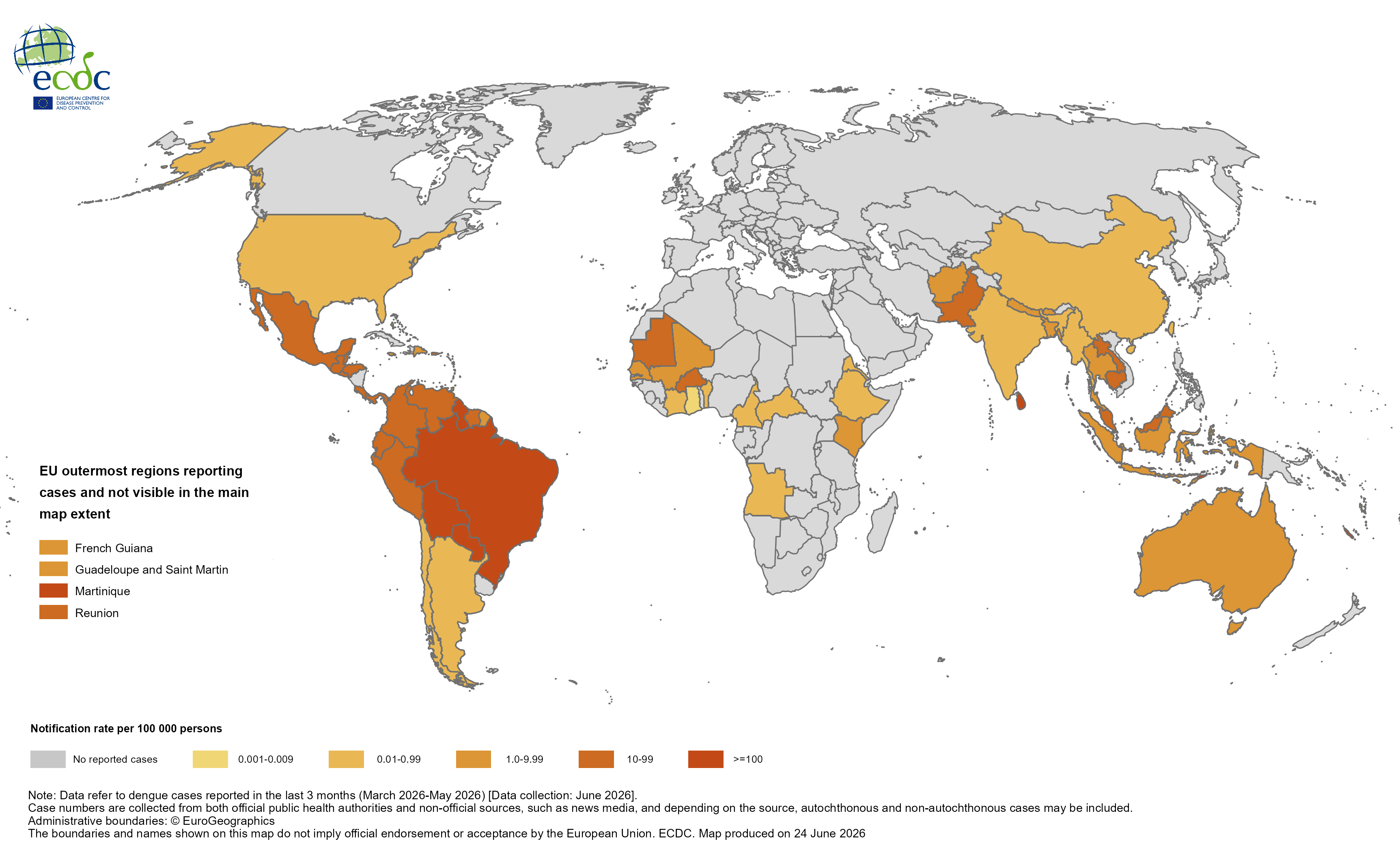
Since the beginning of 2026 and as of 22 June 2026, over 1 million cases of dengue and over 1000 dengue-related deaths had been reported globally according to information from publicly available sources.
Epidemiological overview
Over 80 countries/territories have reported dengue cases between January and June 2026. An overview, based on publicly available information from official sources and reports from different regions highlighting trends in different countries/territories is presented below. The country/territory trends summarised are based on data availability at the time the report was prepared; therefore, more detailed analyses are provided only for countries/territories with sufficient data.
Americas
In the Americas region, as of week 20 of 2026 (17 May 2026), 1 105 019 dengue cases have been reported, of which 26% were laboratory confirmed, according to the WHO PAHO report published on 10 June 2026. The current reported cases are 64% fewer than during the same period in 2025 and 70% below the five-year average. While all four serotypes have been reported in the region so far in 2026, their distribution varies across the different countries of PAHO (Report on the epidemiological situation of dengue in the Americas).
South-East Asia
According to the WHO SEARO epidemiological bulletins published on 3 June and 17 June 2026, since June 2025 and until May 2026, dengue has been reported in Bangladesh, Bhutan, India, Maldives, Myanmar, Nepal, Sri Lanka, Thailand and Timor-Leste. Available information on epidemiological trends are summarised below.
- In 2026 and as of 21 June 2026, Bangladesh has reported 4 900 cases. Monthly cases have been increasing since April 2026 but they follow expected seasonal trends (Bangladesh Daily Dengue Press Release, 21 June 2026 and WHO South-East Asia Region Epidemiological Bulletin, 17 June 2026).
- In 2026 and as of May 2026, India has reported 16 313 cases. In April 2026 alone, 2 918 cases were reported (a decrease of 5% compared to March) (WHO South-East Asia Region Epidemiological Bulletin, 17 June 2026).
- Maldives has reported over 100 dengue cases weekly since January 2026 with week-to-week fluctuations. Overall, the weekly reported number of dengue cases exceeds the expected seasonal baseline. The cumulative number of cases reported since the beginning of 2026 is over 2 900 (as of week 21, ending 24 May 2026) and higher compared to the same period in 2025 (WHO South-East Asia Region Epidemiological Bulletin, 17 June 2026).
- Nepal reported 216 cases in May and 215 cases in April 2026 which is within the expected levels for the season (WHO South-East Asia Region Epidemiological Bulletin, 17 June 2026).
- Sri Lanka has reported increases in weekly cases (with some fluctuations) since mid-April 2026. During week 23 (ending 7 June 2026), 3 265 cases were reported which is 34% higher compared to the number of cases reported the previous week. The total number of cases reported so far in 2026 is 37 118. During the same period in 2025, 25 153 cases were reported (Sri Lanka Weekly Dengue Update; 7 June 2026 and WHO South-East Asia Region Epidemiological Bulletin, 17 June 2026).
- Thailand reported 489 cases during week 24 (ending 14 June 2026) which is a decrease of 26% compared to the cases reported the week before. Overall, cases remail at lower levels compared to 2025 with some week-to-week fluctuations (WHO South-East Asia Region Epidemiological Bulletin, 17 June 2026).
- Timor-Lester reported a decrease in case numbers in May compared to April (126 cases vs 203 cases, respectively). Overall cases are higher in 2026 compared to the same period in 2025 and follow a decreasing trend after increases in beginning of the year (WHO South-East Asia Region Epidemiological Bulletin, 17 June 2026.
Western Pacific Region
In the WHO Western Pacific Region, dengue cases have been reported by several countries in the reports of 28 May and 11 June (WHO WPRO Dengue Situation Update #746: 28 May 2026 and WHO WPRO Dengue Situation Update #747: 11 June 2026). The following trends were highlighted by country:
- Cambodia: increasing trends have been reported since week 14 (ending 5 April) with over 400 cases reported each week with some fluctuations. As of 31 May, 10 126 cases had been reported in 2026. The same period in 2025 5 930 cases had been reported.
- China: 222 cases have been reported in May 2026, 137 cases had been reported in April 2026. Although cases remain at low levels the cases reported in May 2026 are 76.1% higher compared to the cases reported in May 2025.
- Indonesia: the decreasing trend since October 2025 continued until May 2026. As of 11 June 2026, 42 179 cases had been reported since the beginning of the year.
- Laos: Week-to-week fluctuations in case numbers are reported (80 cases were reported the week 31 May-6 June 2026, 56 the week 24-30 May). The 1 343 cases reported as of 6 June represent a 12% increase compared to the same period in 2025.
- Malaysia: cases have been showing an increasing trend since week 22-28 March (week 13). In week 17-23 May 2 053 cases have been reported. A total of 26 973 cases in 2026.
- Singapore: Cases remain at lower levels compared to previous years with 67 cases reported
- the week 24-30 May. Overall, 739 cases were reported until 30 May 2026.
- Vietnam: 44 965 cases were reported from 14 December 2025 and until 18 April 2026.
- In French Polynesia, dengue transmission has remained low in 2026, with one case reported in 10-16 May 2026 and 25 confirmed and five probable cases reported since the beginning of the year.
- New Caledonia: 2 021 cases have been reported in 2026 and as of 6 June with weekly cases showing a decreasing trend after mid-April (week 17).
Africa
According to the Africa CDC Epidemic Intelligence Report of 24 May 2026, a total of 1 337 cases have been reported in the region as of 24 May 2026 from the Central African Republic (1), Mali (1 233), Mauritania (38) and Senegal (65).
EU/EEA
No locally acquired dengue cases have been reported in the EU/EEA excluding the outermost regions.With regards to EU/EEA outermost regions, a summary of recent trends is presented below:
- In Martinique, transmission of dengue is at low levels without impact on hospitalisations. According to the Dengue Surveillance Report published on 18 June 2026, one confirmed case was reported during the week of 8–14 June, while an average of 14 confirmed cases per week was recorded between 11 May and 7 June. In Guadeloupe and Saint Martin dengue circulation remains at low levels (Antilles Dengue Surveillance Report published on 18 June 2026).
- In La Réunion, 273 cases of dengue have been reported since the beginning of 2026 and as of 14 June 2026. Weekly case numbers remain stable with fluctuations. In week 8-14 June, 10 cases were reported. In the previous two weeks, i.e., week 1-7 June and week 25-31 May, 15 and 24 cases were reported respectively (La Reunion Surveillance Report 19 June 2026).
- In French Guiana, dengue activity remains at a low level (French Guiana Surveillance Report 18 June 2026).
Global overview
Since the beginning of 2026 and as of 22 June 2026, over 1 million cases of dengue and over 1000 dengue-related deaths had been reported. This corresponds to a decrease compared with the same period in 2025 (Communicable disease threats report, 31 May-5 June 2026 and Communicable disease threats report, 19−25 July 2025).
Note: the data presented in this report originate from both official public health authorities and non-official sources, such as news media, and depending on the source, autochthonous and non-autochthonous cases may be included. Data completeness depends on the availability of reports from surveillance systems and their accuracy, which varies between countries. All data should be interpreted with caution and comparisons, particularly across countries, should be avoided due to under-reporting, variations in surveillance system structure, different case definitions from country to country and over time, and use of syndromic definitions
ECDC assessment
There are currently no cases of dengue reported in EU/EEA countries in 2026, excluding some of the outermost regions. The likelihood of onward transmission of dengue virus in mainland Europe is linked to importation of the virus by viraemic travellers into receptive areas with established and active competent mosquito vectors (e.g. Aedes albopictus and Aedes aegypti). Aedes albopictus mosquito is established in a large part of Europe. In Europe and neighbouring areas, Aedes aegypti mosquito is established in Cyprus, on the eastern shores of the Black Sea, and in the outermost region of Madeira.
The environmental conditions in most areas of the EU/EEA where Ae. albopictus or Ae. aegypti are established are now favourable for mosquito activity and virus replication in mosquitoes; therefore, locally acquired dengue cases may occur in the coming weeks.
For more information on the risk related to dengue in mainland EU/EEA, please see ECDC's dengue risk assessment for mainland EU/EEA.
Additional information on locally acquired dengue cases in 2026 in the EU/EEA is available on ECDC's seasonal surveillance reports for dengue, and in ECDC's factsheets on dengue.
Mosquito-bite prevention is strongly recommended for travellers to countries with reported cases of dengue. Travellers to areas with active outbreaks or elevated risk should follow travel health advice. Pregnant travellers, older adults and people with chronic conditions may be at higher risk of complications associated with dengue.
Actions
ECDC monitors this threat through its epidemic intelligence activities and reports on it on a monthly basis. A summary of the worldwide overview of dengue is available on ECDC's website.