Key facts
- Since the beginning of 2024, approximately 460 000 chikungunya virus disease (CHIKVD) cases and over 170 deaths have been reported worldwide. A total of 23 countries have reported CHIKVD cases from the Americas (15), Asia (6), Africa (1), and Europe (1). In mainland Europe, one autochthonous case of CHIKVD has been reported by France in 2024.
- Since the beginning of 2024, over 13 million dengue cases and over 8 500 dengue-related deaths have been reported globally. In mainland Europe, autochthonous dengue cases have been reported by France, Italy and Spain.
- The current likelihood of local transmission events involving chikungunya and dengue viruses occurring in areas where the vector is present in mainland EU/EEA is high, as the environmental conditions are favourable for vector activity and virus replication in vectors.
Overview
In 2024 and as of 30 of September, approximately 460 000 chikungunya virus disease (CHIKVD) cases and 170 CHIKVD associated deaths have been reported worldwide. A total of 23 countries reported CHIKVD cases from the Americas (15), Asia (6), Africa (1), and Europe (1). Grenada reported CHIKVD cases in September and for the first time in 2024.
Most countries reporting high CHIKVD burden are from the Americas, in South and Central America. Countries reporting the highest number of CHIKVD cases are Brazil (391 754), Paraguay (2 749), Argentina (768), and Bolivia (409). Additional countries in the Americas reporting CHIKVD cases can be found on PAHO’s dedicated website.
Outside of the Americas, CHIKVD cases have been reported in Asia from India (69 439), Pakistan (2 447), Thailand (468), Maldives (389), Timor Leste (195) and Malaysia (72). One African country reported CHIKVD cases in 2024: Senegal (9).
In 2024, one non-travel associated CHIKVD case has been reported in mainland Europe, from France. In addition, seven non-travel associated CHIKVD cases have been reported from La Réunion.
CHIKVD associated deaths were reported from Brazil (170).
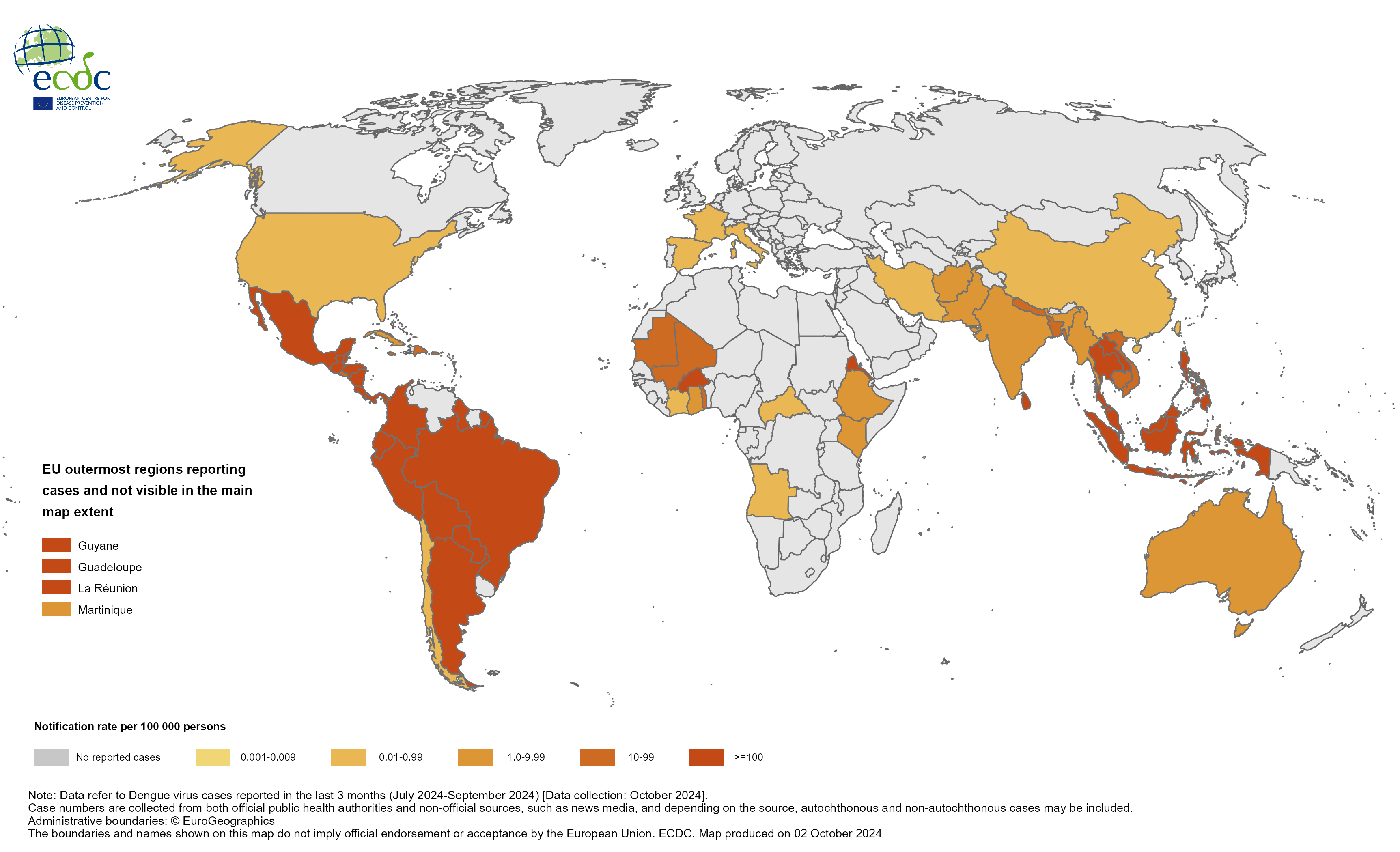
DengueSince the beginning of 2024, over 13 million dengue cases and over 8500 dengue-related deaths have been reported globally. Most cases globally have occurred in the WHO PAHO region where over 11 million cases have been reported in 2024, 53% of these being laboratory confirmed. Among the dengue cases, the total number of deaths in PAHO is over 6 000 (case fatality rate: 0.057%). Brazil has reported most cases in 2024 (over 9.5 million) followed by Argentina, Mexico, Paraguay, and Colombia (source: ).
In mainland Europe, autochthonous cases have been reported by France (68 cases), Italy (63 cases) and Spain (eight cases) as of September 2024.
As of August 2024, in Guadeloupe where a dengue epidemic was reported during the second half of 2023 (which started in July 2023), given the decrease in cases, the current situation is classified as phase 1 with sporadic cases (Dengue fever in the West Indies. Update as of August 8, 2024 Sante Publique France). The epidemic earlier this year was due to DENV-2 serotype while recently there have been increases in the proportion of DENV-3 serotype. In Martinique and Saint-Martin, dengue circulation continues, but at lower levels (epidemic phase 1), with only sporadic cases reported.
In French Guyana, over 8 000 confirmed dengue cases have been reported since the beginning of 2024 and as of August 2024. However, since a peak in January 2024 (Bimonthly Epidemiological Bulletin published on 26 September 2024), case numbers have decreased and been stable at lower levels in recent weeks.
Overall, 1 265 dengue cases have been reported in La Reunion since the beginning of the year and as of August 2024.
Dengue circulation has also been reported in the Eastern Mediterranean, South-East Asia and Western Pacific WHO Regions according to reports from the regional offices (EMRO, SEARO and WPRO, respectively), as well as in Africa during September 2024.
In the EMRO region, autochthonous cases were reported by Iran in June 2024 for the first time (WHO Disease Outbreak News Item published on 22 July 2024) while dengue has also been reported in Afghanistan (2 147 as of 14 September 2024) and Pakistan (20 783 as of August 2024).
According to the SEARO report published on 18 September 2024, increases in dengue cases were reported in Bangladesh and Nepal. In Bangladesh, overall, the total number of dengue cases in 2024 remains lower than that reported for the same period in 2023 (19 074 in 2024 as of 15 September, compared to 167 543 in 2023). In Nepal 2 645 cases have been reported through the EWAR system in 2024, as of 11 August 2024, and although an increase has been recorded in recent weeks, the overall number of cases is lower than for the same period last year. Dengue has been reported in India. In Kerala, 15 658 cases had been reported as of 8 September while in Karnataka, 26 323 cases had been reported for the same period. In both areas the number of dengue cases reported in 2024 so far is higher than the number reported for the same period in 2023. In Indonesia, the monthly number of cases has been decreasing after peaking in March-May and over 0.5 million suspected and confirmed cases have been reported, including over 1 000 deaths.
According to the WPRO Dengue Situation update of 19 September 2024, Cambodia reported a decrease in the number of cases reported in week 36 compared to the previous two weeks. In China, the number of dengue cases was higher in August than in July 2024 (1 801 vs 554) and in Vietnam, although increases have been observed in recent weeks, with a total of 71 300 cases reported up to 8 September 2024, the total number of cases is below 2023 (decrease by 12.4%).
In Africa, according to the Africa CDC Epidemic Intelligence Report of 23 September 2024, 74 201 dengue cases have been reported this year from Burkina Faso, Cameroon, Cabo Verde, Central African Republic, Chad, Cote d Ivoire, Ethiopia, Ghana, Kenya, Mali, Mauritius, Sao Tome and Principe, Senegal, Sudan and Togo. The Central African Republic declared a dengue outbreak on 10 September 2024 after the detection of cases due to dengue serotypes 1 and 2 (DENV-1 and DENV-2) in the country (WHO AFRO Weekly Bulletin 15 September 2024). Togo also has reported increased dengue circulation, with over 2000 cases reported in the country, according to Africa CDC.
Note: the data presented in this report originate from both official public health authorities and non-official sources, such as news media, and depending on the source, autochthonous and non-autochthonous cases may be included. Data completeness depends on the availability of reports from surveillance systems and their accuracy, which varies between countries. All data should be interpreted with caution and comparisons, particularly across countries, should be avoided due to under-reporting, variations in surveillance system structure, different case definitions from country to country and over time, and use of syndromic definitions.
ECDC assessment
The Americas is currently facing the largest ever outbreak of dengue. As a result, there has been a substantial increase in the number of imported cases of dengue to the EU/EEA since the beginning of the year.
The likelihood of onward transmission of dengue and chikungunya virus in mainland EU/EEA is linked to importation of the virus by viraemic travellers into receptive areas with established and active competent vectors (e.g. Aedes albopictus and Aedes aegypti). Aedes albopictus is established in a large part of Europe. In Europe and neighbouring areas, Aedes aegypti is established in Cyprus, on the eastern shores of the Black Sea, and in the outermost region of Madeira.
The current likelihood of the occurrence of local transmission events of chikungunya and dengue viruses in areas where the vectors are present in mainland EU/EEA is high, as the environmental conditions are favourable for vector activity and virus replication in vectors. All past autochthonous outbreaks of CHIKVD and dengue in mainland EU/EEA have so far occurred between June and November.
More information on autochthonous transmission of chikungunya and dengue virus in the EU/EEA is available on ECDC's webpages, and in ECDC's factsheets on dengue and CHIKVD.