Key facts
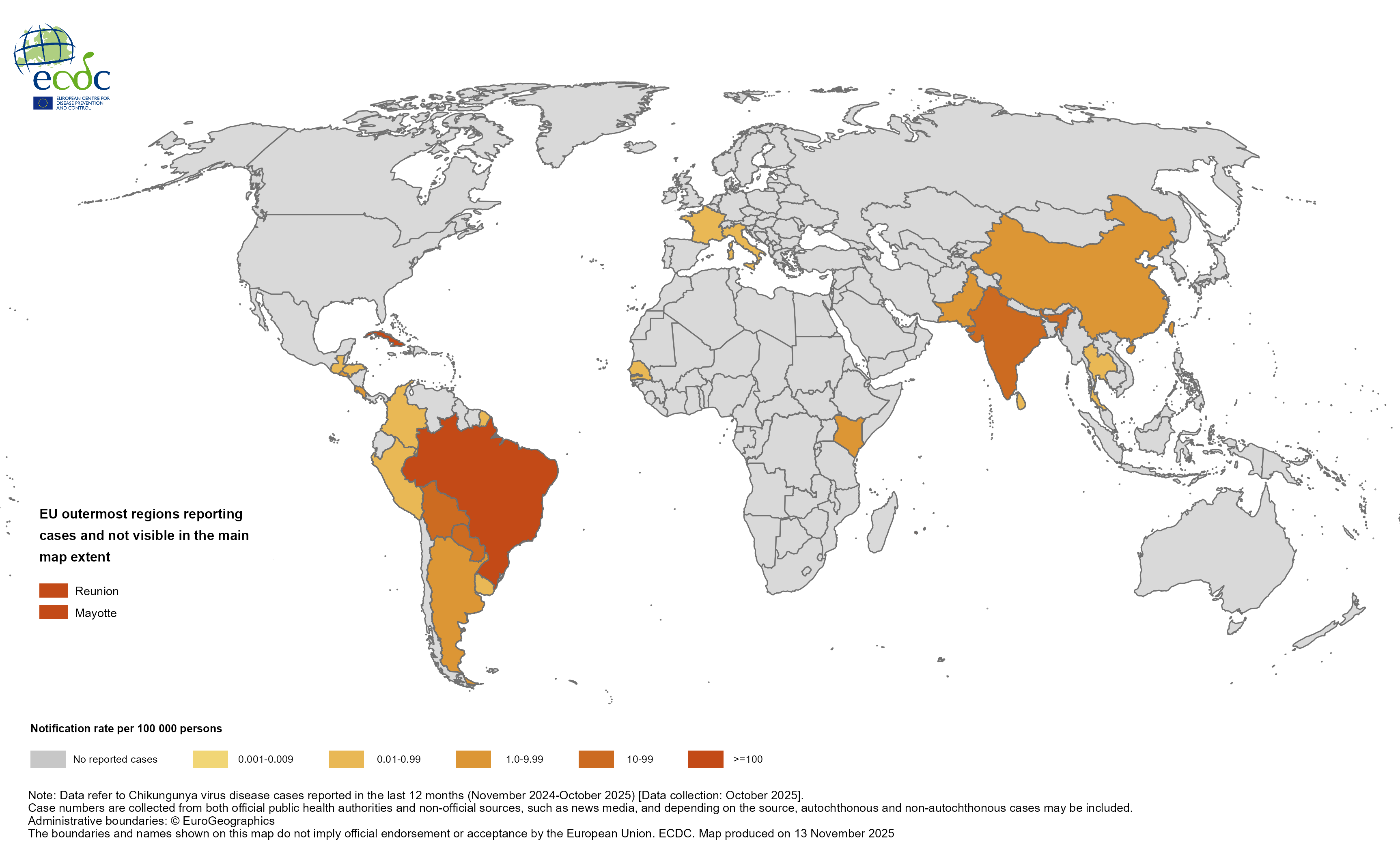
- Since the beginning of 2025, and as of 31 October (last day with available data), approximately 458 840 chikungunya virus disease (CHIKVD) cases and 146 CHIKVD-related deaths have been reported in 24 countries/territories.
- Cases have been reported in the Americas, Africa, Asia, and Europe (France - mainland and outermost regions, i.e. Réunion and Mayotte - and Italy).
Overview
Since the previous update on 9 October 2025 and as of 13 November 2025 (data collection period), 44 295 Chikungunya virus disease (CHIKVD) cases have been detected, including one associated death, from six countries (data available until 31 October). Cases reported in October have increased by 108% compared to September, when 21 266 were reported. Deaths have decreased in October compared to the previous month, when 10 deaths were reported.
New countries reporting casesNo new countries have reported CHIKVD cases for the first time in October and in 2025.
Ongoing CHIKVD outbreaks worldwideCurrently, nine countries have reported CHIKVD cases in the last two months. Of these, the majority are in the Americas and Asia. Below is a description of outbreaks reported in the last two months:
Americas
Brazil: CHIKVD cases continue to be reported in all regions (Centro-Oeste, Nordeste, Norte, Sudeste and Sul) and in most federal units of the country. The Centro-Oeste and Sudeste regions account for the highest number of cases in the last three epidemiological weeks (42-44), where Mato Grosso Do Sul, Minas Gerais, and Sao Paulo are the most affected federal units. During the last three months (June-October), CHIKVD cases have continuously declined, which is a trend observed in 2024. It is expected that cases will increase from November onwards, according to observed trends in 2024 and 2023. In 2025, most of the cases have been reported among females (60%), being the 20 to 29 years age group the most affected one.
Cuba: The current CHIKVD outbreak in Cuba is affecting all 14 provinces of the island. The most affected provinces are Matanzas, La Habana, Camaguey, Cienfuegos, Artemia, and Villa Clara. These provinces account for 98% of all reported cases in Cuba. Febrile syndrome cases have decreased in recent weeks, suggesting a declining trend in CHIKVD cases too. National health authorities are conducting intensive vector control activities in order to limit mosquito populations.
Bolivia: CHIKVD cases have been reported in six out of nine departments: Santa Cruz, Beni, Pando, Cochabamba, Chuquisaca, and Tarija. These departments are located in the eastern side of Bolivia, in the Andean region. In 2025, the most affected department is Santa Cruz, reporting more than 80% of CHIKVD cases in Bolivia, as well as all CHIKVD associated deaths. There have been cases of Guillain-Barre syndrome associated to CHIKVD in Bolivia.
El Salvador: CHIKVD cases have been sporadically reported in the country during 2025. A total of 16 CHIKVD cases have been reported in the current year, without any associated death. Majority of cases were reported in July. Since September (four cases reported), no more CHIKVD cases have been reported in the country.
Barbados: The country has reported sporadic cases of CHIKVD in 2025. Most of the cases were reported in January (six) and no more cases were reported until September (three), bringing the total number of CHIKVD cases in 2025 to nine.
Paraguay: Suspected CHIKVD cases are reported along the year in Paraguay, reaching the highest number of reported cases in min-May and early June (Epi weeks 21-24). Until October 2025, confirmed CHIKVD cases have been reported from Guaira, Itapua, Misiones, Amambay, Canindeyu, and Asuncion departments. Of these, the highest number of cases has been reported Amambay and Itapua. Currently, reported cases are at low levels, which is a similar trend when compared to previous years.
In 2025, there have been 266 165 CHIKVD disease cases and 118 associated deaths reported in the region. This is a decrease of 35.2% compared to the same period of the previous year. The most affected subcontinental region is South America, with Brazil reporting the highest number of cases in 2025.
Asia
China: CHIKVD cases continue to be reported in Guangdong province, following the first notified case in July 2025. Most of the cases are now reported from Jiangmen, Foshan, and Guangzhou cities. Weekly number of cases reported in Guangdong province show a decreasing trend (Epidemiological weeks 41-43). However, the number of total cases reported in October in Guangdong province has increased compared to the previous month. Outside of Guangdong province, CHIKVD cases have been also reported from the Special Administrative Region of Hong Kong and Guangxi province. Initial cases have been associated with imported cases from Guangdong province.
Pakistan: CHIKVD cases are reported along the year in Pakistan, concentrated in Baluchistan, Khyber Pakhtunkhwa, and Sindh provinces. These provinces are located in the Southwest of the country. Of these provinces, the highest number of CHIKVD cases are reported from Sindh, a province bordering with India. In the last 60 days, 109 CHIKVD cases and no deaths have been reported. In October, CHIKVD cases have increased by 37.0% when compared to the previous month.
Singapore: CHIKVD cases have been reported in the country since early August. Cases continued to be reported in September and October. The initial outbreak reported in August has been associated to travellers returning from Guangdong province, China.
In 2025, there have been 136 233 CHIKVD cases and no associated deaths in the region. This is a decrease of 31.5% compared to the same period of the previous year. The most affected subcontinental region is Southeast Asia, with India reporting the highest number of cases in 2025.
Africa
In 2025, there have been 2 197 CHIKVD cases and no associated deaths in the region. This is an increase compared to the same period of the previous year. The most affected subcontinental region is East Africa, with Mauritius reporting the highest number of cases in 2025.
Europe
For CHIKVD cases reported in mainland EU/EEA, please refer to the dedicated ECDC website.
CHIKVD cases have been reported from the French outermost regions of Réunion and Mayotte.
Other countries reporting CHIKV disease cases in 2025Other countries have also reported CHIKVD cases in 2025; however no new cases have been notified in the last two months, these countries are: Argentina, Colombia, Comoros, Costa Rica, Guatemala, Honduras, India, Kenya, Mauritius, Peru, Senegal, Sri Lanka, and Uruguay.
Global overviewIn 2025, there have been 458 840 CHIKVD cases and 146 associated deaths reported worldwide. Cases have increased when compared to the same period in 2024.
NoteThe data presented in this report originate from both official public health authorities and non-official sources, such as news media, and depending on the source, autochthonous and non-autochthonous cases may be included. Data completeness depends on the availability of reports from surveillance systems and their accuracy, which varies between countries. All data should be interpreted with caution and comparisons, particularly across countries, should be avoided due to under-reporting, variations in surveillance system structure, different case definitions from country to country and over time, and use of syndromic definitions.
ECDC assessment
The likelihood of onward transmission of chikungunya virus in mainland Europe is linked to importation of the virus by viraemic travellers into receptive areas with established and active competent vectors (e.g. Aedes albopictus and Aedes aegypti). Aedes albopictus is established in a large part of Europe. In Europe and neighbouring areas, Aedes aegypti is established in Cyprus, on the eastern shores of the Black Sea, and in the outermost region of Madeira.
For the risk related to chikungunya in mainland EU/EEA, please see the dedicated webpage: Chikungunya virus disease risk assessment for mainland EU/EEA.
More information on autochthonous transmission of chikungunya virus in 2025 in the EU/EEA is available on ECDC's webpages, and in ECDC's factsheets on CHIKVD.
Actions
ECDC monitors these threats through its Epidemic Intelligence activities, and reports on a monthly basis. A summary of the worldwide overview of CHIKVD is available on ECDC's website.