Key facts
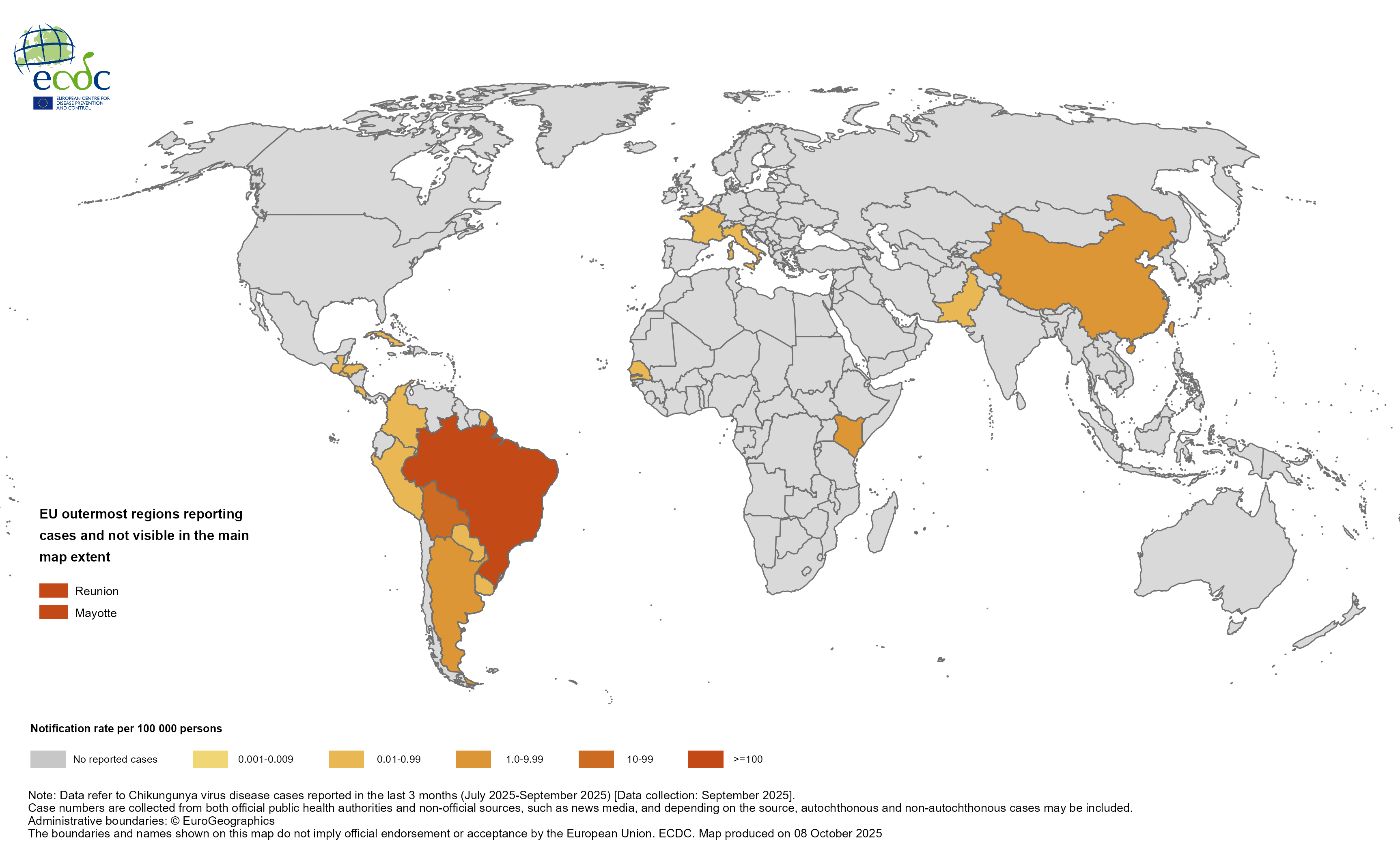
- Since the beginning of 2025, and as of September, approximately 339 822 chikungunya virus disease (CHIKVD) cases and 145 CHIKVD-related deaths have been reported in 24 countries/territories. Cases have been reported in the Americas, Africa, Asia, and Europe (France - mainland and outermost regions, i.e. Réunion and Mayotte - and Italy).
Overview
Since the previous update on 22 August 2025 and as of 27 September 2025, there have been 21 266 chikungunya virus disease (CHIKVD) cases, including 10 associated deaths reported worldwide from seven countries, of which two are EU/EEA countries. Cases have increased by 29.3% compared to the previous month, when 16 451 were reported. Deaths have also increased when compared to the previous month, when four deaths were reported.
New countries reporting casesNo new countries have reported CHIKVD cases for the first time this month and in 2025.
Ongoing CHIKVD outbreaks worldwideCurrently, 13 countries have reported CHIKVD cases in the last 60 days. Of these, the majority are in the Americas
and Asia. Below is a description of outbreaks reported in the last two months:
Americas
• Brazil: The outbreak was notified in January 2025. Since then, 221 919 CHIKVD cases and 113 deaths have been reported. The month when the highest number of CHIKVD cases were reported was May 2025. In the last 60 days, 23 409 CHIKVD cases and 11 deaths have been reported. Cases have increased by 61.5% in September 2025 when compared to the previous month. The regions with highest number of reported cases are Mato Grosso, Mato Grosso do Sul, and Rondonia.
• Bolivia: The outbreak was notified in January 2025. Since then, 5 372 CHIKVD cases and four deaths have been reported. The month when the highest number of CHIKVD cases were reported was July 2025. In the last 60 days, 651 CHIKVD cases and three deaths have been reported. Cases have decreased by 33.9% in September 2025 when compared to the previous month. Most of the cases are in the regions of Santa Cruz, Beni, Pando, and Cochabamba.
• Colombia: The outbreak was notified in January 2025. Since then, 40 CHIKVD cases and no deaths have been reported. The month when the highest number of CHIKVD cases were reported was August 2025. In the last 60 days, 39 CHIKVD cases have been reported. No cases have been reported in September 2025. Most of the cases have been reported in the regions of Tolima, Antioquia, Cundinamarca, Putumayo, and Meta.
• Cuba: The outbreak was notified in July 2025. Since then, 34 CHIKVD cases and no deaths have been reported. The day
when the highest number of CHIKVD cases were reported was 20 Sep 2025. In the last 60 days, 26 CHIKVD cases have been reported. Cases have increased in September 2025 when compared to the previous month. Cases have been reported from the regions of Guantanamo, La Habana, Matanzas, Pinar del Rio and Santiago de Cuba.
• Argentina: The outbreak was notified in January 2025. Since then, 2 666 CHIKVD cases and no deaths have been reported.
The month when the highest number of CHIKVD cases were reported was May 2025. In the last 60 days, 15 CHIKVD cases have been reported. No cases have been reported in September 2025. CHIKVD cases have been reported from regions of Entre Rios, Chaco, and Tucuman.
• El Salvador: The outbreak was notified in January 2025. Since then, 16 CHIKVD cases and no deaths have been reported. The month when the highest number of CHIKVD cases were reported was July 2025. In the last 60 days, five CHIKVD cases have been reported. Cases have increased in September 2025 when compared to the previous month.
• Guatemala: The outbreak was notified in January 2025. Since then, 23 CHIKVD cases and no deaths have been reported. The
month when the highest number of CHIKVD cases were reported was May 2025. In the last 60 days, two CHIKVD cases have been reported. No cases have been reported in September 2025.
• Uruguay: The outbreak was notified in August 2025. Since then, two CHIKVD cases and no deaths have been reported. The
month when the highest number of CHIKVD cases were reported was August 2025. In the last 60 days, two CHIKVD cases have been reported. No cases have been reported in September 2025.
• Honduras: The outbreak was notified in May 2025. Since then, six CHIKVD cases and no deaths have been reported. The month when the highest number of CHIKVD cases were reported was May 2025. In the last 60 days, one CHIKVD case has been reported. No cases have been reported in September 2025. CHIKVD cases have been reported from regions of Cortes, El Paraiso, and Santa Barbara.
In 2025, there have been 230 266 CHIKVD cases and 117 associated deaths reported in the region. This is a decrease of 42.8% compared to the same period of the previous year. The most affected subcontinental region is South America, with Brazil reporting the highest number of cases in 2025.
Asia
• China: The outbreak was notified in July 2025. Since then, 16 452 CHIKVD cases and no deaths have been reported. The month when the highest number of CHIKVD cases were reported was September 2025. In the last 60 days, 13 135 CHIKVD cases have been reported. Cases decreased by 1.5% in September 2025 when compared to the previous month. Most of the cases are reported from the regions of Guangdong and Guanxi.
• Singapore: The outbreak was notified in August 2025. Since then, 17 CHIKVD cases and no deaths have been reported. The month when the highest number of CHIKVD cases were reported was August 2025. In the last 60 days, 17 CHIKVD cases and no deaths have been reported. No cases have been reported in September 2025.
In 2025, there have been 51 461 CHIKV disease cases and no associated deaths in the region. Cases have decreased 30.5% compared to the same period of the previous year. The most affected subcontinental region is South East Asia, with India reporting the highest number of cases in 2025.
Africa
In 2025, there have been 2 197 CHIKVD cases and no associated deaths in the region. This is an increase compared to the same period of the previous year. The most affected subcontinental region is East Africa, with Mauritius reporting the highest number of cases in 2025.
Europe
For CHIKVD cases reported in mainland EU/EEA, please refer to the dedicated ECDC website.
CHIKVD cases have been reported from the French outermost regions of Réunion and Mayotte.
Other countries reporting CHIKV disease cases in 2025The following countries have also reported CHIKVD cases in 2025, however no new cases have been notified in the last two months, these countries are: Barbados, Comoros, Costa Rica, India, Kenya, Mauritius, Pakistan, Paraguay, Peru, Senegal, Sri Lanka.
Global overviewIn 2025, there have been 339 822 CHIKVD cases and 145 associated deaths reported worldwide. Cases have decreased by 28.7% compared to the same period in 2024, when 476 962 CHIKVD cases were reported.
NoteThe data presented in this report originate from both official public health authorities and non-official sources, such as news media, and depending on the source, autochthonous and non-autochthonous cases may be included. Data completeness depends on the availability of reports from surveillance systems and their accuracy, which varies between countries. All data should be interpreted with caution and comparisons, particularly across countries, should be avoided due to under-reporting, variations in surveillance system structure, different case definitions from country to country and over time, and use of syndromic definitions.
ECDC assessment
The likelihood of onward transmission of chikungunya virus in mainland Europe is linked to importation of the virus by viraemic travellers into receptive areas with established and active competent vectors (e.g. Aedes albopictus and Aedes aegypti). Aedes albopictus is established in a large part of Europe. In Europe and neighbouring areas, Aedes aegypti is established in Cyprus, on the eastern shores of the Black Sea, and in the outermost region of Madeira.
For the risk related to chikungunya in mainland EU/EEA, please see the dedicated webpage: Chikungunya virus disease risk assessment for mainland EU/EEA.
More information on autochthonous transmission of chikungunya virus in 2025 in the EU/EEA is available on ECDC's webpages, and in ECDC's factsheets on CHIKVD.
Actions
ECDC monitors these threats through its Epidemic Intelligence activities, and reports on a monthly basis. A summary of the worldwide overview of CHIKVD is available on ECDC's website.