Key facts
- Since the previous update on 8 January 2025, and as of 5 February 2025, no new MERS-CoV cases have been reported by the World Health Organization (WHO) or by national health authorities.
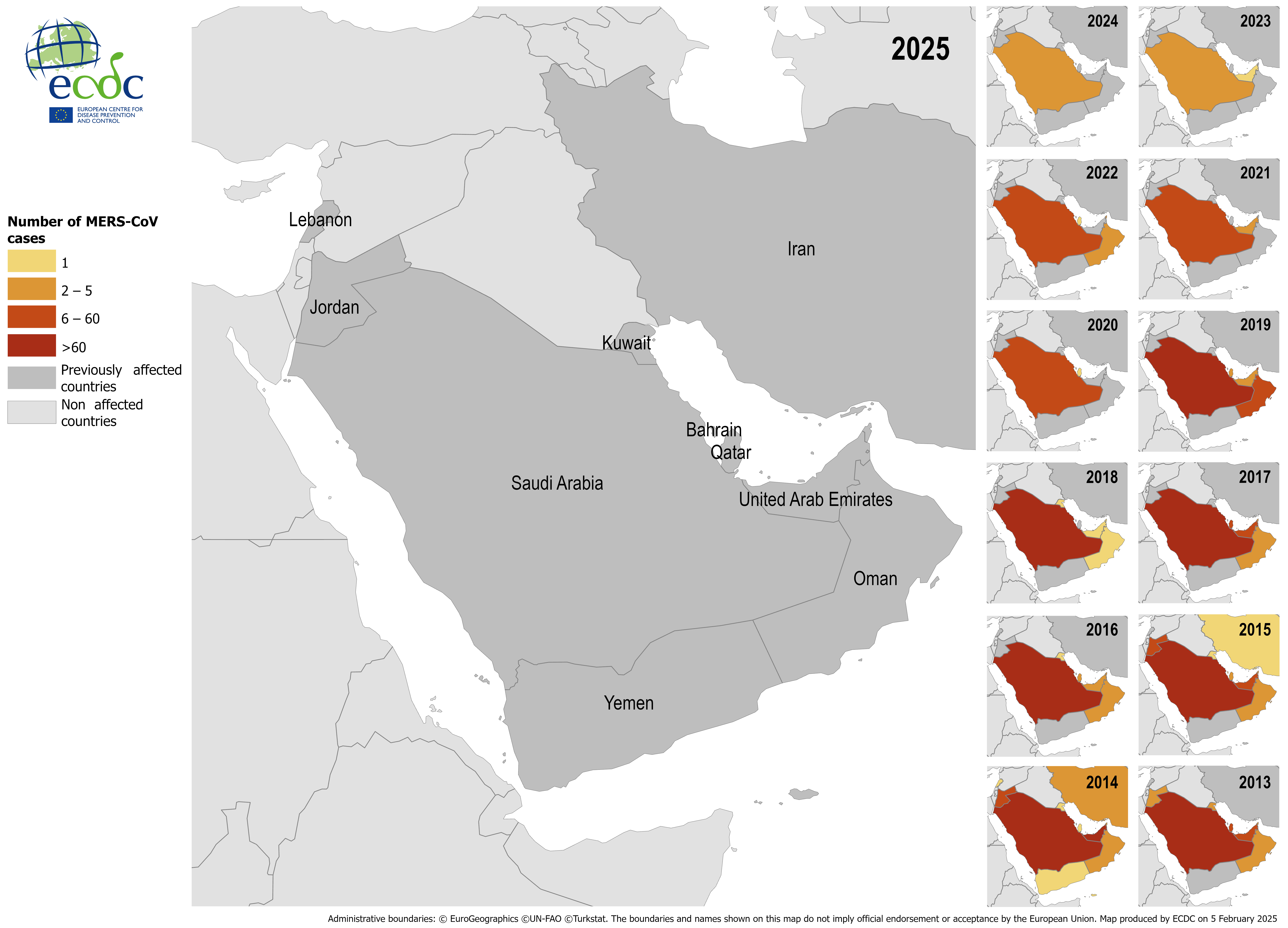
- Since the beginning of 2025, and as of 5 February 2025, no MERS-CoV cases have been reported with date of onset in 2025.
- The risk of sustained human-to-human transmission in Europe remains very low and the current MERS-CoV situation poses a low risk to the EU/EEA.
Overview
Update: Since the previous update on 8 January 2025, and as of 5 February 2025, no new MERS-CoV cases have been reported by the World Health Organization (WHO) or national health authorities.
Summary: Since the beginning of 2025, and as of 5 February 2025, no MERS-CoV cases have been reported with date of onset in 2025.
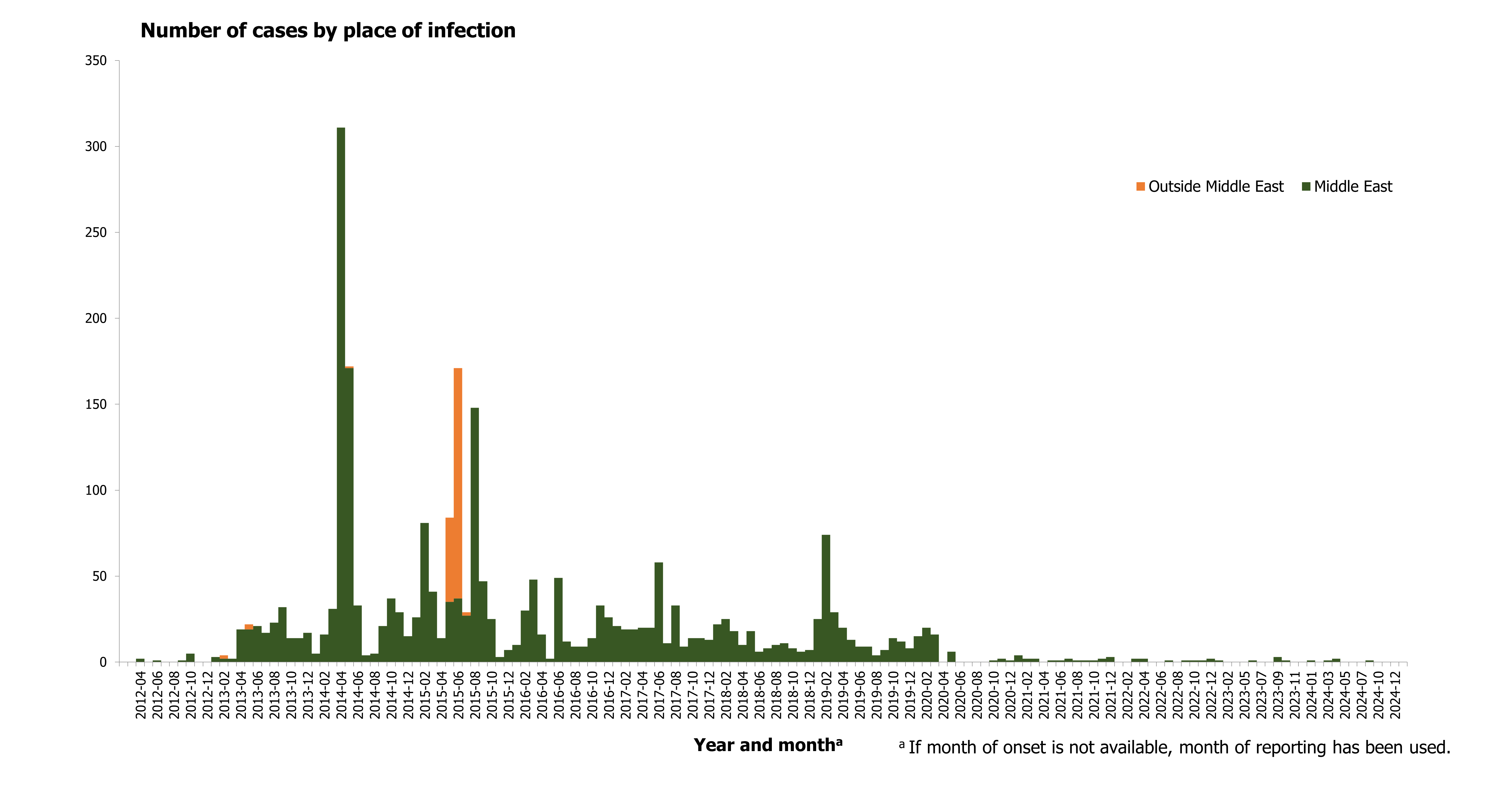
Since April 2012, and as of 5 February 2025, a total of 2 626 cases of MERS-CoV, including 953 deaths, have been reported by health authorities worldwide.
Sources: ECDC MERS-CoV page | WHO MERS-CoV | ECDC factsheet for professionals | WHO updated global summary and assessment of risk (November 2022) | Qatar MoPH Case #1 | Qatar MoPH Case #2 | FAO MERS-CoV situation update | WHO DON Oman | WHO DON Saudi Arabia | WHO DON UAE | WHO DON Saudi Arabia 1 | WHO IHR | WHO EMRO MERS Situation report | WHO DON Saudi Arabia 2 | WHO DON Saudi Arabia 3
ECDC assessment
Human cases of MERS-CoV continue to be reported in the Arabian Peninsula. However, the number of new cases detected and reported through surveillance has dropped to the lowest levels since 2014. The risk of sustained human-to-human transmission in Europe remains very low. The current MERS-CoV situation poses a low risk to the EU/EEA, as stated in the Rapid Risk Assessment published by ECDC on 29 August 2018, which also provides details on the last person reported with the disease in Europe.
ECDC published a technical report, Health emergency preparedness for imported cases of high-consequence infectious diseases, in October 2019, which is still useful for EU Member States wanting to assess their level of preparedness for a disease such as MERS-CoV. ECDC also published Risk assessment guidelines for infectious diseases transmitted on aircraft (RAGIDA) – Middle East respiratory syndrome coronavirus (MERS-CoV) in 22 January 2020.