Key facts
- Since the previous update on 29 September 2026, and as of 19 October 2026, six new MERS cases have been reported in Saudi Arabia. In addition, further information has become available on the two cases previously reported in 2026.
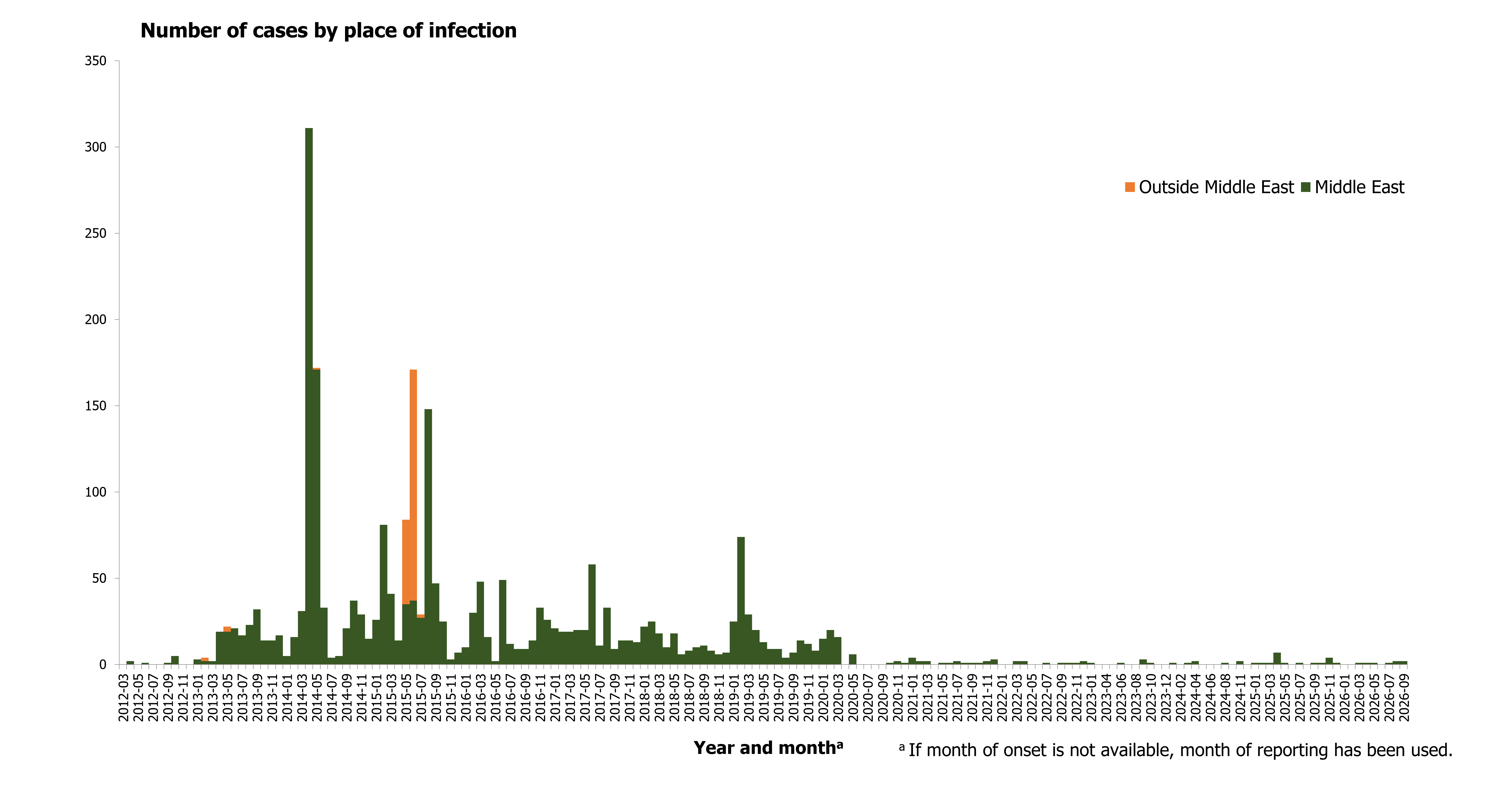
- Since the beginning of 2026, and as of 19 October 2026, eight MERS cases, including one fatality, have been reported in Saudi Arabia.
- The probability of sustained human-to-human transmission among the general population in Europe remains very low, and the impact of the disease in this population is also considered to be low. The current MERS-CoV situation remains unchanged and poses a low risk to the EU/EEA.
Overview
Update: Since the previous update on 31 August 2026, and as of 19 October 2026, six new MERS cases have been reported in Saudi Arabia. In addition, further information has become available on the two cases previously reported in 2026.
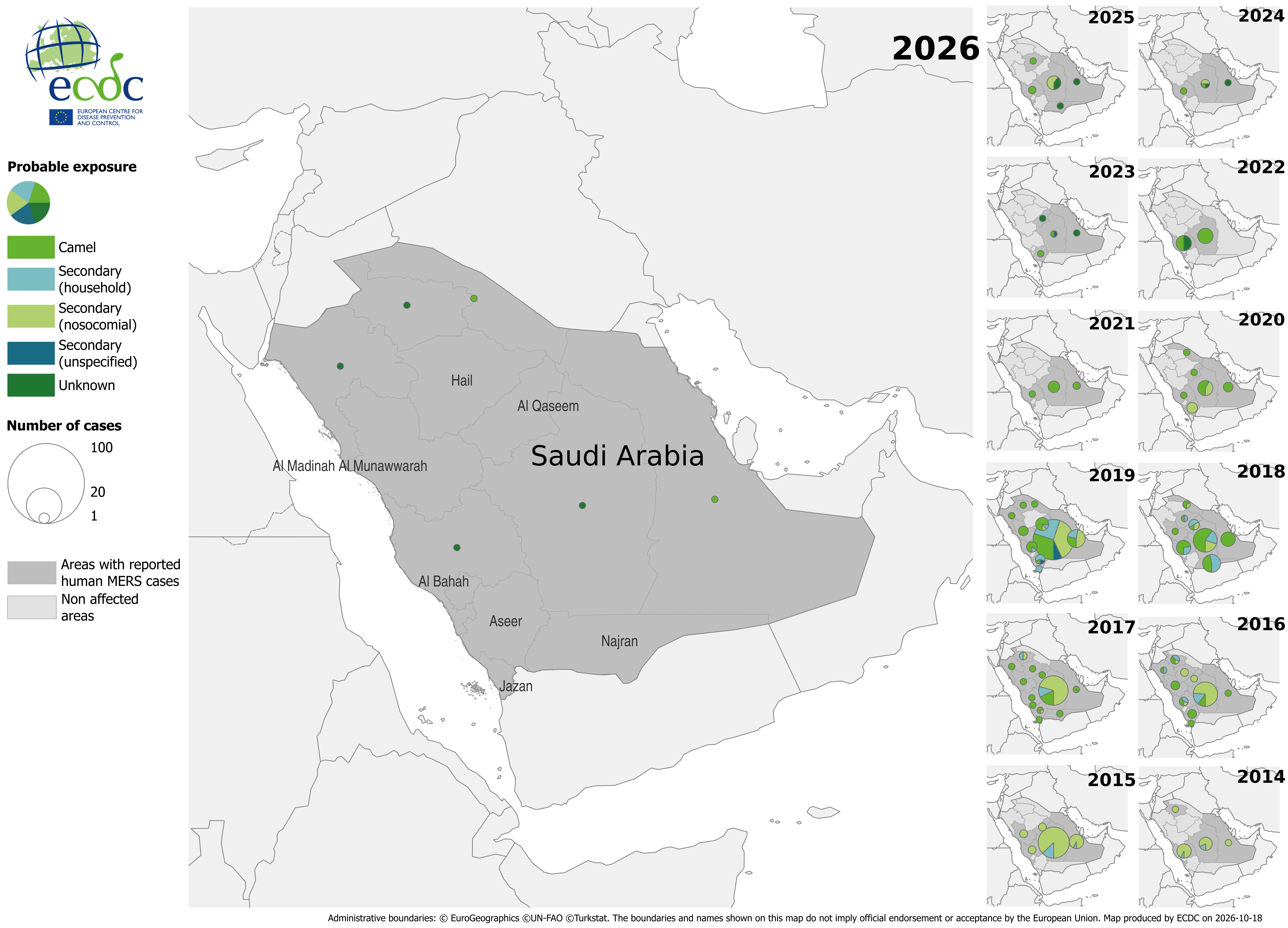
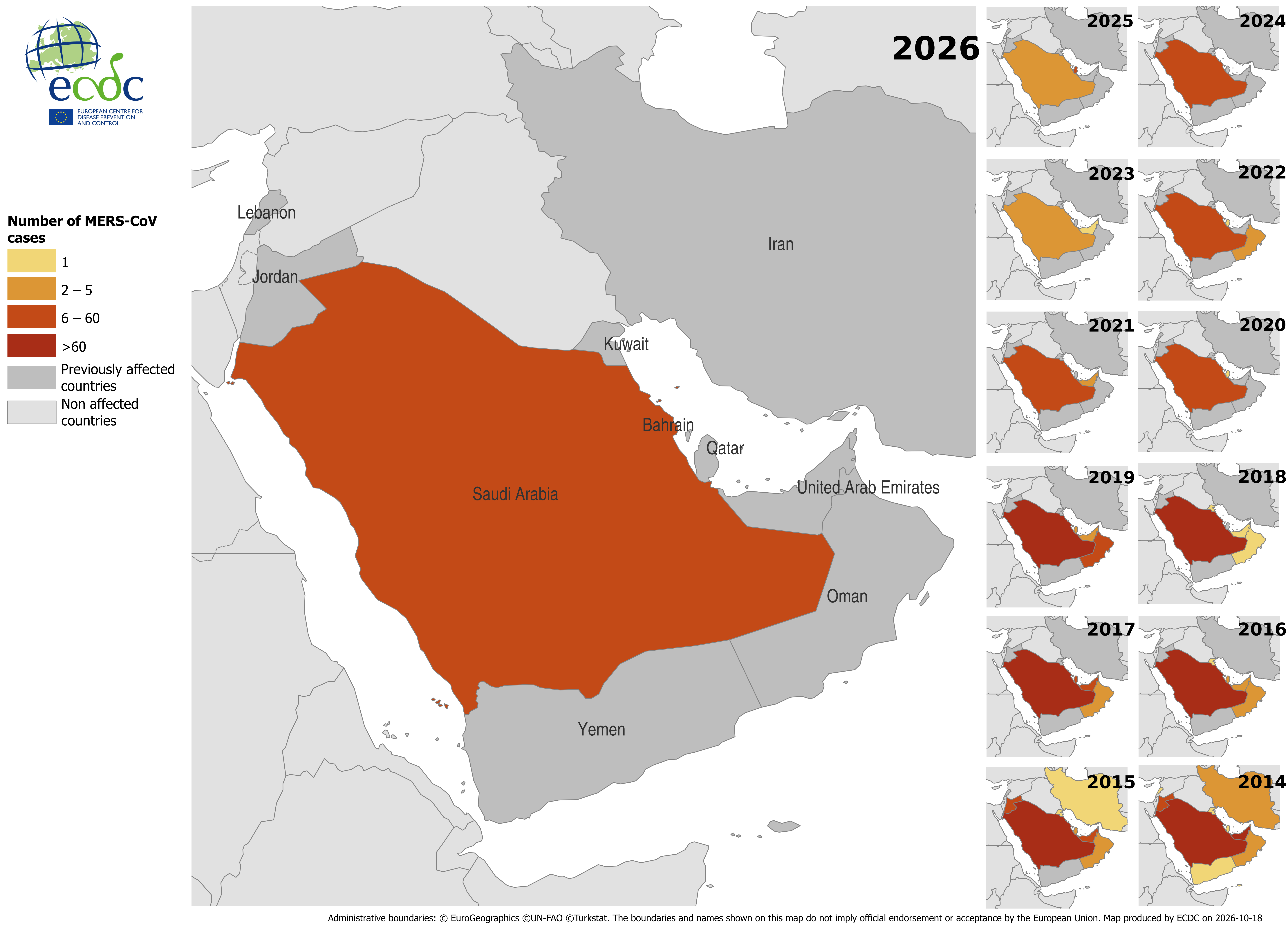
Eight cases, including one fatality, have been reported in Saudi Arabia in 2026 with dates of onset in March (1), April (1), May (1), July (1), August (2) and September (2). All cases are in non-healthcare workers and all but one had comorbidities. The median age of the indivduals was approximately 70 years, and seven were male and one was female. Cases were reported in Riyad (2), Makkah (2), Al-Jawf (1), Eastern Region (1), Northern Borders (1) and Tabuk (1). Two cases had direct contact with camels and six cases had no known history of contact with camels or camel products. No epidemiological links were identified among the eight cases.
Summary: Since the beginning of 2026, and as of 19 October 2026, eight MERS cases, including one fatality, have been reported in Saudi Arabia.
Since April 2012, and as of 19 October 2026, a total of 2 655 MERS cases, including 960 deaths, have been reported by health authorities worldwide.
Sources: ECDC MERS-CoV page | WHO MERS-CoV | ECDC factsheet for professionals | Qatar MoPH Case #1 | Qatar MoPH Case #2 | FAO MERS-CoV situation update | WHO DON Oman | WHO DON Saudi Arabia | WHO DON UAE | WHO DON Saudi Arabia 1 | WHO EMRO MERS Situation report | WHO DON Saudi Arabia 2 | WHO DON Saudi Arabia 3 | WHO DON Saudi Arabia 4 | WHO DON Saudi Arabia 5 | MERS-CoV Dashboard | French Ministry of Health | WHO DON France & Saudi Arabia | WHO DON Saudi Arabia 6
ECDC assessment
Human MERS cases continue to be reported in the Arabian Peninsula. However, the number of new cases detected and reported through surveillance has dropped to the lowest level since 2014. The probability of sustained human-to-human transmission among the general population in Europe remains very low, and the impact of the disease in this population is considered low. The current MERS-CoV situation remains unchanged and poses a low risk to the EU/EEA, as stated in the Rapid Risk Assessment published by ECDC on 29 August 2018.
In October 2019, ECDC published a technical report, 'Health emergency preparedness for imported cases of high-consequence infectious diseases' that is still useful for EU/EEA countries that would like to assess their level of preparedness for a disease such as MERS. ECDC also published 'Risk assessment guidelines for infectious diseases transmitted on aircraft (RAGIDA) – Middle East respiratory syndrome coronavirus (MERS-CoV)' on 22 January 2020.