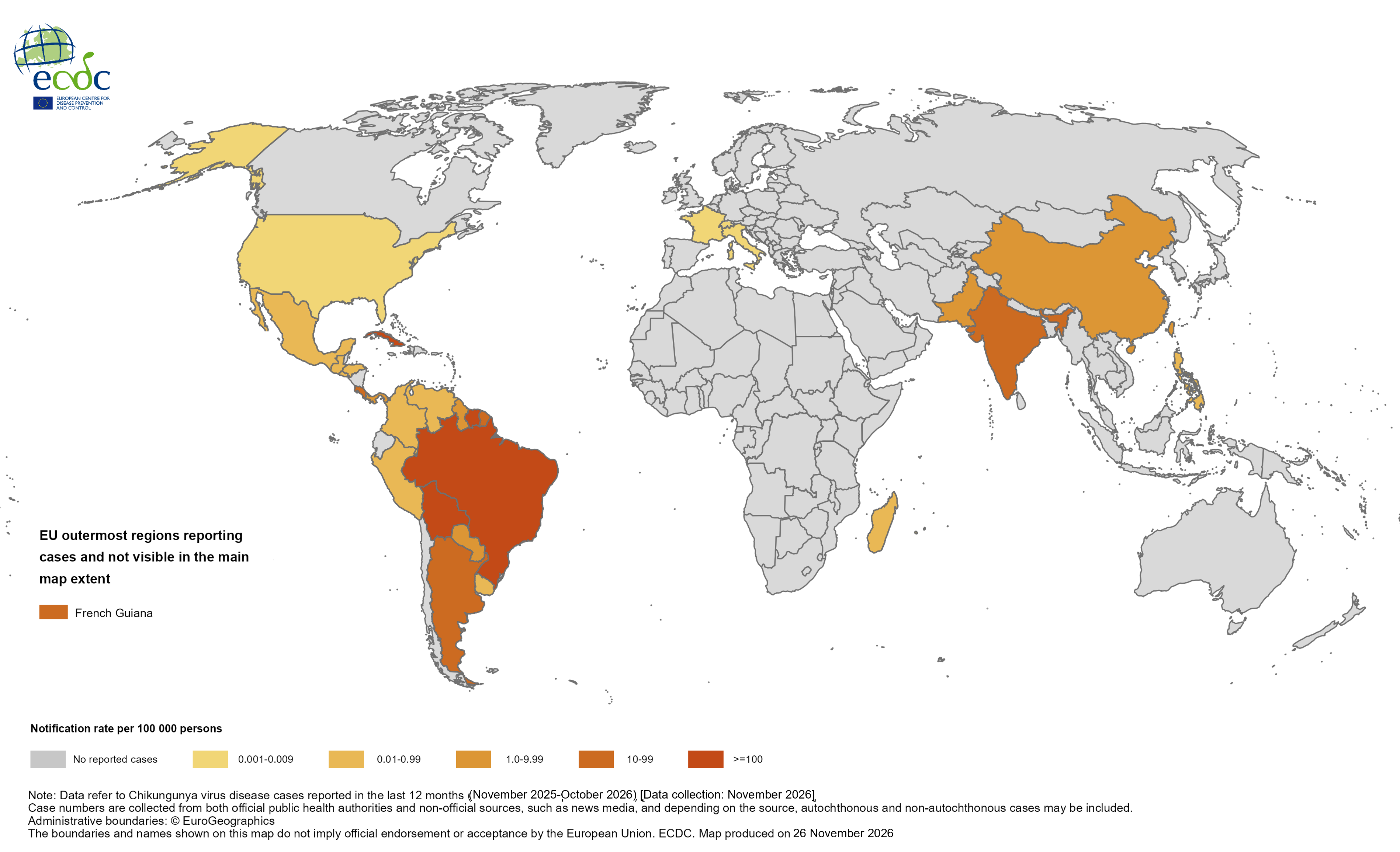
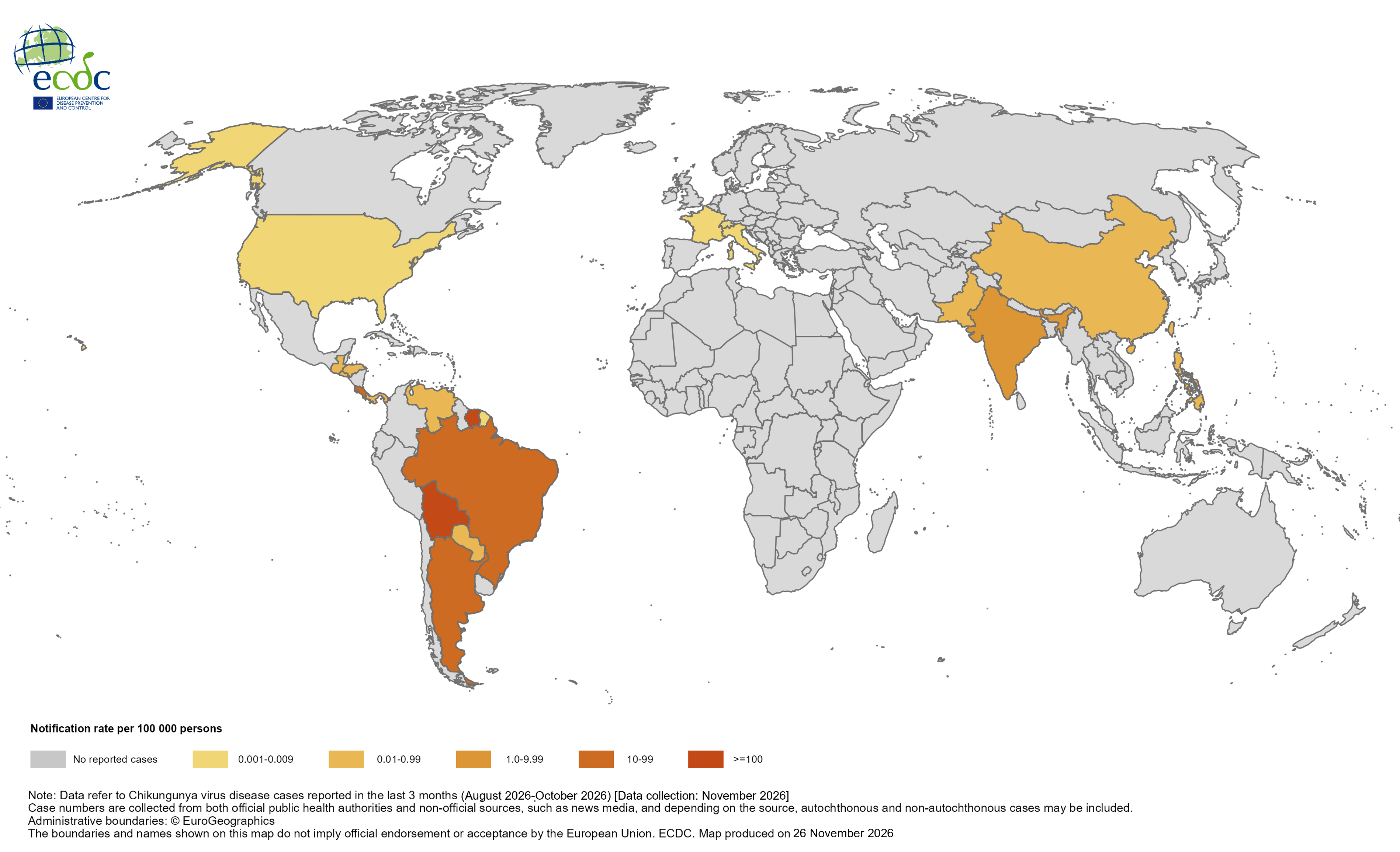
Key facts
- Since the previous update and as of 31 October, 10 525 chikungunya virus disease (CHIKVD) cases and three associated deaths have been detected in 12 countries outside of the EU/EEA.
- Since the start of 2026, and as of 31 October, 281 748 chikungunya virus disease (CHIKVD) cases and 116 associated deaths have been detected in 26 countries (not including the EU/EEA).
- Cases reported in October (10 525 cases) decreased compared with September, when 20 457 cases were reported. The number of deaths reported in October (three deaths) also decreased compared with the previous month, when 26 deaths were reported.
Overview
Since the previous update (data collection period 29–30 October 2026, data available up to 30 September) and as of 31 October 2026
(data collection period 23–24 November 2026, data available up to 31 October), 10 525 chikungunya virus disease (CHIKVD) cases and three associated deaths have been detected in 12 countries outside of the EU/EEA. The number of cases reported in October (10 525 cases) decreased compared with September, when 20 457 cases were reported. The number of deaths reported in October (three deaths) also decreased compared with the previous month, when 26 deaths were reported. In 2026, a total of 281 748 CHIKVD cases and 116 associated deaths have been reported.
New outbreaksIn October, no new countries reported CHIKVD cases for the first time in 2026.
Epidemiological overviewIn 2026, 15 countries reported ongoing CHIKVD outbreaks. Of these, the majority are in the Americas. Below is a description of ongoing outbreaks:
Americas
In 2026, there have been 225 986 CHIKVD cases and 116 associated deaths reported in the region. The most affected subcontinental region is South America, with Brazil reporting the highest number of cases in 2026 (143 767 cases).
- Argentina: CHIKVD cases are reported throughout the year in the country. As of epidemiological week 43 (25-31 October 2026), one confirmed case and four probable cases have been reported from Salta. In the previous season, CHIKVD cases were reported from ten jurisdictions (Buenos Aires, Autonomous City of Buenos Aires, Cordoba, Entre Rios, Chaco, Catamarca, Jujuy, Salta, Santiago del Estero, Tucuman), with Salta and Tucuman the most affected.
- Bolivia: CHIKVD cases have been extensively reported in the country since the start of 2026, with Santa Cruz, Cochabamba, Tarija and La Paz the most affected. Santa Cruz reported most of CHIKVD cases in Bolivia. At national level, the number of reported cases increased in October compared to September.
- Brazil: CHIKVD cases continue to be reported in all regions (Centro-Oeste, Nordeste, Norte, Sudeste and Sul) and in most federal units of the country. The Centro-Oeste, Sudeste, and Nordeste regions continue to account for the highest number of cases in the last four epidemiological weeks (39-43), with Bahia, Mato Grosso Do Sul, and Minas Gerais being the most affected federal units. Since the start of 2026, CHIKVD cases increased continuously in Brazil until epidemiological week 14. This year, most of the cases have been reported among females (58%), with the age group 20-29 years most affected. In 2026, a total of 135 878 CHIVKD cases had been reported from Brazil by the end of epidemiological week 38.
- Costa Rica: In 2026, 1 229 CHIKVD cases have been reported, with a sustained increase in case reporting during October. Cases have been reported from six out of seven provinces, only Cartago province has not reported cases.
- El Salvador: In 2026, 23 CHIKVD cases have been reported in the country. In 2025, 21 CHIKVD cases were reported in the same period.
- Guatemala: In 2026, 18 CHIKVD cases have been reported in the country. In 2025, 24 CHIKVD cases were reported in the same period.
- Guyana: In 2026, 20 CHIKVD cases have been reported in the country. No CHIKVD cases were reported in 2025.
- Honduras: In 2026, 44 CHIKVD cases have been reported in the country. In 2025, 23 CHIKVD cases were reported in the same period. The first reported case in 2026 was from San Marcos Department, close to the border with Mexico.
- Panama: In 2026, six CHIKVD cases have been reported in the country. In 2025, 26 CHIKVD cases were reported in the same period.
- Suriname: CHIKVD cases continue to be reported in the country, reaching a total of 16 716 cases in 2026. Since February 2026, the number of cases has continuously decreased in the country.
- United States: In September 2026, the Florida Department of Health reported a locally acquired case of CHIKVD in the county.
- Venezuela: In 2026, 45 CHIKVD cases have been reported in the country. No CHIKVD cases were reported in 2025.
Asia
In 2026, 48 803 CHIKVD cases and no associated deaths have been reported in the region. The most affected subcontinental region is South Asia, with India reporting the highest number of cases in 2026 (45 402 cases).
- China: In 2026, 2 734 CHIKVD cases have been reported in the country. In 2025, 24 754 CHIKVD cases were reported for the same period, linked to the outbreaks from Guangdong and Guanxi provinces.
- Pakistan: A total of 583 CHIKVD cases have been reported in the country in 2026. Cases decreased in October (48 new cases) compared with the previous month (476 new cases). In October, cases were reported from Sindh and Baluchistan provinces. In general, CHIKVD cases are reported throughout the year in Pakistan, mainly from Baluchistan, Khyber Pakhtunkhwa, and Sindh provinces. These provinces are located in the south-west of the country.
Africa
In 2026, at least 6 959 CHIKVD cases and no associated deaths have been reported in the region. The most affected sub-continental region is East Africa, with Mauritius reporting the highest number of cases in 2026 (6 929 cases).
- Mauritius: Since January 2026, the country has reported a total of 6 929 CHIKVD cases from Mauritius Island and Rodriges Island. Most of the cases have been reported from Mauritius Island.
Europe
For CHIKVD cases reported in mainland EU/EEA, please visit the dedicated ECDC website. In 2026, CHIKVD cases have been reported from the French outermost regions of French Guiana, Mayotte and Réunion.
NoteThe data presented in this report originate from both official public health authorities and non-official sources, such as news media, and depending on the source, autochthonous and non-autochthonous cases may be included. Data completeness depends on the availability of reports from surveillance systems and their accuracy, which varies between countries. All data should be interpreted with caution and comparisons, particularly across countries, should be avoided due to under-reporting, variations in surveillance system structure, different case definitions from country to country and over time, and use of syndromic definitions.
ECDC assessment
Since the beginning of 2026 and as of September 2026, France and Italy were the only European countries to report locally acquired chikungunya virus disease transmission.
The likelihood of onward transmission of chikungunya virus in mainland Europe is linked to importation of the virus by viraemic travellers into receptive areas with established and active competent mosquito vectors (e.g. Aedes albopictus and Aedes aegypti). Aedes albopictus mosquito is established in a large part of Europe. In Europe and neighbouring areas, the Aedes aegypti mosquito is established in Cyprus, on the eastern shores of the Black Sea, and in the outermost region of Madeira.
For the risk related to CHIKVD in mainland EU/EEA, please see the dedicated webpage: Chikungunya virus disease risk assessment for mainland EU/EEA.
More information on autochthonous transmission of chikungunya virus in 2026 in the EU/EEA is available on ECDC's website, and in ECDC's factsheets on CHIKVD.
Preventive measures against mosquito bites are strongly recommended for travellers to countries with reported cases of dengue and chikungunya. Where possible, travellers to areas with active outbreaks or elevated risk should receive appropriate advice on travel health. Pregnant travellers, older adults and people with chronic conditions may be at higher risk of complications associated with these diseases.
Actions
ECDC monitors this threat through its epidemic intelligence activities and reports on a monthly basis. A summary of the worldwide overview of CHIKVD is available on ECDC's website.