Key facts
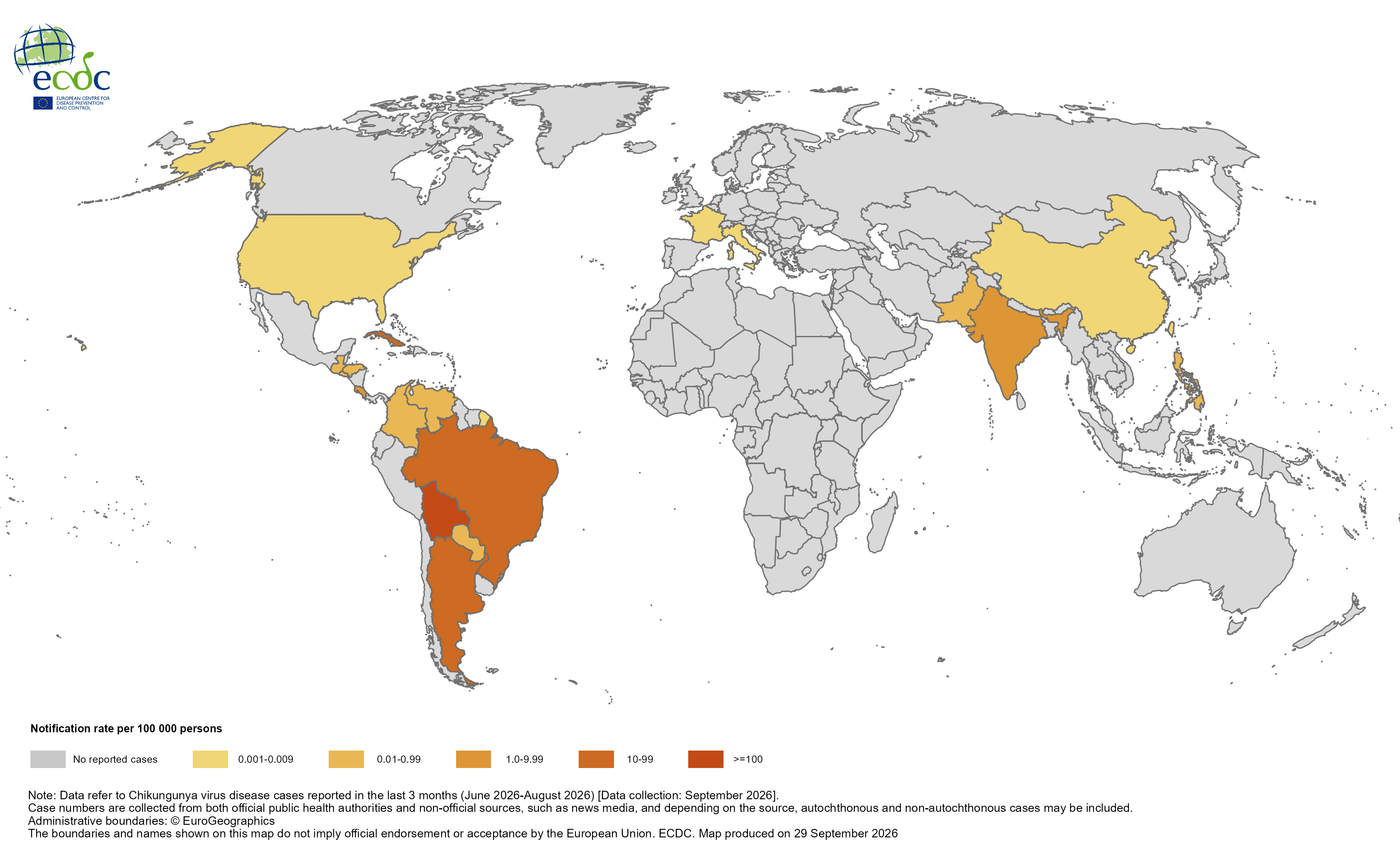
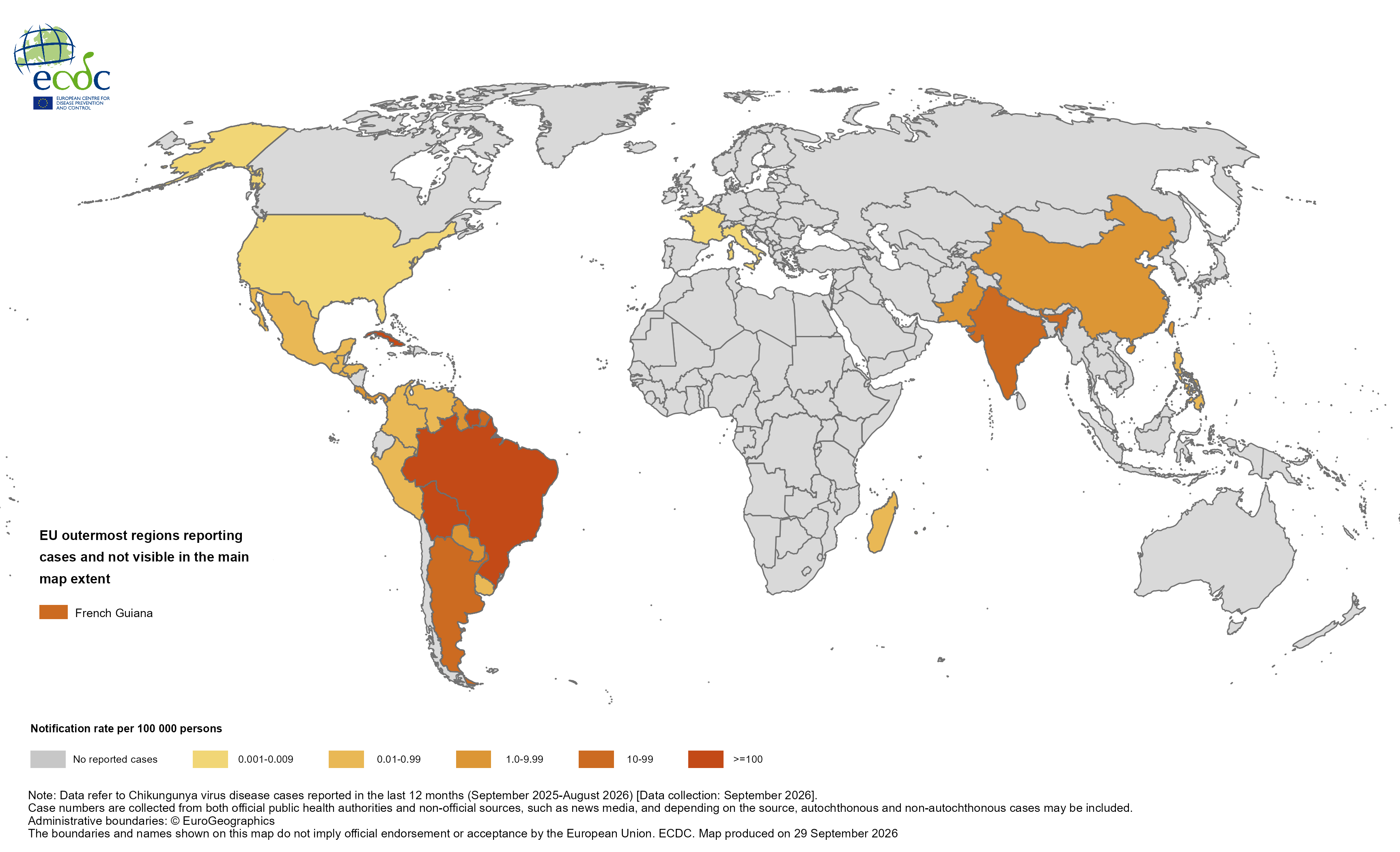
- Since the start of 2026, and as of 30 August 2026 (data available until 30 August), 250 051 chikungunya virus disease (CHIKVD) cases and 87 associated deaths have been detected from 26 countries (not including EU/EEA countries and territories).
- Cases reported in August (29 268 cases) increased compared with July, when 6 748 cases were reported. However, deaths reported in August (two deaths) decreased compared with the previous month, when four deaths were reported.
Overview
Since the previous update (data collection period 3–5 August, data available up to 28 July) and as of 30 August (data collection period 22–24 September, data available up to 30 August), 29 268 chikungunya virus disease (CHIKVD) cases and two associated deaths have been detected in nine countries, excluding EU/EEA countries and territories. Cases reported in August (29 268 cases) increased compared with July, when 6 748 cases were reported. However, deaths reported in August (two deaths) decreased compared with the previous month, when four deaths were reported. In 2026, a total of 250 051 CHIKVD cases has been reported and 87 associated deaths.
Epidemiological overview
In 2026, several countries have ongoing CHIKVD outbreaks. Of these, the majority are in the Americas. Below is a description of ongoing outbreaks:
Americas
In 2026, there have been 197 497 CHIKVD cases and 87 associated deaths reported in the region. The most affected subcontinental region is South America, with Brazil reporting the highest number of cases in 2026.
- Argentina: CHIKVD cases are reported through the year in the country. Since epidemiological week 31 (2-8 August), the country has started seasonal surveillance for the period 2026/2027. As of epidemiological week 34 (23-29 August) no confirmed cases have been reported for the new season. In the previous season, CHIKVD cases were reported from ten jurisdictions (Buenos Aires, Autonomous City of Buenos Aires, Cordoba, Entre Rios, Chaco, Catamarca, Jujuy, Salta, Santiago del Estero, Tucuman), being Salta and Tucuman the most affected provinces.
- Barbados: In 2026, seven confirmed CHIKVD cases have been reported in the country. In 2025, nine CHIKVD cases were reported during the same period.
- Bolivia: CHIKVD cases have been extensively reported in the country since the start of 2026, being the most affected departments Santa Cruz, Cochabamba, Tarija and La Paz. Santa Cruz reported most of CHIKVD cases in Bolivia. At national level, the number of reported cases has increased over the past weeks.
- Brazil: CHIKVD cases continue to be reported in all regions (Centro-Oeste, Nordeste, Norte, Sudeste, and Sul) and in most federal units of the country. The Centro-Oeste, Sudeste, and Nordeste regions continue to account for the highest number of cases in the last four epidemiological weeks (31-34), where Bahia, Algoas, Pernambuco, Mato Grosso Do Sul, and Minas Gerais are the most affected federal units. Since the start of 2026, CHIKVD cases have continuously increased in Brazil until epidemiological week 14. This year, most of the cases have been reported among females (59%), being the 20 to 29 years age group the most affected one. In 2026, a total of 127 676 CHIVKD cases has been reported from Brazil by the end of epidemiological week 34.
- Costa Rica: In 2026, 300 CHIKVD cases have been reported with a significant increase in case reporting during the second half of August. Local transmission has been reported from Alajuela and Guanacaste provinces. In 2025, a total of eight CHIKVD cases were reported.
- El Salvador: In 2026, 13 CHIKVD case have been reported in the country. In 2025, 12 CHIKVD cases were reported in the same period.
- Honduras: In 2026, two CHIKVD cases have been reported in the country. In 2025, 11 CHIKVD cases were reported in the same period.
- Paraguay: In 2026, 19 CHIKVD cases have been notified in the country until July. In 2025, 48 CHIKVD cases were reported in the same period.
Asia
In 2026, 45 633 CHIKVD cases and no associated deaths have been reported in the region. The most affected subcontinental region is Southeast Asia, with India being the country reporting the highest number of cases in 2026.
- India: Additional 167 CHIKVD cases have been reported in August in the country. These cases have been reported from State of Kerala, most of them concentrated at Thiruvananthapuram city. Local authorities have pointed out the monsoon season as the expected driver of this outbreak.
- Pakistan: A total of 59 CHIKVD cases has been reported in the country in 2026. Cases have doubled since July, with Sindh and Khyber Pakhtunkhwa regions showing the highest case counts. In addition, Baluchistan region has also reported cases in August. In general, CHIKVD cases are reported throughout the year in Pakistan, mainly concentrated in Baluchistan, Khyber Pakhtunkhwa, and Sindh provinces. These provinces are located in the Southwest of the country.
- Philippines: In July 2026, CHIKVD cases were reported by Gandara Municipal Health Officer. Two outbreaks were identified, with a total of 84 cases reported.
Africa
In 2026, approximately 6 921 CHIKVD cases and no associated deaths have been reported in the region. The most affected subcontinental region is East Africa, with Mauritius being the country reporting the highest number of cases in 2026.
- Mauritius: Since January 2026, the country has reported a total of 6 891 CHIKVD cases from Mauritius Island and Rodriges Island. Most of the cases are reported from Mauritius Island.
Europe
Since the beginning of 2026 and as of September 2026, two countries in Europe have reported locally acquired cases of chikungunya virus disease: France and Italy. For more information on CHIKVD cases reported in mainland EU/EEA, please visit the dedicated ECDC website. CHIKVD cases have been reported from the French outermost regions of French Guiana, Mayotte and Réunion.
NoteThe data presented in this report originate from both official public health authorities and non-official sources, such as news media, and depending on the source, autochthonous and non-autochthonous cases may be included. Data completeness depends on the availability of reports from surveillance systems and their accuracy, which varies between countries. All data should be interpreted with caution and comparisons, particularly across countries, should be avoided due to under-reporting, variations in surveillance system structure, different case definitions from country to country and over time, and use of syndromic definitions.
ECDC assessment
Since the beginning of 2026 and as of September 2026, France and Italy were the only European country to report locally acquired chikungunya virus disease transmission.
The likelihood of onward transmission of chikungunya virus in mainland Europe is linked to importation of the virus by viraemic travellers into receptive areas with established and active competent mosquito vectors (e.g. Aedes albopictus and Aedes aegypti). Aedes albopictus mosquito is established in a large part of Europe. In Europe and neighbouring areas, Aedes aegypti mosquito is established in Cyprus, on the eastern shores of the Black Sea, and in the outermost region of Madeira.
For the risk related to CHIKVD in mainland EU/EEA, please see the dedicated webpage: Chikungunya virus disease risk assessment for mainland EU/EEA.
More information on autochthonous transmission of chikungunya virus in 2026 in the EU/EEA is available on ECDC's website, and in ECDC's factsheets on CHIKVD.
Mosquito bite prevention is strongly recommended for travellers to countries with reported cases of dengue and chikungunya. Travel health advice is advised for travellers to areas with active outbreaks or elevated risk. Pregnant travellers, older adults and people with chronic conditions may be at higher risk of complications associated with these diseases.
Actions
ECDC monitors this threat through its epidemic intelligence activities and reports on it on a monthly basis. A summary of the worldwide overview of CHIKVD is available on ECDC's website.