Key facts
- Since the beginning of 2025, and as of August, approximately 317 000 CHIKVD cases and 135 CHIKVD-related deaths have been reported in 16 countries/territories. Cases have been reported in the Americas, Africa, Asia, and Europe (France - mainland and outermost regions, i.e. Réunion and Mayotte - and Italy).
Overview
Chikungunya virus disease (CHIKVD)
Since the beginning of 2025, and as of August, approximately 317 000 CHIKVD cases and 135 CHIKVD-related deaths have been reported in 16 countries/territories. Cases have been reported in the Americas, Africa, Asia, and Europe.
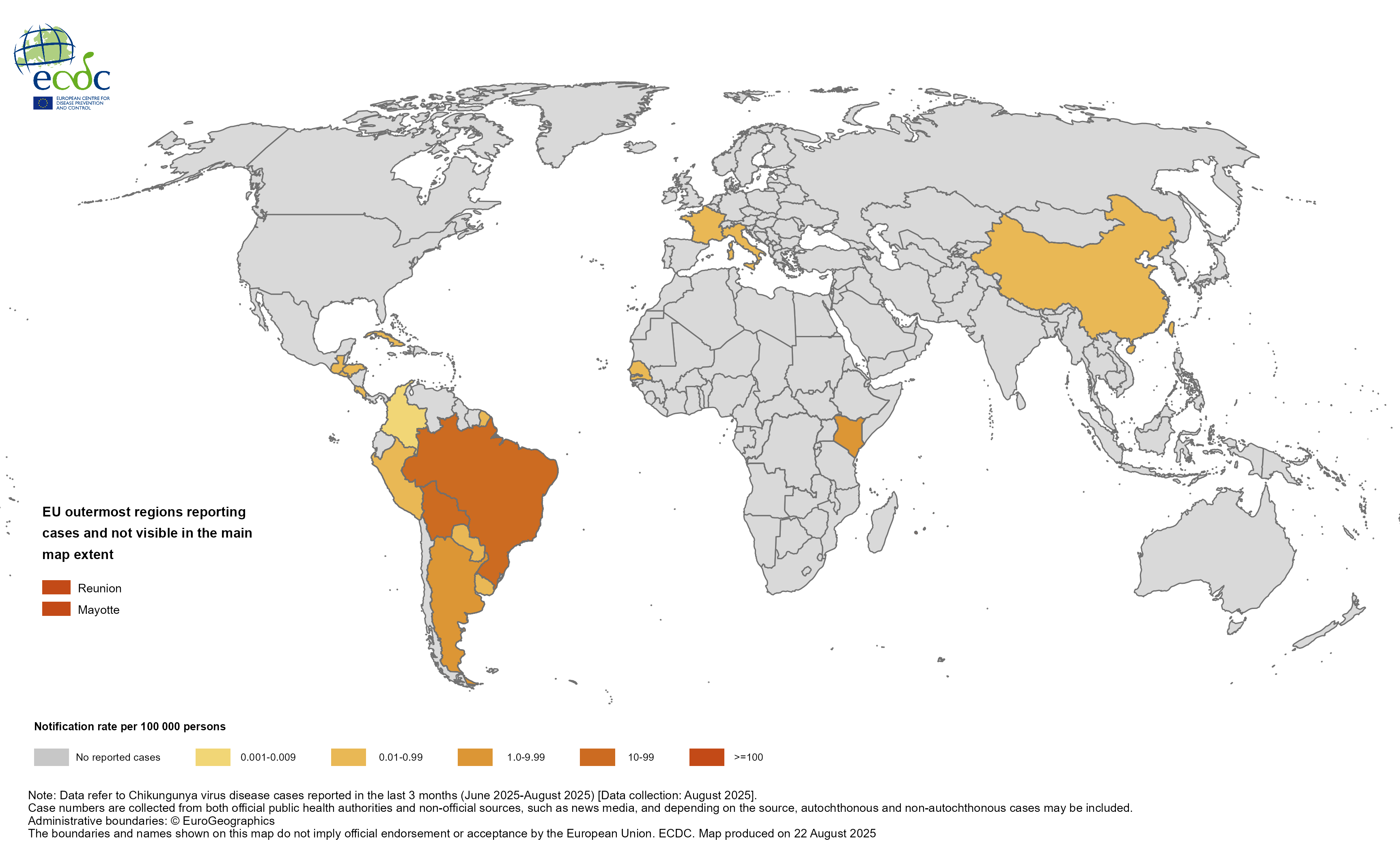
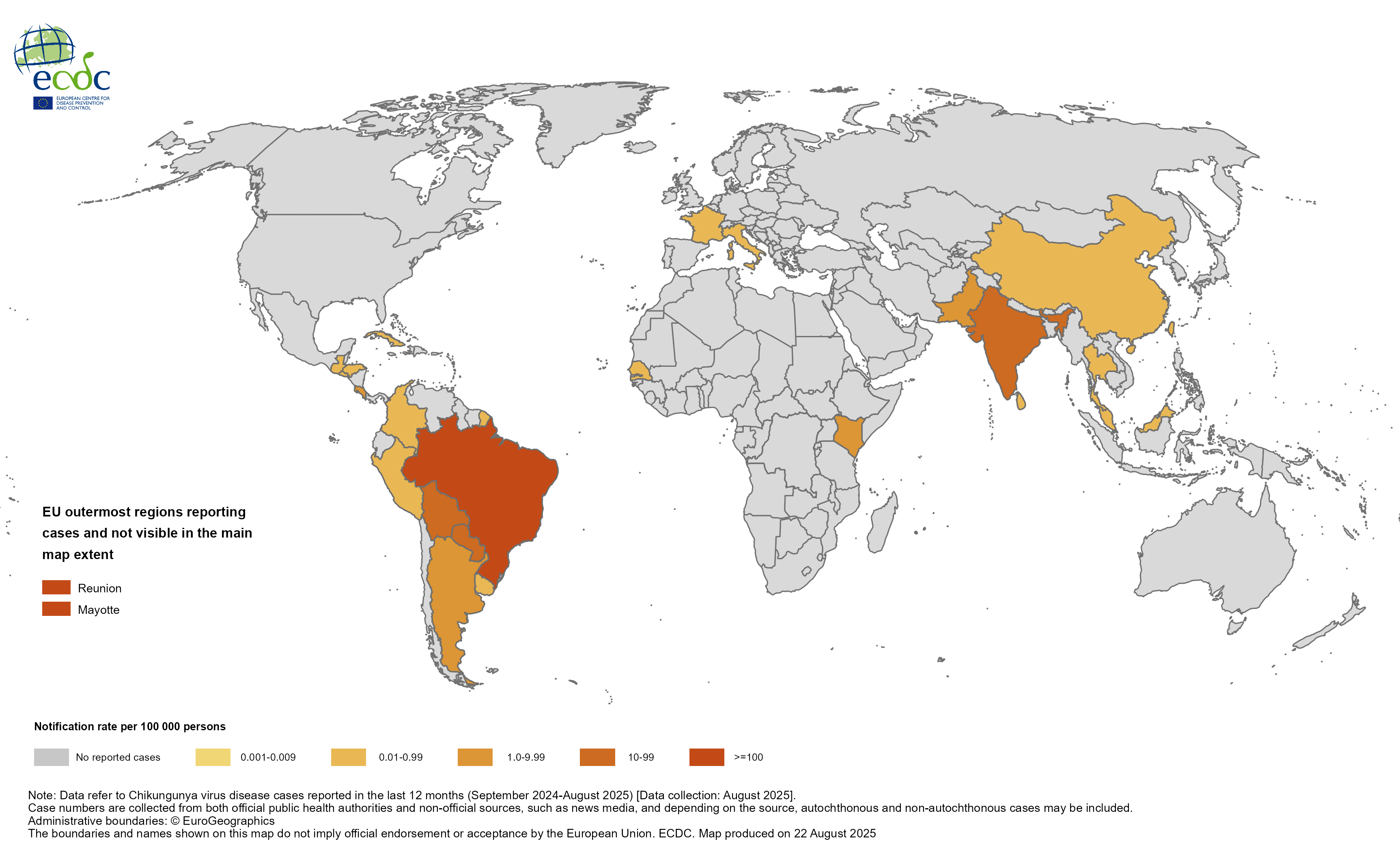
In 2025 to date, the Americas account for the highest number of CHIKVD cases reported worldwide. As of mid-August 2025 (data collected by 20-22 August 2025), the countries reporting the highest number of CHIKVD cases are Brazil (most cases in Mato Grosso, Mato Grosso do Sul, and Minas Gerais States), Bolivia (Santa Cruz), Argentina, and Peru. A complete list of the countries of the Americas reporting CHIKVD cases can be found on PAHO's dedicated website.
As of beginning of August 2025, over 40 000 CHIKVD cases were reported in Asia from India (Maharashtra State), Sri Lanka (Colombo, Gampaha and Kandy cities), Pakistan (Khyber Pakhtunkhwa and Sindh provinces), and China (Guangdong province and Special Administrative Region of Macao).
In Africa, CHIKVD cases in 2025 have been reported by Mauritius, Senegal (Kafferine region), and Kenya (Mombasa county). EU/EEA countries have reported imported cases from other African countries, e.g. Madagascar and the Seychelles, possibly indicating more widespread circulation of chikungunya in the Indian Ocean region.
In EU (excluding the outermost regions), cases of autochthonous cases of CHIKVD have been reported from France and Italy. In addition, 54 550 CHIKVD cases have been reported from the French outermost region of Réunion as of 10 August 2025. Cases have been reported in all of the island's municipalities. In Mayotte, 1 201 autochthonous cases of CHIKVD have also been reported. Mayotte continues to be in the epidemic phase (phase 3 since 27 May 2025), which indicates intense and widespread transmission of the virus throughout the territory.
Recent outbreaks with public health relevance
In China, an outbreak of CHIKVD is ongoing since July. The outbreak is located Guangdong province, where Foshan is the city accounting for most of the cases. Outside of Foshan city, cases have also been reported in the cities of Guangzhou, Zhanjiang, Shenzhen. According to Chinese authorities, total number of daily cases have been decreasing in the last weeks, suggesting an overall downward trend.
Other areas, such as the Special Administrative Region of Macao have also reported locally acquired CHIKVD cases associated with imported cases from Guangdong province.
Note: the data presented in this report originate from both official public health authorities and non-official sources, such as news media, and depending on the source, autochthonous and non-autochthonous cases may be included. Data completeness depends on the availability of reports from surveillance systems and their accuracy, which varies between countries. All data should be interpreted with caution and comparisons, particularly across countries, should be avoided due to under-reporting, variations in surveillance system structure, different case definitions from country to country and over time, and use of syndromic definitions.
ECDC assessment
The likelihood of onward transmission of chikungunya virus in mainland Europe is linked to importation of the virus by viraemic travellers into receptive areas with established and active competent vectors (e.g. Aedes albopictus and Aedes aegypti). Aedes albopictus is established in a large part of Europe. In Europe and neighbouring areas, Aedes aegypti is established in Cyprus, on the eastern shores of the Black Sea, and in the outermost region of Madeira.
For the risk related to chikungunya in mainland EU/EEA, please see the dedicated webpage: Chikungunya virus disease risk assessment for mainland EU/EEA.
More information on autochthonous transmission of chikungunya virus in 2025 in the EU/EEA is available on ECDC's webpages, and in ECDC's factsheets on CHIKVD.
Actions
ECDC monitors these threats through its Epidemic Intelligence activities, and reports on a monthly basis. A summary of the worldwide overview of CHIKVD is available on ECDC's website.