
Disease information about HIV/AIDS
Case definition
European Union/European Economic Area (EU/EEA) countries report data on new cases of HIV and AIDS to the European Centre for Disease Prevention and Control on an annual basis using the EU case definitions [1]:
Clinical criteria (AIDS)
Any person who has any of the clinical AIDS-defining conditions (Table 1), as defined in the European AIDS case definition for:
- Adults and adolescents ≥ 15 years old
- Children < 15 years old.
Laboratory criteria (HIV)
Adults, adolescents and children ≥ 18 months old
At least one of the following three:
- Positive result from an HIV screening antibody test or a combined screening test (HIV antibody and HIV p24 antigen) confirmed by a more specific antibody test (e.g. Western blot);
- Positive results from two enzyme immunoassay (EIA) antibody tests, confirmed by a positive result from a further EIA test;
- Positive results from two separate specimens from at least one of the following three:
- Detection of HIV nucleic acid (HIV-RNA, HIV-DNA);
- Demonstration of HIV by HIV p24 antigen test, including neutralisation assay;
- Isolation of HIV.
Children < 18 months old
Positive results on two separate specimens (excluding cord blood) from at least one of the following three:
- Detection of HIV nucleic acid (HIV-RNA, HIV-DNA);
- Demonstration of HIV by HIV p24 antigen test, including neutralisation assay in a child ≥ 1 month old;
- Isolation of HIV.
Epidemiological criteria
Not applicable
Case classification
A. Possible case – not applicable
B. Probable case – not applicable
C. Confirmed case:
- HIV infection: Any person meeting the laboratory criteria for HIV infection.
- AIDS: Any person meeting the clinical criteria for AIDS and the laboratory criteria for HIV infection.
In addition to the EU case definitions, ECDC uses the following case definition for notification of AIDS: AIDS is defined in adults, adolescents and children five years old and above by a CD4 cell count below 200 cells/mm³ or the presence of one or more severe opportunistic infections indicative of advanced immunosuppression, including those classified as AIDS-defining conditions (Table 1).
Table 1. List of AIDS-defining conditions
| Bacterial infections, multiple or recurrent in a child under 13 years of age |
| Candidiasis of bronchi, trachea, or lungs |
| Candidiasis, oesophageal |
| Coccidioidomycosis, disseminated or extrapulmonary |
| Cryptococcosis, extrapulmonary |
| Cryptosporidiosis, intestinal with diarrhoea (>1 months duration) |
| Cytomegalovirus disease (other than liver, spleen, or nodes) in a patient over one month old |
| Cytomegalovirus retinitis (with loss of vision) |
| Herpes simplex: chronic ulcer(s) (>1 months duration); or bronchitis, pneumonitis, or oesophagitis in a patient over one month old |
| Histoplasmosis, disseminated or extrapulmonary |
| Isosporiasis, intestinal with diarrhoea (>1 months duration) |
| Mycobacterium avium complex or M. kansasii, disseminated or extrapulmonary |
| Mycobacterium tuberculosis, pulmonary in an adult or an adolescent (13 years old or above) |
| Mycobacterium tuberculosis, extrapulmonary |
| Mycobacterium, other species or unidentified species, disseminated or extrapulmonary |
| Pneumocystis carinii pneumonia |
| Pneumonia, recurrent in an adult or an adolescent (13 years old or above) |
| Progressive multifocal leukoencephalopathy |
| Salmonella (non-typhoid) septicaemia, recurrent |
| Toxoplasmosis of brain in a patient over one month old |
| Cervical cancer, invasive in an adult or an adolescent (13 years old or above) |
| Encephalopathy, HIV related |
| Kaposi’s sarcoma |
| Lymphoid interstitial pneumonia in a child under 13 years old |
| Lymphoma, Burkitt’s (or equivalent term) |
| Lymphoma, immunoblastic (or equivalent term) |
| Lymphoma, primary, of brain |
| Wasting syndrome due to HIV |
| Opportunistic infection(s), not specified |
| Lymphoma(s), not specified |
Source: Adapted from the 1993 United States Centers for Disease Control and Prevention’s surveillance case definition for AIDS among adolescents and adults [2].
The pathogen
Human immunodeficiency virus (HIV) is an enveloped RNA retrovirus of the family Retroviridae and genus Lentivirus [3]. Two distinct types exist: HIV-1 and HIV-2. HIV-1 accounts for most infections globally, while HIV-2 is endemic to West Africa, is less transmissible and causes a slower disease progression [4,5].
HIV infects and destroys immune cells in the body, primarily CD4 cells (also known as ‘helper T cells’), which are white blood cells that coordinate the immune response by activating other immune cells to fight infections. As these cells are the main target of the virus, CD4 cell count is an important measure of immune system health in a person with HIV infection.
If HIV is left untreated, rapid viral replication causes progressive immunodeficiency and increased susceptibility to opportunistic infections and cancers, leading to severe illness and subsequent death.
Clinical features and sequelae
The availability of effective antiretroviral therapy (ART) has changed the clinical course of HIV infection significantly and enables people with HIV to live long, healthy and productive lives [6,7].
Life expectancy of individuals with HIV varies considerably and is largely determined by CD4 cell count at ART initiation and subsequent virological response. Individuals who initiate ART earlier and achieve sustained viral suppression experience substantially improved clinical outcomes [8]. Those diagnosed with HIV prior to progression to AIDS and who receive effective therapy can attain a life expectancy approaching that of the general population, especially when adequate CD4 recovery is achieved.
Stages of HIV-1 infection
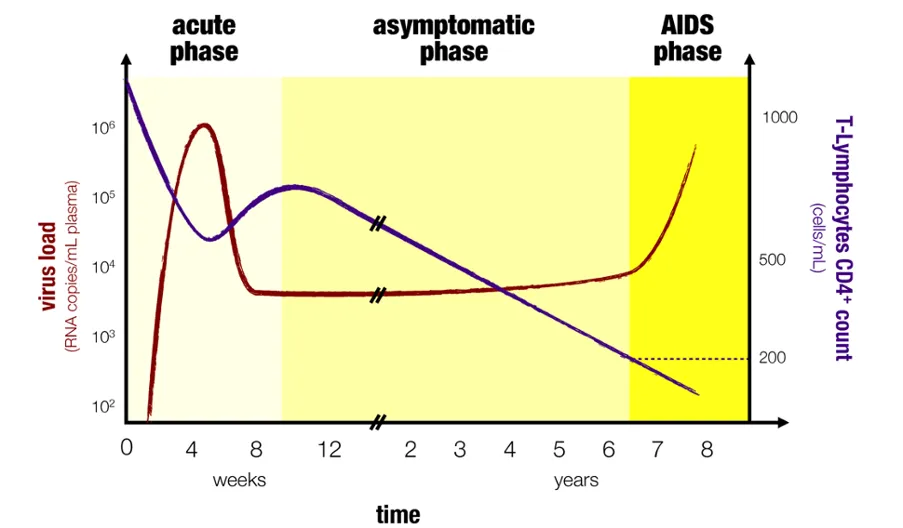
Untreated HIV progresses through three distinct stages: acute phase, asymptomatic phase, then AIDS phase (Figure 1).
Figure 1. Natural history of an HIV-1 infection
Source: Alizon S, Magnus C. Modelling the course of an HIV infection: insights from ecology and evolution. Viruses. 2012;4(10):1984-2013. Available at: https://doi.org/10.3390/v4101984[9].
Acute HIV infection
Within several weeks after acquiring HIV, many people will experience acute illness lasting one to two weeks, or they may not experience any symptoms [10,11]. The most common symptoms include fever, fatigue, swollen lymph nodes, sore throat, rash, muscle and joint pain, and headache [12]. This is when the virus begins to spread in the body and replicate rapidly, depleting CD4 cells, and the immune system responds by producing antibodies. The probability of transmitting the virus is highest during acute infection, due to the high viral load (HIV RNA copies per mL blood plasma).
Chronic HIV infection
After acute infection, the immune response reduces the viral load to a ‘set point’ [11]. This is followed by an asymptomatic chronic infection that can last from months to years – with some studies finding it lasts eight years on average without ART [4,12]. Viral load gradually increases, and CD4 cell count (CD4 cells per mm3 blood) decreases over time. As the immune system is progressively weakened, symptoms develop and progress from mild to severe.
Acquired immunodeficiency syndrome (AIDS)
The advanced stage of HIV infection, known as acquired immunodeficiency syndrome (AIDS), is defined by the presence of one or more diseases due to severe immunosuppression [4]. People can experience a wide range of symptoms and life-threatening opportunistic infections, such as tuberculosis or cancers like Kaposi’s sarcoma [11-13].
Epidemiology
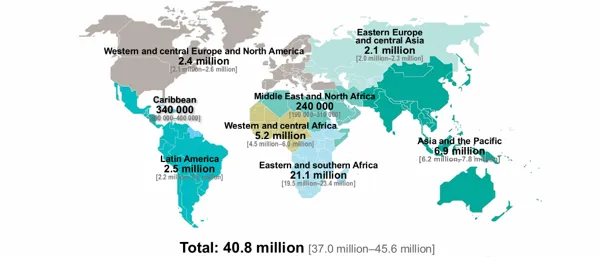
Since the start of the HIV and AIDS pandemic in 1981, tremendous progress has been made in prevention and treatment options. Global HIV incidence and AIDS-related mortality have decreased since their peaks in 1996 and 2004, respectively [5]. However, HIV and AIDS remain a significant public health threat. Globally, an estimated 40.8 million people are living with HIV, with around 1.3 million new infections each year [14]. Tuberculosis is the leading cause of mortality among people with HIV.
There is considerable variation in disease burden across population subgroups, as well as across regions, countries, and sub-national areas, including provinces, districts and sub-districts (Figure 2) [5,14]. Epidemics are described as ‘concentrated’ when transmission occurs primarily within clearly defined groups that are more vulnerable to infection, such as sex workers; gay, bisexual or men who have sex with men; or people who inject drugs [15]. Conversely, epidemics are considered ‘generalised’ when transmission is sustained within the general population through sexual behaviour, which is typically indicated by a population prevalence greater than 1%. In a generalised epidemic, transmission is likely to persist even if there are effective prevention programmes in place for groups at greater risk of infection.
Figure 2. Number of adults and children estimated to be living with HIV in 2024
Source: Joint United Nations Programme on HIV/AIDS (UNAIDS). Core epidemiology slides. 2025. [16].
An estimated 2 100 000 people were living with HIV in Europe and Central Asia by the end of 2024, including 792 000 people in the EU/EEA [17]. Annual EU/EEA surveillance data show that most reported HIV diagnoses occur among men, and sex between men remains the most common mode of transmission. However, there is also an increasing trend in new diagnoses among women. Notably, over half of the HIV diagnoses reported in the region occur among migrants. Between 2014 and 2024, 46% of reported HIV diagnoses in the EU/EEA were among people born outside their reporting country [18-20].
Approximately half of reported HIV diagnoses in the EU/EEA are diagnosed late, defined as a CD4 cell count below 350 cells/mm3 at the time of diagnosis [21]. Late diagnosis leads to further transmission and worse health outcomes for the patient.
AIDS incidence and AIDS-related deaths are declining in the EU/EEA [21]. Among AIDS diagnoses reported in 2024, the most frequent AIDS-defining illnesses were Pneumocystis jirovecii pneumonia and all forms of tuberculosis (pulmonary and extrapulmonary) [21]; as at 2026, this likely remains unchanged, as drastic changes are unlikely in only a couple of years.
Although developments such as ART have contributed to improved life expectancy and decreased morbidity and mortality for people living with HIV, the population is ageing and facing more comorbidities. People with HIV have a higher burden of non-communicable diseases (NCDs) like cardiovascular, pulmonary, kidney and liver disease, attributable to HIV itself but also to ART toxicity and behavioural risk factors [21-23]. This necessitates integrated care models to promote the health and well-being of people on ART.
Transmission
HIV is a sexually transmitted infection (STI). It is spread through direct contact with blood or other bodily fluids (e.g. semen, pre-seminal fluid, vaginal fluids, rectal fluids and breast milk) [4,10]. Most HIV transmission occurs when people have anal or vaginal sex with someone who has detectable levels of the virus without using protection (such as condoms or pre-exposure prophylaxis) [24].
HIV can also spread through sharing needles or syringes with someone who has the virus, or through transfusion or transplantation of certain substances of human origin [25]. Babies born to a person living with HIV can also get the virus during pregnancy, childbirth or through breastfeeding (vertical transmission) [26].
Diagnostics
HIV infection is diagnosed by tests performed on samples of blood or other bodily fluids. These include virological tests that detect the virus (e.g. HIV-RNA, HIV-DNA, viral culture) or its components (e.g. p24 antigen), as well as serological tests that detect markers of the body’s immune response to infection (e.g. HIV antibodies) [4].
The World Health Organization (WHO) standard testing strategy for HIV-1 diagnosis among people 18 months old and above recommends at least three consecutive screening tests. This may include three HIV rapid tests or a combination of rapid tests, enzyme immunoassays, or HIV nucleic acid tests (NATs) for a confirmed positive diagnosis. In children under 18 months old, WHO recommends testing two separate specimens, with the second taken and tested more than four weeks after birth, using HIV NATs or a p24 antigen enzyme immunoassay [27,28].
Case management and treatment
As there is no cure for HIV, it is classified as a chronic infectious disease. However, ART enables people with HIV to live a long, healthy life. ART reduces the HIV viral load significantly, thereby slowing disease progression. Viral suppression is defined as a sustained viral load below 200 copies/mL [4]. The goal of ART is to achieve an undetectable viral load, typically defined as below 50 copies/mL, which prevents onward transmission of HIV.
ART regimens consist of daily oral pills or, for eligible individuals, long-acting injectable formulations. Standard regimens generally include a combination of two nucleoside/nucleotide reverse transcriptase inhibitors (NRTIs), with either an integrase strand transfer inhibitor (INSTI), a non-nucleoside reverse transcriptase inhibitor (NNRTI), or a protease inhibitor with a pharmacokinetic enhancer (boosted PI) [4]. For detailed clinical guidelines, see the European AIDS Clinical Society guidelines [29].
It is crucial that ART be started as soon as possible for all people with HIV because the effectiveness of ART depends on starting early and adhering to it [8,30]. Rapid linkage to care is therefore essential for both newly diagnosed people and people who have interrupted ART [29,31,32]. Retention in care is also essential to support adherence and monitor the health of people on treatment. The response to therapy should be monitored by regular blood tests to determine viral load and CD4 cell count. HIV care should also involve periodic screening and prophylaxis of co-morbidities, such as age-related NCDs and co-infections [22].
For newly diagnosed individuals, partner notification and contact tracing should be conducted as extensively as possible. This includes identifying the probable source of exposure, as well as notifying all sexual and needle-sharing partners of their potential exposure and encouraging them to undergo HIV testing [10].
Public health prevention and control measures (for the authorities)
HIV transmission is prevented by [4,5,10,25,33,34]:
- Safe sex practices, including use of condoms;
- Pre-exposure prophylaxis (PrEP) with antiretroviral drugs for adults at a high risk of acquiring HIV. This might include gay, bisexual and other men who have sex with men; partners in couples where one partner is living with HIV and the other is not; people who inject drugs; transgender people; sex workers; or people in prison. Eligibility should be determined based on regional and/or national epidemiology;
- Harm reduction services for people who inject drugs, including provision of sterilised needles and provision of effective drug treatment (such as opioid agonist treatment);
- Maternal testing, ART and infant PrEP to prevent vertical transmission;
- Universal testing and rapid initiation of ART to achieve viral suppression;
- Post-exposure prophylaxis (PEP) with antiretroviral drugs for people with recent exposure, such as occupational exposure in healthcare or other settings;
- HIV testing of donated substances of human origin;
- Appropriate sterilisation of equipment for tattooing and skin piercing.
The United Nations Sustainable Development Goal (SDG) 3.3 aims to ‘end the epidemic of AIDS’. The UNAIDS Global AIDS Strategy 2026–2031 features global targets for testing and treatment of people with HIV as part of a continuum of care framework [35]:
- 95% of people living with HIV know their HIV status;
- 95% of people living with HIV who know their HIV status receive treatment;
- 95% of people living with HIV who are on treatment have a suppressed viral load;
- 86% of people living with HIV have a suppressed viral load.
These targets address the essential need to reduce the proportion of people living with HIV who have transmissible levels of the virus, since virally suppressed individuals (viral load <200 copies/mL) cannot transmit the virus.
In Europe, countries should scale-up and reduce barriers to existing interventions covering prevention, testing and treatment [17,36,37]. Priorities include equal access to and greater uptake of PrEP for key populations, improved access to care for migrants and continued harm reduction services for people who inject drugs [21]. HIV testing and treatment services should be streamlined to prevent late diagnosis of HIV and should be tailored to reach key populations (e.g. expanding routine opt-out testing in healthcare settings and promoting self-testing and community-based testing) [31]. Countries should also address HIV associated stigma, discrimination and criminalisation through education and policy.
References
- European Commission (EC). Commission Implementing Decision (EU) 2018/945 of 22 June 2018 on the communicable diseases and related special health issues to be covered by epidemiological surveillance as well as relevant case definitions. Brussels: EC; 2018. Available at: https://eur-lex.europa.eu/eli/dec_impl/2018/945/oj/eng
- Castro KG, Ward JW, Slutsker L, Buehler JW, Jaffe HW, Berkelman RL, et al. 1993 Revised Classification System for HIV Infection and Expanded Surveillance Case Definition for AIDS Among Adolescents and Adults. Clin Infect Dis. 1993;17(4):802-10. Available at: https://doi.org/10.1093/clinids/17.4.802
- International Committee on Taxonomy of Viruses (ICTV). ICTV; 2026. Available at: https://ictv.global/taxonomy
- Bartlett JG, Redfield RR, Pham PA. Bartlett's Medical Management of HIV Infection: Oxford University Press; 2019. Available at: https://doi.org/10.1093/med/9780190924775.001.0001
- Mody A, Sohn AH, Iwuji C, Tan RKJ, Venter F, Geng EH. HIV epidemiology, prevention, treatment, and implementation strategies for public health. Lancet. 2024;403(10425):471-92. Available at: https://doi.org/10.1016/S0140-6736(23)01381-8
- May MT, Gompels M, Delpech V, Porter K, Orkin C, Kegg S, et al. Impact on life expectancy of HIV-1 positive individuals of CD4+ cell count and viral load response to antiretroviral therapy. AIDS. 2014;28(8):1193-202. Available at: https://doi.org/10.1097/qad.0000000000000243
- Trickey A, Sabin CA, Burkholder G, Crane H, d'Arminio Monforte A, Egger M, et al. Life expectancy after 2015 of adults with HIV on long-term antiretroviral therapy in Europe and North America: a collaborative analysis of cohort studies. Lancet HIV. 2023;10(5):e295-e307. Available at: https://doi.org/10.1016/S2352-3018(23)00028-0
- INSIGHT START Study Group. Initiation of Antiretroviral Therapy in Early Asymptomatic HIV Infection. N Engl J Med. 2015;373(9):795-807. Available at: https://doi.org/10.1056/NEJMoa1506816
- Alizon S, Magnus C. Modelling the course of an HIV infection: insights from ecology and evolution. Viruses. 2012;4(10):1984-2013. Available at: https://doi.org/10.3390/v4101984
- Chung MH, Titanji BK, De Cock K. HIV Infection and AIDS. 2015. In: Control of Communicable Diseases Manual. American Public Health Association. Available at: https://doi.org/10.2105/CCDM.2745.079
- Vergis EN, Mellors JW. Natural history of HIV-1 infection. Infect Dis Clin N Am. 2000;14(4):809-25. Available at: https://doi.org/10.1016/S0891-5520(05)70135-5
- Sterling TR, Chaisson RE. General Clinical Manifestations of Human Immunodeficiency Virus Infection (Including Acute Retroviral Syndrome and Oral, Cutaneous, Renal, Ocular, Metabolic, and Cardiac Diseases). 2015. In: Bennett JE, Dolin R, Blaser MJ, editors. Mandell, Douglas, and Bennett's Principles and Practice of Infectious Diseases. Philadelphia: W.B. Saunders. Available at: https://www.sciencedirect.com/science/article/pii/B9781455748013001247
- Burke RM, Sabet N, Ellis J, Rangaraj A, Lawrence DS, Jarvis JN, et al. Causes of hospitalisation among people living with HIV worldwide, 2014–23: a systematic review and meta-analysis. Lancet HIV. 2025;12(5):e355-e66. Available at: https://doi.org/10.1016/S2352-3018(24)00347-3
- Joint United Nations Programme on HIV/AIDS (UNAIDS). AIDS, crisis and the power to transform: UNAIDS Global AIDS Update 2025. Geneva: UNAIDS; 2025. Available at: https://www.unaids.org/en/resources/documents/2025/2025-global-aids-update
- Wilson D, Halperin DT. "Know your epidemic, know your response": a useful approach, if we get it right. Lancet. 2008;372(9637):423-6. Available at: https://doi.org/10.1016/S0140-6736(08)60883-1
- Joint United Nations Programme on HIV/AIDS (UNAIDS). Core epidemiology slides. 2025. Available at: https://www.unaids.org/en/resources/documents/2025/core-epidemiology-slides
- European Centre for Disease Prevention and Control (ECDC). Progress report on the continuum of HIV care, 2025 (2024 data): Monitoring implementation of the Dublin Declaration on partnership to fight HIV/AIDS in Europe and Central Asia. Stockholm: ECDC; 2025. Available at: https://www.ecdc.europa.eu/en/publications-data/continuum-hiv-care-monitoring-implementation-dublin-declaration-partnership-1
- Segala FV, Di Gennaro F, Frallonardo L, De Vita E, Petralia V, Sapienza V, et al. HIV-related outcomes among migrants living in Europe compared with the general population: a systematic review and meta-analysis. Lancet HIV. 2025;12(12):e873-e82. Available at: https://doi.org/10.1016/S2352-3018(25)00301-7
- Reyes-Urueña J, Stoppa G, Pizzolato F, van der Werf MJ, Deogan C, Cabral-Veríssimo V, et al. Trends in new HIV diagnoses and factors contributing to late diagnosis among migrant populations in EU/EEA countries, 2014 to 2023. Euro Surveill. 2024;29(48):2400759. Available at: https://doi.org/10.2807/1560-7917.ES.2024.29.48.2400759
- Reyes-Urueña J, Stoppa G, Pizzolato F, Marrone G, Hansson D, EU/EEA HIV network. Late HIV diagnosis: trends, risk factors, and progress toward the 2025 target of <20% late diagnosis in 23 EU/EEA countries, 2022 to 2024. Euro Surveill. 2025;30(47):2500855. Available at: https://doi.org/10.2807/1560-7917.ES.2025.30.47.2500855
- European Centre for Disease Prevention and Control (ECDC), WHO Regional Office for Europe (WHO). HIV/AIDS surveillance in Europe 2025 – 2024 data. Stockholm: ECDC; 2025. Available at: https://www.ecdc.europa.eu/en/publications-data/hivaids-surveillance-europe-2025-2024-data
- Jespersen NA, Axelsen F, Dollerup J, Norgaard M, Larsen CS. The burden of non-communicable diseases and mortality in people living with HIV (PLHIV) in the pre-, early- and late-HAART era. HIV Med. 2021;22(6):478-90. Available at: https://doi.org/10.1111/hiv.13077
- European Centre for Disease Prevention and Control (ECDC). European Standards of HIV prevention and care: Module on HIV and co-morbidities. Stockholm: ECDC; 2025. Available at: https://www.ecdc.europa.eu/en/publications-data/european-standards-hiv-prevention-and-care-module-hiv-and-co-morbidities
- Patel P, Borkowf CB, Brooks JT, Lasry A, Lansky A, Mermin J. Estimating per-act HIV transmission risk: a systematic review. AIDS. 2014;28(10):1509-19. Available at: https://doi.org/10.1097/qad.0000000000000298
- European Centre for Disease Prevention and Control (ECDC). Guidelines on the prevention of HIV transmission through substances of human origin. Stockholm: ECDC; 2025. Available at: https://www.ecdc.europa.eu/en/publications-data/guidelines-prevention-hiv-transmission-through-substances-human-origin
- Walters MK, Bulterys MA, Barry M, Hicks S, Richey A, Sabin M, et al. Probability of vertical HIV transmission: a systematic review and meta-regression. Lancet HIV. 2025;12(9):e638-e48. Available at: https://doi.org/10.1016/S2352-3018(25)00132-8
- World Health Organization (WHO). Consolidated guidelines on differentiated HIV testing services. Geneva: WHO; 2024. Available at: https://www.who.int/publications/i/item/9789240096394
- World Health Organization (WHO). Consolidated guidance for strengthening national routine surveillance systems: updated HIV case definitions, advanced HIV disease indicators and surveillance checklist. Geneva: WHO; 2026. Available at: https://www.who.int/publications/i/item/9789240124271
- European AIDS Clinical Society (EACS). EACS Guidelines version 13.0. 2025 Available at: https://eacs.sanfordguide.com/
- Cohen MS, Chen YQ, McCauley M, Gamble T, Hosseinipour MC, Kumarasamy N, et al. Antiretroviral Therapy for the Prevention of HIV-1 Transmission. N Engl J Med. 2016;375(9):830-9. Available at: https://doi.org/10.1056/nejmoa1600693
- World Health Organization (WHO). Consolidated guidelines on HIV prevention, testing, treatment, service delivery and monitoring: recommendations for a public health approach. Geneva: WHO; 2021. Available at: https://www.who.int/publications/i/item/9789240031593
- European Centre for Disease Prevention and Control (ECDC). European Standards of HIV prevention and care: Module on commencement of antiretroviral therapy (ART). Stockholm: ECDC; 2025. Available at: https://www.ecdc.europa.eu/en/publications-data/european-standards-hiv-prevention-and-care-module-commencement-antiretroviral
- O Murchu E, Marshall L, Teljeur C, Harrington P, Hayes C, Moran P, et al. Oral pre-exposure prophylaxis (PrEP) to prevent HIV: a systematic review and meta-analysis of clinical effectiveness, safety, adherence and risk compensation in all populations. BMJ Open. 2022;12(5):e048478. Available at: https://doi.org/10.1136/bmjopen-2020-048478
- European Centre for Disease Prevention and Control (ECDC). European standards of HIV prevention and care: Module on pre-exposure prophylaxis. Stockholm: ECDC; 2025. Available at: https://www.ecdc.europa.eu/en/publications-data/european-standards-hiv-prevention-and-care-module-pre-exposure-prophylaxis
- Joint United Nations Programme on HIV/AIDS (UNAIDS). The Global AIDS Strategy for 2026–2031: Towards Ending AIDS. Geneva: UNAIDS; 2026. Available at: https://www.unaids.org/en/resources/documents/2026/2026%E2%80%932031_Global-AIDS-Strategy
- Parczewski M, Gokengin D, Sullivan A, de Amo J, Cairns G, Bivol S, et al. Control of HIV across the WHO European region: progress and remaining challenges. Lancet Reg Health Eur. 2025;52:101243. Available at: https://doi.org/10.1016/j.lanepe.2025.101243
- European Centre for Disease Prevention and Control (ECDC). Progress towards reaching the Sustainable Development Goals related to HIV in the European Union and European Economic Area. Monitoring the implementation of the Dublin Declaration on partnership to fight HIV/AIDS in Europe and Central Asia – 2025 progress report. Stockholm: ECDC; 2025. Available at: https://www.ecdc.europa.eu/en/publications-data/evidence-brief-progress-towards-reaching-sustainable-development-goals-related-1