
Travel-associated malaria cases reported to ECDC by place of infection
This page presents travel-associated malaria cases caused by Plasmodium falciparum reported to ECDC by likely place of infection. The maps and downloadable tables show the number of reported cases and rates per 100 000 travellers arriving in the EU/EEA, by place of infection. The aim is to inform public health authorities and EU/EEA citizens about travel-associated malaria (P. falciparum) and support travel health advice.
Note: This page only includes cases with a likely place of infection outside mainland EU/EEA. Cases with a likely place of infection in mainland EU/EEA are not included.
Travel-associated malaria cases reported to ECDC, by place of infection, 2024
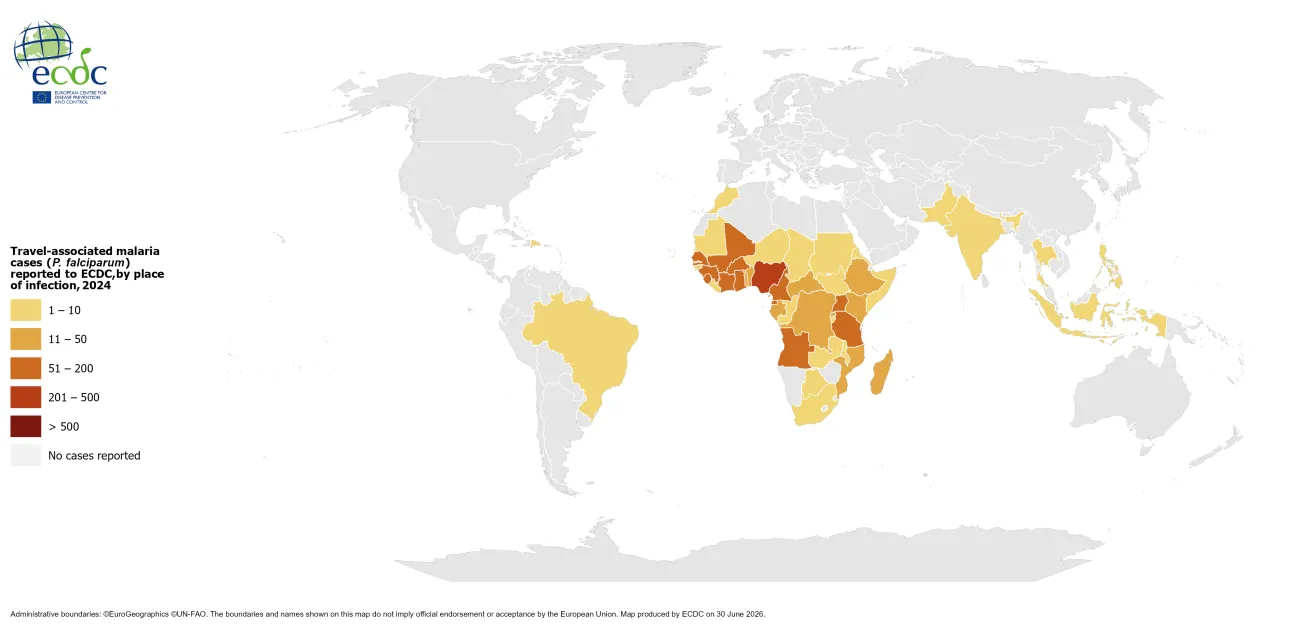
Certain countries and EU outermost regions may not be fully displayed within the map extent; however, comprehensive data are available in the 'Download the data' section.
Travel-associated malaria cases (P. falciparum) reported to ECDC, by place of infection, 2020-2024
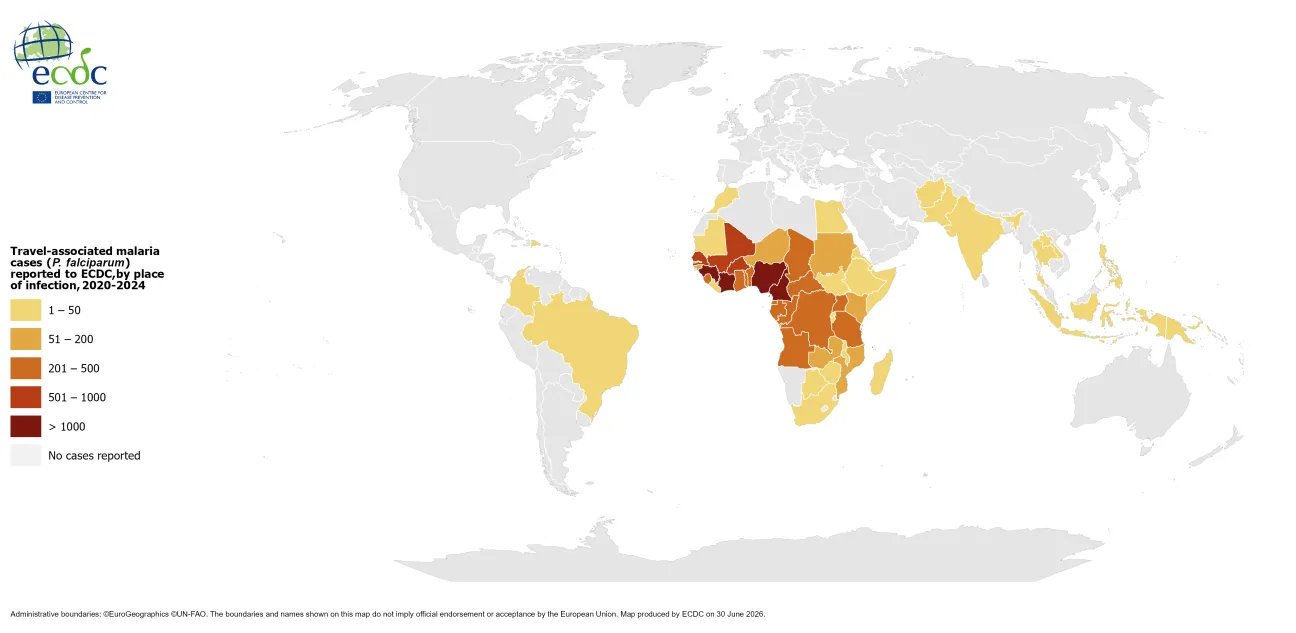
Certain countries and EU outermost regions may not be fully displayed within the map extent; however, comprehensive data are available in the 'Download the data' section.
Rates of travel-associated malaria cases (P. falciparum) among 100 000 travellers arriving in the EU/EEA, by place of infection, 2024
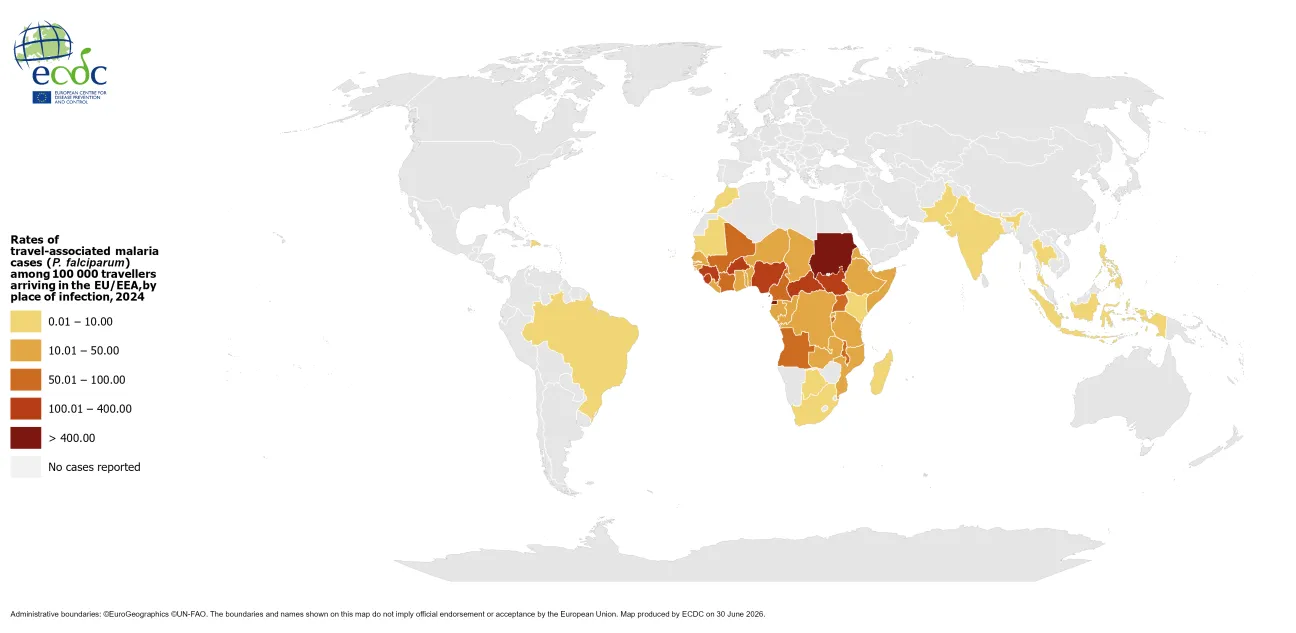
Certain countries and EU outermost regions may not be fully displayed within the map extent; however, comprehensive data are available in the 'Download the data' section.
Rates of travel-associated malaria cases (P. falciparum) among 100 000 travellers arriving in the EU/EEA, by place of infection, 2020-2024
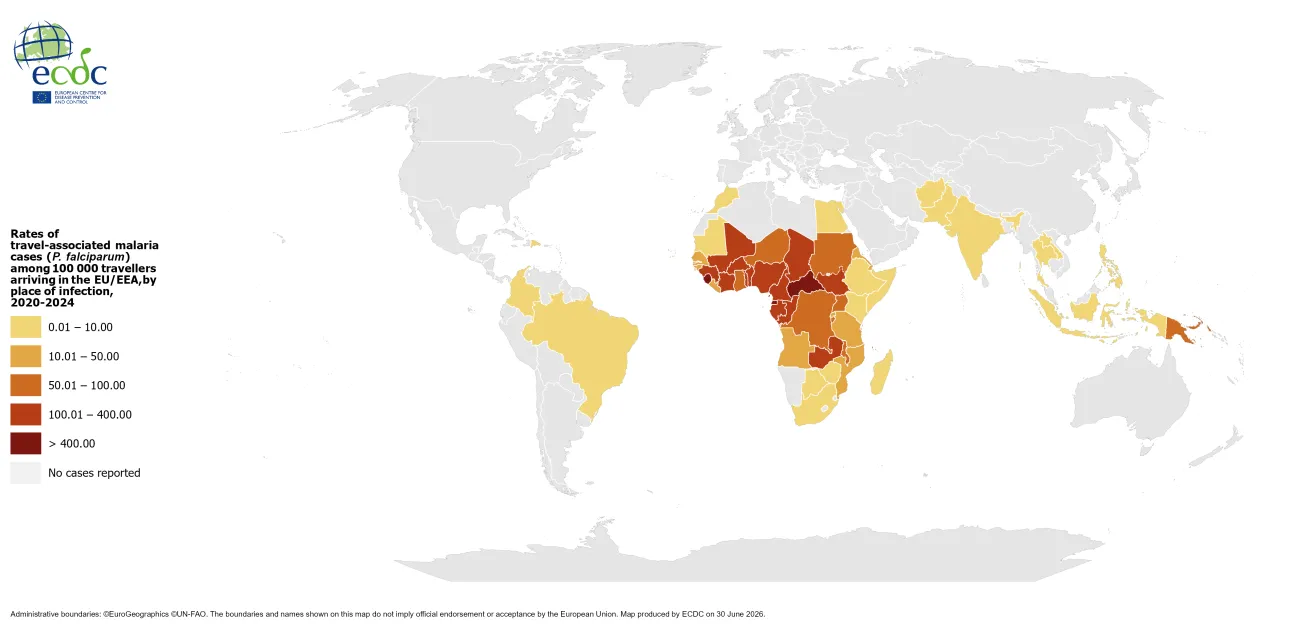
Certain countries and EU outermost regions may not be fully displayed within the map extent; however, comprehensive data are available in the 'Download the data' section.
Download the data
When importing the data in MS Excel, please do not forget to select Unicode (UTF-8) as encoding.
About the data
These data are based on confirmed malaria (P. falciparum) cases reported to ECDC by EU/EEA countries through the EpiPulse Cases platform, as of December 2025. They only include cases diagnosed in the EU/EEA with a single place of infection specified and from whom information on the Plasmodium species was available (specifically Plasmodium falciparum). For the period 2020–2024, 63% of all malaria cases were reported as infections with P. falciparum only and were therefore included in this analysis. Approximately 30% of cases could not be assigned to a single Plasmodium species, as they were reported as Plasmodium spp., recorded as unknown, or involved mixed infections with multiple Plasmodium species and were therefore excluded from the analysis. The remaining cases were attributed to Plasmodium ovale, Plasmodium malariae, Plasmodium vivax or Plasmodium knowlesi and were also excluded from the analysis.
Data on the place of infection were provided at the sub-national level for the EU outermost regions*, while for other locations, the data were at the national level. People who were infected in the EU outermost regions were classified as travel-associated, and each outermost region was treated separately as a place of infection in the analysis. Cases with a place of infection in mainland EU/EEA were excluded.
For all data included in this overview, outlying observations were excluded. Places of infection are included in the maps if they are linked to confirmed cases reported over the past five years and meet at least one of the following criteria:
- they were identified in at least two different years; or
- they were reported by at least two different EU/EEA countries; or
- at least five cases were reported for the same place of infection.
Rates of travel-associated malaria (P. falciparum) cases among travellers were calculated using EpiPulse Cases data from 2020–2024 and IATA MarketIS data on air passenger flows (extracted on 5 December 2025). MarketIS captures passenger volumes on direct and connecting flights from point A to point B, including itineraries with layovers of 18 hours or less. These data were further filtered to include flights scheduled between 2020 and 2024 from any country or EU outermost region worldwide to mainland EU/EEA.
Rates of travel-associated malaria (P. falciparum) cases among travellers were calculated as follows:

Confidence intervals were calculated using the Clopper-Pearson method.
The data presented in this summary should be interpreted with caution for the following reasons:
- The data are presented as reported by EU/EEA countries and have not been validated by the health authorities in the places of infection.
- This summary does not account for regional variation within places of infection, and the risk of infection may be higher in some areas than in others.
- The data cover only the years 2020–2024 and do not necessarily indicate ongoing transmission in the places shown.
- The analysis is based only on MarketIS flight data, which include direct flights and connecting flights, and exclude other forms of international travel such as bus, train, boat and car.
This surveillance output reports travel-associated malaria (P. falciparum) cases among travellers diagnosed in the EU/EEA, by reported likely place of infection. It is not intended to assess, verify or comment on the malaria-free status of any country or territory, including any status granted under WHO processes. Any interpretation of these data should therefore be kept separate from assessments related to malaria-free certification.
*EU outermost regions include Guadeloupe, French Guiana, Réunion, Martinique, Mayotte and Saint-Martin (France), the Azores and Madeira (Portugal), and the Canary Islands (Spain).