Key facts
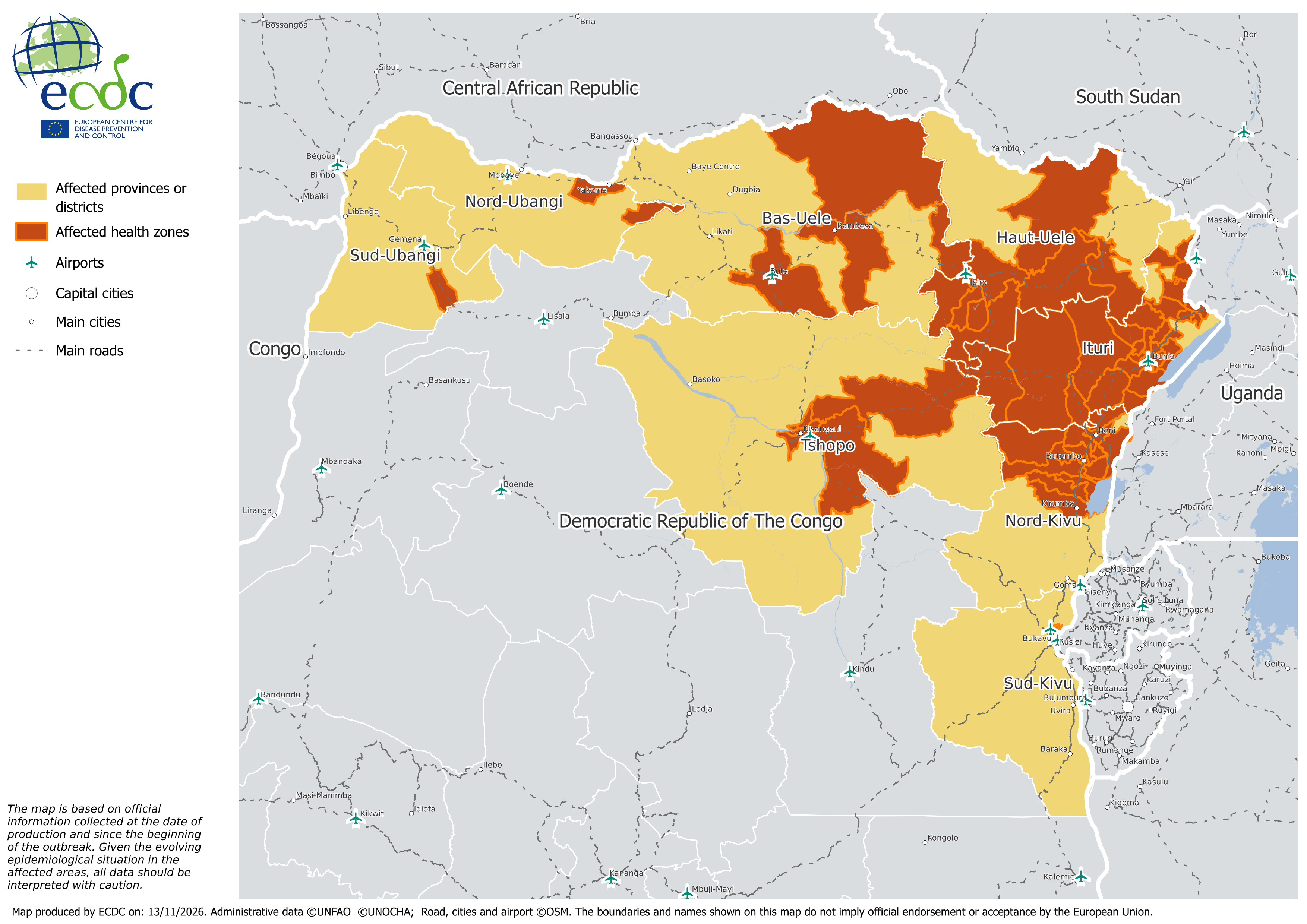
- As of 17 November 2026, the Democratic Republic of the Congo (DRC), where community transmission is ongoing, has reported a total of 11 504 confirmed cases, including 5 630 related deaths (from data up until 16 November). Since the beginning of the outbreak, eight provinces have been affected: Ituri, Nord-Kivu, Sud-Kivu, Tshopo, Haut-Uélé, Bas-Uélé, Sud Ubangi and Nord Ubangi.
- Since the beginning of the outbreak, excluding cases reported from DRC and those medically evacuated to Europe, 20 cases have been reported in Uganda, nine in Kenya and one in Nigeria (medically evacuated to Switzerland). Secondary transmission associated with imported cases was reported in Uganda and Kenya.
- On the basis of the available information, and given the uncertainties surrounding this outbreak, the likelihood of infection for people from the European Union/European Economic Area (EU/EEA) living in or travelling to affected areas is estimated to be low. Given the very low likelihood of importation and secondary transmission, the likelihood of infection for people living in the EU/EEA is estimated to be very low. This assessment will be reviewed as further information becomes available.
- ECDC is monitoring the outbreak through its epidemic intelligence activities and actively liaising with partners to support the response.
Overview
Latest epidemiological information
Democratic Republic of the Congo
As of 17 November 2026, the Democratic Republic of the Congo (DRC) has reported a total of 11 504 confirmed cases, including 5 630 related deaths (from data up until 16 November). A total of 1 743 patients have been hospitalised in isolation, and among the individuals who have tested positive for Bundibugyo virus, 3 142 have recovered. In total, 81.6% of identified case contacts were under follow-up in the affected provinces.
Since the previous ECDC update on 16 November (with data up until 14 November), an additional 128 confirmed cases and 64 deaths have been reported. The additional cases were reported in Nord-Kivu (65 cases), Ituri (53 cases), Haut-Uélé (9 cases) and Tshopo (one case) (SitRep n.185/MVE-BDBV/15/11/2026, SitRep n.186/MVE-BDBV/16/11/2026).
Overall, as of 17 November, Ituri province remains the most affected, with 7 911 cases, including 3 738 deaths, reported from 28 of 36 health zones. In Nord-Kivu, 2 925 cases, including 1 623 deaths, have been reported from 17 of 34 health zones. In Haut-Uélé, 532 cases, including 229 deaths, have been reported from eight of 13 health zones. In Tshopo, 108 cases, including 33 deaths, have been reported from seven of 23 health zones. In Sud-Kivu, three cases, including one death, have been reported from one of 34 health zones. In Bas-Uélé, 13 cases, including four deaths, have been reported from four of 11 health zones. In Sud Ubangi, two cases, including one death, have been reported from one of 16 health zones. In Nord Ubangi, 10 cases, including one death, have been reported from two of 11 health zones. Overall, 68 of 178 health zones have been affected across the eight provinces since the beginning of the outbreak.
Data reported by DRC on confirmed cases and deaths are under continuous review and harmonisation.
On 13 November, UNICEF reported on the impact of the ongoing outbreak on children in DRC. Using data as of 4 November, a total of 2 959 children were among confirmed cases (28% of total confirmed cases). This includes 1 737 deaths (35% of total deaths). Among children under five years of age with confirmed infection, 72% have died (UNICEF, Fast facts: Ebola outbreak toll on children six months into the response, 13 November 2026).
Nigeria
On 20 October 2026, one confirmed case of Ebola disease was reported in Nigeria. According to a press statement by the Federal Ministry of Health and Social Welfare and a press release by WHO African Region, the person travelled from Uganda to Nigeria on an international flight. She developed symptoms on 7 October, four days after arriving in Nigeria, and sought medical care on 11 October in Abuja. Infection with Bundibugyo virus was confirmed on 20 October. She had transited through Addis Ababa (Ethiopia) before arriving in Nigeria (NCDC, An Update of Ebola Outbreak in Nigeria, 27 October 2026). On 26 October, the affected individual\ and one close contact (her husband) were evacuated from Nigeria to Switzerland (Muhammad Ali Pate, Coordinating Minister of Health and Social Welfare, Nigeria on X, 26 October 2026, ARISE NEWS on X, 26 October 2026, Swiss Federal Authorities, Press Release, 26 October 2026: Ebola case and close contact being treated in Switzerland). She recovered and was discharged from hospital on 11 November (Geneva University Hospitals, Discharge from hospital of the person with Ebola, 11 November 2026).
A total of 62 contacts of the case were identified and monitored. As of 13 November, all contacts completed the 21-day quarantine (NCDC on X, 13 November 2026, NCDC, Ebola disease outbreak in Nigeria, 14 November 2026).
Kenya
Kenya has reported a cluster of nine cases, including two deaths. The first case was imported from DRC and reported on 6 October. The patient, a Kenyan citizen who had been residing in DRC, reportedly travelled from DRC to Kenya, via Uganda, on 3 October. The patient subsequently died. Between 14 and 20 October 2026, eight additional cases were reported, including four family members or other relatives of the first case, and four healthcare workers (one of whom was initially reported to have attended the patient) (Kenya Ministry of Health X post, 14 October 2026, Kenya Ministry of Health, X post 16 October, Kenya Ministry of Health X post 17 October, Kenya Ministry of Health X post 17 October 2026, Kenya Ministry of Health 20 October 2026). The second death was reported on 23 October 2026; the patient was the third confirmed case in the cluster. She had developed symptoms on 13 October and was receiving supportive care (Kenya Ministry of Health on X, 23 October 2026). Between 3 and 11 November, the remaining seven cases recovered and were discharged from hospital (Kenya Ministry of Health on X, 3 November 2026, Kenya Ministry of Health on X, 6 November 2026, Kenya Ministry of Health on X, 11 November 2026).
Overall, 135 contacts of the index case were identified (Kenya Ministry of Health, 22 October 2026). All of the identified contacts under monitoring in Kenya completed the 21-day quarantine by 11 November (Kenya Ministry of Health on X, 11 November 2026, Kenya Ministry of Health Ebola Response Update, 11 November 2026).
Monitoring cases that were medically evacuated or imported to Europe
- On 5 November, a healthcare worker of British nationality who was working in DRC and tested positive for Ebola was medically evacuated to the UK to receive specialist treatment in a high-level isolation unit (UK Government Department of Health & Social Care, Press Release 5 November 2026, UK Health Security Agency, 5 November 2026).
- On 26 October, a woman was medically evacuated from Nigeria to Switzerland for treatment of an Ebola infection, along with a close contact of hers (Swiss Federal Authorities, Press Release, 26 October 2026: Ebola case and close contact being treated in Switzerland). The individual subsequently recovered and was discharged from hospital on 11 November (Geneva University Hospitals, Discharge from hospital of the person with Ebola, 11 November 2026).
- On 29 September, a healthcare worker based in DRC who tested positive for Bundibugyo virus was medically evacuated to the Netherlands to receive specialised care. The patient was admitted to the high-level isolation unit at Leiden University Medical Center on 1 October and was subsequently discharged on 9 October.
- On 21 July, the United Kingdom Ministry of Health reported that a UK resident who had been treating patients with Ebola in the DRC had been evacuated and isolated in a London hospital. The individual showed no symptoms and this was deemed a precautionary measure.
- On 10 July 2026, the US CDC reported that a US citizen who was working for a humanitarian organisation in DRC had tested positive for Bundibugyo virus. The patient was medically evacuated to Germany on 13 July 2026.
- On 24 June, the Ministry of Health in France reported a first positive case of Ebola virus disease, identified in a doctor returning from a humanitarian mission to one of the areas affected by the ongoing outbreak in DRC.
- On 18 May 2026, a US citizen working in healthcare in the affected areas tested positive and was transferred to Germany, together with six high-risk contacts (US CDC Update on Ebola Outbreak, 18 May 2026, Serge News and Updates, 18 May 2026). The American doctor subsequently recovered well and was discharged from the hospital in Berlin where he was treated (Ebola patient discharged from Charite hospital in Berlin in good health, 6 June 2026). Another contact of US nationality was transferred to Czechia (US CDC Transcript -19 May 2026).
A summary of the event since May 2026 is provided on the dedicated page of the ECDC website: Ebola disease: Multi-country outbreak 2026.
ECDC assessment
Given the gaps in epidemiological information and limited follow-up of contacts, it is likely that the outbreak in DRC is larger than currently reported in terms of the number of affected cases/areas.
Given all the available information and uncertainties surrounding this outbreak, the likelihood of infection for people from the EU/EEA living in or travelling to affected areas is estimated to be low. Although infection with BDBV leads to severe disease at an individual level, the impact for people from the EU/EEA living and travelling in affected areas is considered low at population level. Therefore, the current risk for people from the EU/EEA living in or travelling to affected areas is considered low.
The likelihood of sustained transmission following an imported case is estimated to be very low for people living in the EU/EEA, as possible imported cases are likely to be promptly identified and isolated and recommended control measures would be implemented. BDBV infection can cause severe disease in affected individuals, and there is a significant operational impact on healthcare facilities caring for such patients. However, the population-level public health impact in the EU/EEA is expected to be very low because only very few cases are expected and EU/EEA countries have robust hospital and public health systems. Therefore, the overall risk of BDBV for the general population in the EU/EEA is assessed as very low.
The overall risk of Bundibugyo virus transmission through substances of human origin (SoHO) in the EU/EEA is currently assessed as very low (Risk of Bundibugyo virus transmission through substances of human origin in the European Union/European Economic Area (EU/EEA).
Exit screening in affected countries, including symptom checks and exposure assessment, is important as it contributes to risk reduction by identifying and preventing travellers who are symptomatic from travelling. Exit screening also helps dissuade people with symptoms from travelling and enhances public and stakeholder confidence. However, it cannot fully prevent exportation of cases, because the absence of symptoms at departure does not exclude subsequent onset of disease.
ECDC considers that the screening of returning travellers from affected areas would not be effective in preventing introduction to Europe. This consideration is based on the experience gained during the current outbreak and the lessons learned and results of the large EVD outbreak in West Africa between 2013 and 2016, where tens of thousands of cases were reported, transmission was ongoing in large urban centres, and hundreds of EU/EEA humanitarian and military personnel were deployed to the affected areas. Screening incoming travellers involves extensive time and resources and will not effectively identify people with the infection. Priority should instead be given to providing travellers with clear information on symptoms, routes of transmission, and what to do if symptoms develop after arrival in the EU/EEA.
ECDC published Threat Assessment Briefs on 21 May 2026 and 23 October 2026 (Threat assessment brief: Ebola disease outbreak caused by Bundibugyo virus – Democratic Republic of the Congo and Uganda – 2026 and Threat assessment brief: Importation of Ebola disease cases caused by Bundibugyo virus to Kenya and Nigeria).
Actions
ECDC continues to monitor the outbreak through its epidemic intelligence activities to provide epidemiological updates, situational awareness and risk assessment for the EU/EEA.
Since 19 May 2026, the EU Health Task Force, in collaboration with the European Civil Protection and Humanitarian Aid Operations (DG ECHO), EU Delegations, the Directorate-General for International Partnerships (DG INTPA), the World Health Organization (WHO) and the Global Outbreak Alert and Response Network (GOARN), has been deploying ECDC experts and fellows to Addis Ababa (Ethiopia) at Africa CDC's headquarters, South Sudan, Kampala (Uganda), Bunia (DRC) and Abuja (Nigeria).
ECDC is actively liaising with key partners, including Africa CDC, the European Commission and WHO to provide further support through the EU Health Task Force in response to this outbreak.
ECDC is regularly re-evaluating the situation as new information becomes available and continues to provide updated epidemiological information, scientific assessments and advice on its website: Ebola disease: Multi-country outbreak 2026.
The event will be updated on a weekly basis on Thursday and on an ad hoc basis when other relevant epidemiological updates become available.