Risk classification and contact tracing of travellers returning from affected areas – Ebola disease outbreak 2026 caused by Bundibugyo virus
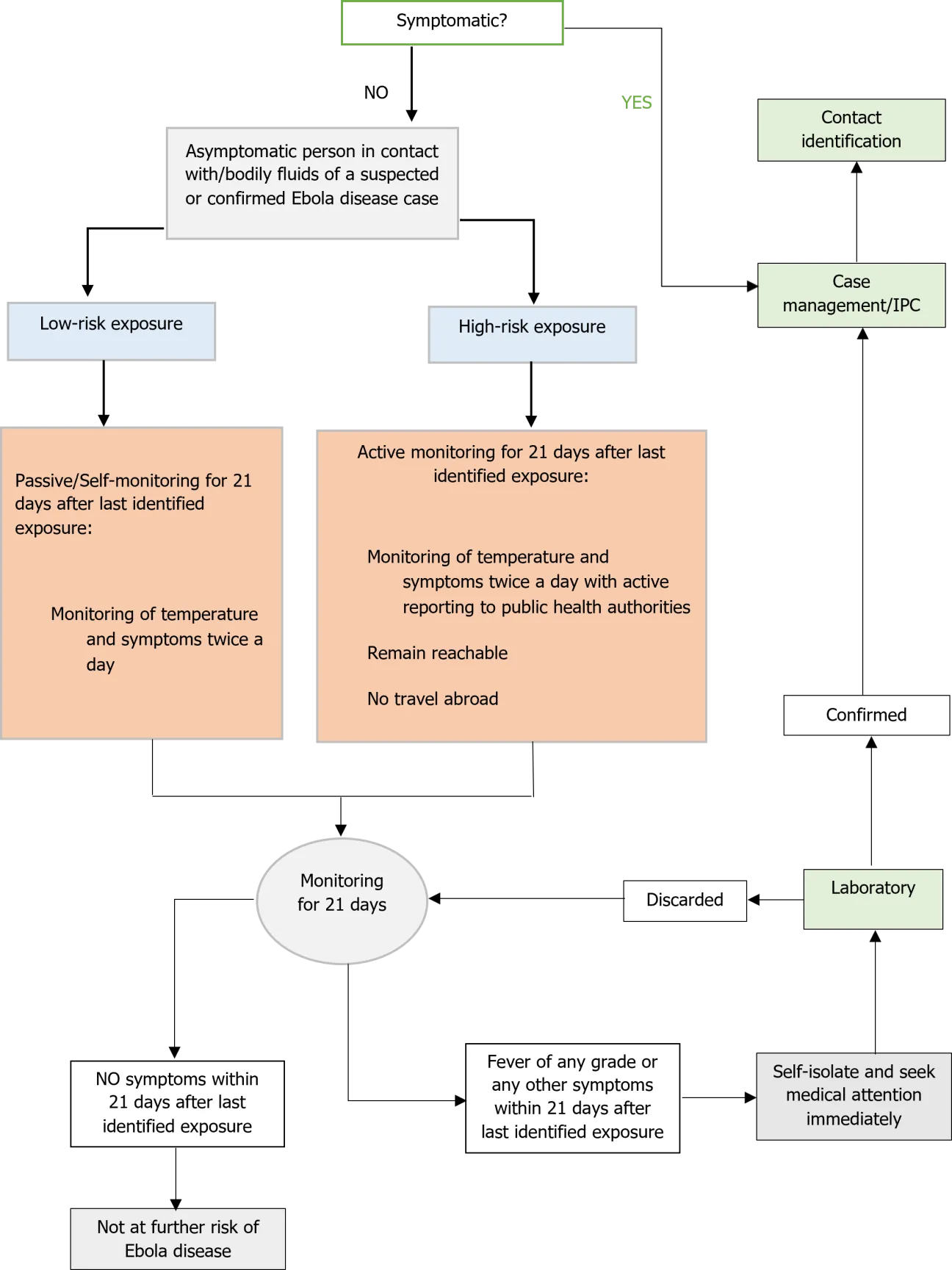
This table and accompanying algorithm provide guidance for EU/EEA public health authorities, decision-makers, and healthcare professionals on risk categorisation and management of individuals potentially exposed to Ebola disease. The guidance applies to contacts of confirmed or probable cases following travel to, residence in, or work in Ebola outbreak-affected areas, as well as to occupational exposures.
As long as an outbreak is ongoing, individuals arriving from affected regions may develop Ebola disease after entering non-affected countries. Minimising transmission relies on rapid case detection and isolation, effective contact tracing, and strict infection prevention and control (IPC) measures.
Given the severity of Ebola disease, timely identification and risk-based management of exposed individuals is essential. Early detection of symptomatic contacts enables prompt isolation, testing, and clinical care, thereby reducing the interval between symptom onset and case recognition. This approach minimises opportunities for onward transmission and strengthens outbreak control.
Risk exposure classification and proposed measures
| Risk exposure category | Exposure type and examples | Proposed measures |
|
No exposure |
No exposure to symptomatic cases or persons under investigation
|
Provision of clear, accurate, and up‑to‑date information about Ebola disease, including transmission risks, symptoms, and required monitoring after potential exposure Instructions for action if symptoms develop after arrival, including targeted behavioural guidance |
|
Low-risk occupational exposure |
Protected occupational exposure*
*Contact using appropriate PPE is not considered significant exposure, however, context regarding PPE protocols used and their adherence should always be considered.
|
Self- monitoring (passive monitoring) for 21 days after last exposure: temperature and symptoms check twice a day Provision of clear, accurate, and up‑to‑date information about Ebola disease, including transmission risks, symptoms, and required monitoring after potential exposure Instructions for action if symptoms develop after arrival including targeted behavioural guidance |
|
Low-risk exposure |
Contact with symptomatic case (non-fluid exposure) E.g. Close face-to-face contact (e.g. within <1 meter, sharing seating or public transport (incl. airplane), receptionist duties, household/classroom/office contact with a feverish or symptomatic person who has suspected/confirmed Ebola disease not coughing, vomiting, bleeding, or with diarrhoea |
Self- monitoring (passive monitoring) for 21 days after last exposure: temperature and symptoms check twice a day Provision of clear, accurate, and up‑to‑date information about Ebola disease, including transmission risks, symptoms, and required monitoring after potential exposure Instructions for action if symptoms develop after arrival including targeted behavioural guidance Public health authorities may indicate more actions, depending on the circumstances |
|
High-risk exposure |
Close contact without appropriate PPE / unprotected exposure Unprotected sexual contact with someone who has Ebola disease or a survivor without confirmed negative semen RT-PCR tests (2 negative tests ≥1 week apart) Burial exposure Percutaneous injury (e.g. with needle) or mucosal exposure to laboratory specimens suspected of containing orthoebolavirus or to bodily fluids, tissues, or specimens
|
Active monitoring for 21 days following last exposure: - Temperature and symptoms check twice a day with active reporting to public health authorities or after active contact by public health authorities Remain reachable No travel abroad Consider restriction of social interactions Consider restrictions of engagement in clinical activities and follow national occupational health plan Provision of clear, accurate, and up‑to‑date information about Ebola, including transmission risks, symptoms, and required monitoring after potential exposure. Instructions for action if symptoms develop after arrival including targeted behavioural guidance. Public health authorities may indicate more actions, depending on the circumstances In case of clearly established percutaneous injury or mucosal exposure: restrictions of social interactions/contacts and movements as a precautionary measure. |
Other types of ‘high-risk’ exposure are beyond the scope of this document, for example:
-
Direct contact with bushmeat (e.g. eating raw bushmeat, carving up the animal, direct contact with the animal’s blood or bodily fluids), bats, rodents, primates living or dead, in or from Ebola disease-affected areas
-
Exposure through breastfeeding
Note: This classification is based on selected examples of exposures and is not exhaustive.
Contact tracing