Key facts
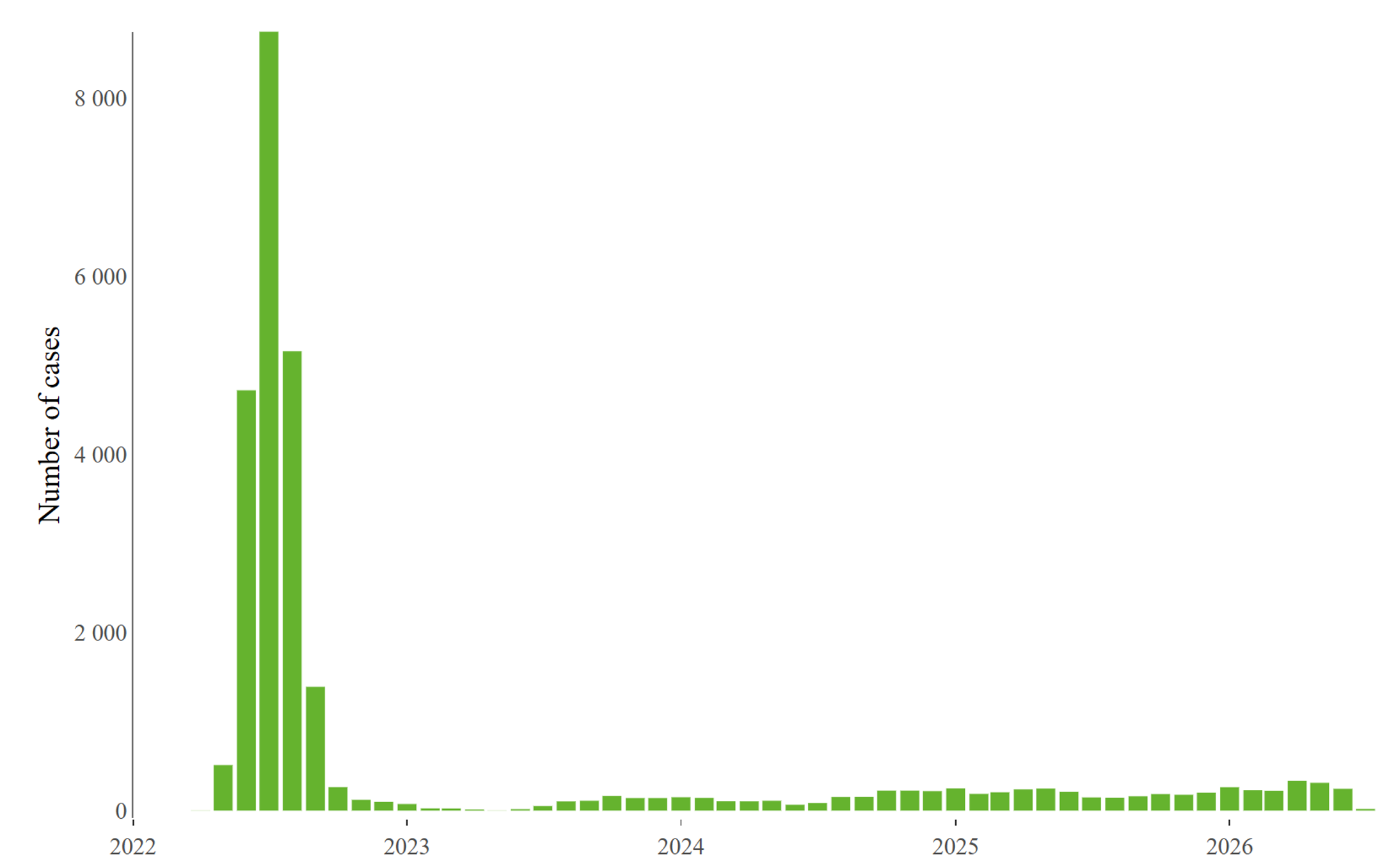
- In June 2026, 129 mpox cases caused by monkeypox virus (MPXV) clade I were reported by nine EU/EEA countries, indicating a relatively stable transmission following increases observed earlier in 2026. In the same period, 22 mpox cases caused by MPXV clade II were reported by six countries, continuing a decreasing trend.
- Transmission for both clades occurs predominantly within networks of men who have sex with men, with ongoing circulation across the EU/EEA and most cases reported among unvaccinated individuals.
- Disease severity remains generally mild, with low hospitalisation rates reported for both clades.
- With increased travel and mass gatherings during summer, there is a risk of further spread.
Overview
The monthly surveillance report on mpox in the EU/EEA, Western Balkans and Türkiye, covering the period up to June 2026 has been published on ECDC's website.
June 2026 update
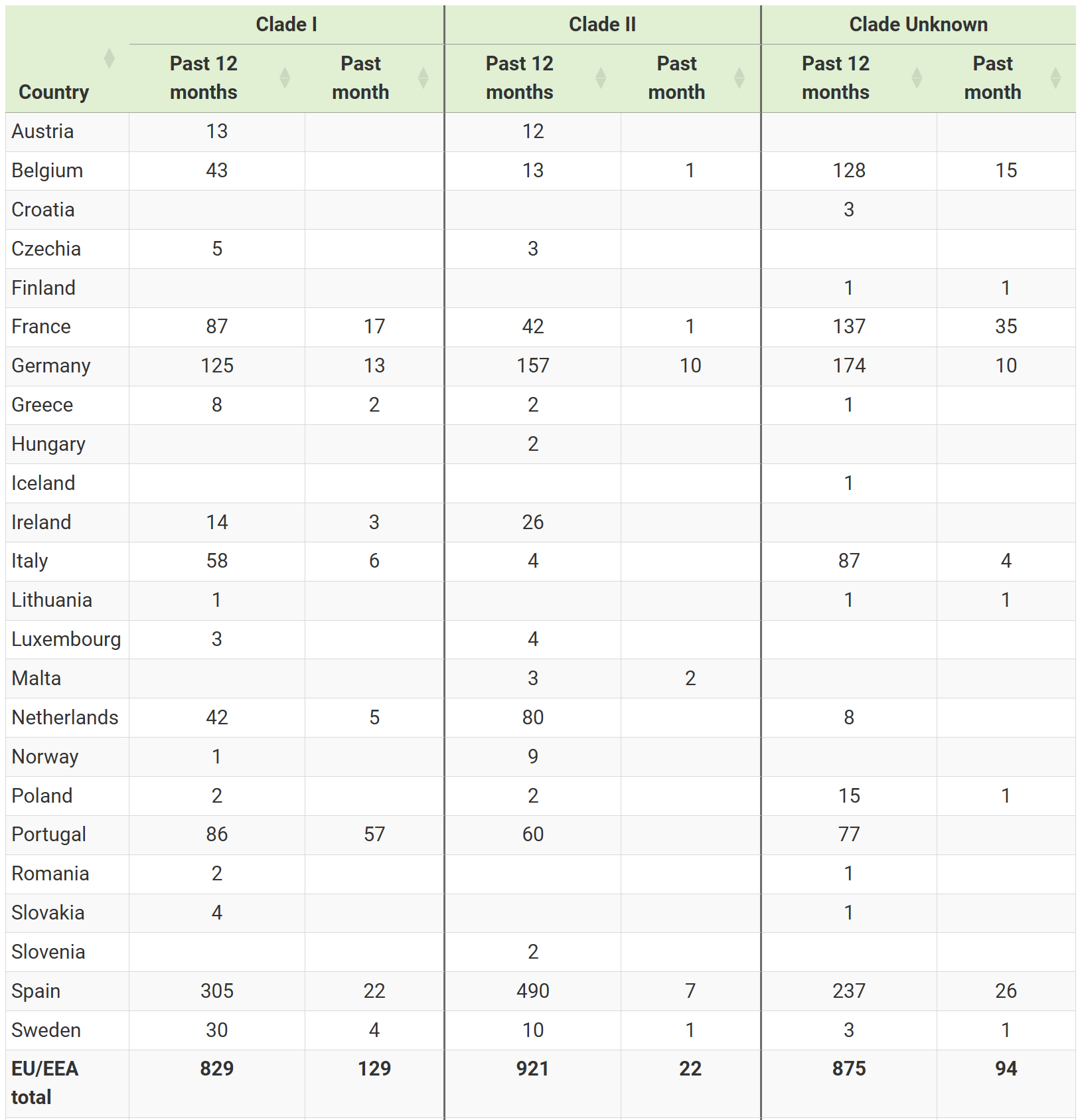
In June 2026, 129 mpox cases caused by clade I MPXV were reported by nine countries, with the largest number of cases being reported by Portugal (57).
In June 2026, 22 mpox clade II cases were reported by six countries, with the largest number of cases being reported by Germany (10).
Overview of the past 12 months (July 2025 to June 2026)
In the past 12 months, 18 countries have reported 829 clade I mpox cases and 18 countries have reported 921 clade II mpox cases.
Among cases with complete information:
- In total, 90% of clade I mpox cases and 91% of clade II mpox cases were reported among men who have sex with men.
- Overall, 14% of clade I mpox cases and 8% of clade II mpox cases were hospitalised. Two deaths have been reported among people infected with clade II MPXV; no deaths have been reported in people infected with clade I MPXV.
- A total of 22% of clade I mpox cases and 21% of clade II mpox cases with known vaccination status had received two vaccine doses.
Following increases observed in late 2025 and early 2026, the number of clade I mpox cases reported in the EU/EEA remains relatively stable, while the number of reported clade II mpox cases continues to decline.
However, interpretation of trends is limited due to missing clade information for a substantial proportion of reported cases, and case and epidemiological information may be updated retrospectively.
Based on information provided by Member States, clinical presentation is generally mild, including among hospitalised cases. Clades Ib and IIb account for the vast majority of reported mpox cases. Among cases with known clade, only one case of clade Ia and three cases of clade IIa have been reported in the EU/EEA since the start of surveillance in 2022.
ECDC assessment
Both clade I and clade II mpox cases continue to be reported across the EU/EEA, with generally mild clinical presentation.
While early clade I cases were mainly imported from outside the EU/EEA and reported among heterosexual individuals and their close contacts, most cases are now reported among men who have sex with men. Transmission in these networks is observed for both clades and occurs predominantly among unvaccinated individuals.
With increased travel over the summer and attendance at mass gatherings such as Pride events, there is a risk for further spread of both clade I and clade II mpox.
The risk assessment in ECDC's Threat Assessment Brief published on 24 October 2025 remains valid: 'The risk of clade Ib infection is assessed as moderate for men who have sex with men and low for the general population in the EU/EEA. The risk for clade IIb infection remains low for men who have sex with men and very low for the general population in the EU/EEA.'
Actions
ECDC's Threat Assessment Brief outlines actions that EU/EEA countries can take. ECDC continues to monitor mpox in the EU/EEA and globally through event- and indicator-based surveillance and collaboration with partners.
EU/EEA countries are encouraged to increase vaccination uptake, particularly among populations at higher risk of exposure, including men who have sex with men. Increasing vaccination coverage remains the most important intervention to mitigate the spread of both clades, particularly during the spring and summer season. Health promotion and community engagement are also critical to ensure effective outreach and high vaccine acceptance and uptake among those most at risk of exposure.
Primary preventive vaccination (PPV) and post-exposure preventive vaccination (PEPV) strategies may be combined to target individuals at substantially higher risk of exposure and close contacts of cases, respectively, particularly in the event of limited vaccine supply. PPV strategies should prioritise gay, bisexual, and transgender people, and men who have sex with men, who are at higher risk of exposure. Strategies should also prioritise individuals at risk of occupational exposure, based on epidemiological or behavioural criteria.
Further response options for EU/EEA countries include:
- raising awareness among healthcare professionals;
- supporting sexual health services in case detection, contact tracing, and case management;
- ensuring testing is easily accessible.
Countries should continue efforts to sequence all confirmed cases and ensure that sequences are deposited in public repositories (European Nucleotide Archive (ENA), Sequence Read Archive (SRA), and/or GISAID EpiPox (GISAID’s mpox genomic surveillance platform) or shared with ECDC through the EpiPulse platform.