Key facts
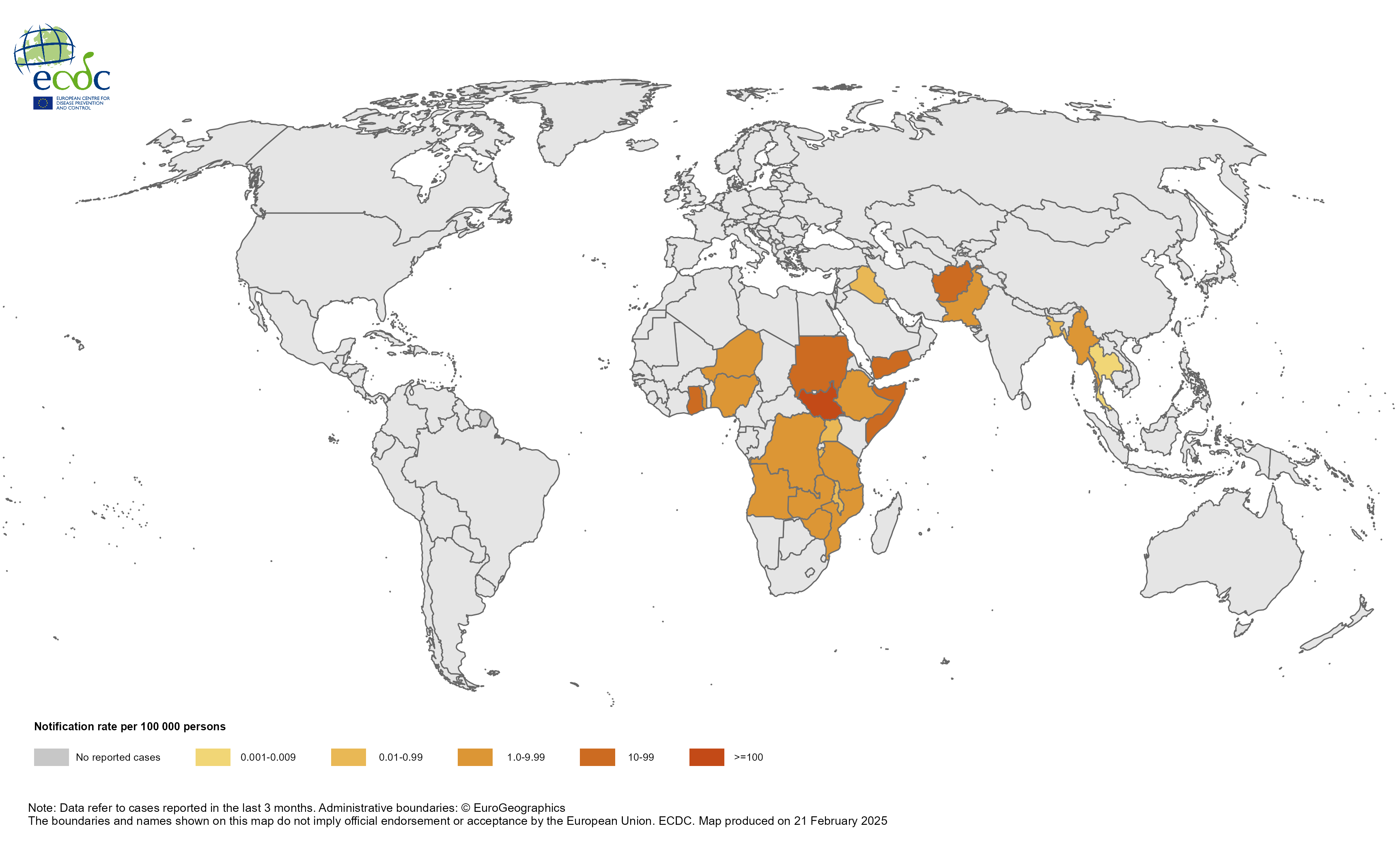
- Since 1 January 2025, and as of 20 February 2025, 45 731 new cholera cases, including 491 new deaths, have been reported worldwide. In 2024, 791 755 new cholera cases, including 5 374 new deaths, have been reported worldwide.
- In 2025, new cases have been reported from Afghanistan, Angola, Bangladesh, Burundi, Cameroon, Democratic Republic of the Congo, Ethiopia, Ghana, Malawi, Mozambique, Myanmar, Niger, Nigeria, Pakistan, Somalia, South Sudan, Sudan, Thailand, Togo, Uganda, United Republic of Tanzania, Yemen, Zambia, and Zimbabwe.
- In 2025, cholera cases continue to be reported in Africa, Asia, and the Middle East. The risk of cholera infection in travellers visiting these countries remains low, even though sporadic importation of cases to the EU/EEA is possible.
Overview
Data presented in this report originate from several sources, both official public health authorities and non-official sources, such as the media. Case definitions, testing strategies, and surveillance systems vary between countries. In addition, data completeness and levels of under-reporting vary between countries. All data should therefore be interpreted with caution. For details on the epidemiological situation and more information regarding the case definitions in use, refer to the original sources.
Summary
Since 1 January 2025 and as of 20 February 2025, 45 731 cholera cases, including 491 deaths, have been reported worldwide. In comparison, since 01 January 2024 and as of 20 February 2024, 69 825 cholera cases, including 1 099 deaths, were reported worldwide.
New cases have been reported from Afghanistan, Angola, Bangladesh, Burundi, Democratic Republic of the Congo, Ethiopia, Ghana, Malawi, Mozambique, Myanmar, Niger, Nigeria, Pakistan, Somalia, South Sudan, Sudan, Thailand, Togo, Uganda, United Republic of Tanzania, Yemen, Zambia and Zimbabwe.
The five countries reporting most cases are South Sudan (13 882), Afghanistan (9 456), Yemen (6 110), Democratic Republic of the Congo (4 771) and Angola (3 147).
New deaths have been reported from Afghanistan, Angola, Democratic Republic of the Congo, Ethiopia, Ghana, Malawi, Niger, Nigeria, Somalia, South Sudan, Sudan, Togo, Uganda, United Republic of Tanzania, Yemen, Zambia, and Zimbabwe.
The five countries reporting most new deaths are South Sudan (193), Angola (108), Democratic Republic of the Congo (85), Sudan (53) and Nigeria (14).
In 2025, new cholera cases and new deaths have been reported from:
Africa
Angola: Since 1 January 2025 and as of 18 February 2025, 3 147 cases, including 108 deaths, have been reported. In comparison, in 2024 and as of 20 February 2024, no cases were reported. The last time cases were reported was in February 2019.
Burundi: Since 1 January 2025 and as of 3 February 2025, 74 cases have been reported. In comparison, in 2024 and as of 31 January 2024, 33 cases were reported.
Democratic Republic of the Congo: Since 1 January 2025 and as of 27 January 2025, 4 771 cases, including 85 deaths, have been reported. In comparison, in 2024 and as of 31 January 2024, 31 135 cases, including 430 deaths were reported.
Ethiopia: Since 1 January 2025, and as of 3 February 2025, 177 cases, including three deaths have been reported. In comparison, in 2024 and as of 31 January 2024, 779 cases, including 12 deaths were reported.
Ghana: Since 1 January 2025, and as of 18 February 2025, 1 479 cases, including nine deaths, have been reported. In comparison, in 2024 and as of 20 February 2024, no cases were reported.
Malawi: Since 1 January 2025 and as of 18 February 2025, 83 cases, including two deaths, have been reported. In comparison, in 2024 and as of 31 January 2024, 11 cases were reported.
Mozambique: Since 1 January 2025 and as of 3 February 2025, 64 cases have been reported. In comparison, in 2024 and as of 31 January 2024, 2 563 cases, including six deaths, were reported.
Niger: Since 1 January 2025 and as of 31 December 2024, 1 066 cases, including 23 deaths, have been reported. In comparison, in 2024, and as of 20 February 2024, no cases were reported.
Nigeria: Since 1 January 2025 and as of 10 February 2025, 889 cases, including 14 deaths, have been reported. In comparison, in 2024 and as of 20 February 2024, no cases were reported.
Somalia: Since 1 January 2025 and as of 20 January 2025, 777 cases, including one death, have been reported. In comparison, in 2024 and as of 31 January 2024, 1 406 cases, including 18 deaths, were reported.
South Sudan: Since 1 January 2025 and as of 10 February 2025, 13 882 cases, including 193 deaths, have been reported. In comparison, in 2024 and as of 20 February 2024, no cases were reported.
Sudan: Since 1 January 2025 and as of 18 February 2025, 2 437 cases, including 53 deaths, have been reported. In comparison, in 2024 and as of 20 February 2024, no cases were reported.
Togo: Since 1 January 2025 and as of 3 February 2025, 138 cases, including four deaths, have been reported. In comparison, in 2024 and as of 20 February 2024, no cases were reported.
Uganda: Since 1 January 2025 and as of 3 February 2025, 87 cases, including one death, have been reported. In comparison, in 2024 and as of 29 January 2024, 13 cases were reported.
United Republic of Tanzania: Since 1 January 2025 and as of 31 December 2024, 12 148 cases, including 145 deaths, have been reported. In comparison, in 2024 and as of 20 January 2024, 164 cases, including one death, was reported.
Zambia: Since 1 January 2025 and as of 18 February 2025, 224 cases, including nine deaths, have been reported. In comparison, in 2024 and as of 31 January 2024, 13 015 cases, including 488 deaths were reported.
Zimbabwe: Since 1 January 2025 and as of 18 February 2025, 133 cases, including two deaths, have been reported. In comparison, in 2024 and as of 31 January 2024, 7 219 cases, including 124 deaths, were reported.
Asia
Afghanistan: Since 1 January 2025 and as of 3 February 2025, 9 456 cases, including three deaths, have been reported. In comparison, in 2024 and as of 27 January 2024, 8 402 cases, including eight deaths, were reported.
Bangladesh: Since 1 January 2025 and as of 3 February 2025, 83 cases have been reported. In comparison, in 2024 and as of 20 February 2024, no cases were reported.
Myanmar: Since 1 January 2025 and as of 20 January 2025, 553 cases have been reported. In comparison, in 2024 and as of 20 February 2024, no cases were reported.
Pakistan: Since 1 January 2025 and as of 6 January 2025, 1 162 cases have been reported. In comparison, in 2024 and as of 30 January 2024, 2 405 cases were reported.
Thailand: Since 1 January 2025 and as of 20 January 2025, 5 cases have been reported. In comparison, in 2024 and as of 31 January 2024, no cases were reported.
Yemen: Since 1 January 2025 and as of 20 January 2025, 6 110 cases, including four deaths, have been reported. In comparison, in 2024 and as of 20 February 2024, no cases were reported.
ECDC assessment
In 2025, cholera cases have continued to be reported in Africa and Asia. Within the last six months, cholera outbreaks have also been reported in parts of the Middle East and the Americas.
In this context, although the risk of cholera infection for travellers visiting these countries remains low, sporadic importation of cases to the EU/EEA is possible.
In the EU/EEA, cholera is rare and primarily associated with travel to endemic countries. Cholera reporting at EU level is done on an annual basis, at the end of May for the year prior. In 2023, 12 confirmed cases were reported by five EU/EEA countries, while 29 were reported in 2022, two in 2021, and none in 2020. In 2019, 25 cases were reported in EU/EEA countries (including the United Kingdom). All cases had a travel history to cholera-affected areas.
According to the World Health Organization (WHO), vaccination should be considered for travellers at higher risk, such as emergency and relief workers who may be directly exposed. Vaccination is generally not recommended for other travellers. Travellers to cholera-endemic areas should seek advice from travel health clinics to assess their personal risk and apply precautionary sanitary and hygiene measures to prevent infection. Such measures can include drinking bottled water or water treated with chlorine, carefully washing fruit and vegetables with bottled or chlorinated water before consumption, regularly washing hands with soap, eating thoroughly cooked food, and avoiding the consumption of raw seafood products.
Actions
ECDC continues to monitor cholera outbreaks globally through its epidemic intelligence activities in order to identify significant changes in epidemiology and provide timely updates to public health authorities. Reports are published on a monthly basis. The worldwide overview of cholera outbreaks is available on ECDC's website.