
‘Summary report on EARS-Net EQA 2025’ published by the European Union Reference Laboratory for Public Health on AMR (EURL-PH-AMR)
On 4 June 2026, the European Union Reference Laboratory for Public Health on AMR (EURL-PH-AMR) published the ‘Summary report on EARS-Net EQA 2025’. It describes the results of the 2025 external quality assessment (EQA) exercise for antimicrobial susceptibility testing (AST) by clinical laboratories that participate in the European Antimicrobial Resistance Surveillance Network (EARS-Net). The report was produced by Technical University of Denmark, National Food Institute (DTU Food), in their capacity as a consortium member of the EURL-PH-AMR. ECDC coordinates the European Union Reference Laboratory (EURL) network and EARS-Net and provided technical advice and peer-review support during the development of the EQA report.
The 2025 EARS-Net EQA exercise aimed to assess the quality of species identification by participating laboratories; assess the accuracy of the qualitative AST results reported by participating laboratories; and evaluate the overall comparability of routinely collected AST results between laboratories and EU/EEA countries.
All European Union/European Economic Area (EU/EEA) countries were eligible to participate if they were participants in EU4Health (n=29, i.e. all except Liechtenstein), and all 29 eligible countries participated. As in each annual EARS-Net EQA exercise, eligible laboratories were identified by National EARS-Net EQA Coordinators, designated by the Coordinating Competent Body in each EU/EEA country. Participating laboratories were requested to identify the species of six bacterial strains and to submit AST results for the antimicrobials included in EARS-Net surveillance, using the AST methods that they apply routinely. In 2025, the panel of six EQA strains consisted of Acinetobacter baumannii (n=2), Escherichia coli, Klebsiella pneumoniae, Streptococcus pneumoniae and Staphylococcus aureus (Table 1). The 2025 EARS-Net EQA exercise used the same scoring system as in the 2023 and 2024 EARS-Net EQAs to evaluate reported interpretations of AST results. The scoring system incorporated an assessment of both the ‘level of difficulty’ and the ‘severity of error’ for each strain-antimicrobial combination, with each reported interpretation of AST results evaluated according to the clinical breakpoints in the European Committee on Antimicrobial Susceptibility Testing (EUCAST) Clinical Breakpoints Tables v15.0.
On 3 June 2025, the six strains were distributed via the National EARS-Net EQA Coordinators to 977 laboratories in 29 EU/EEA countries. An EQA webtool was opened to receive submission of results between 4 June and 10 August 2025. Results were submitted by 895 laboratories (91.6%). In total, 4 917 (99.7%) of the 4 932 evaluated species identification results were correct. The interpretation of AST results was evaluated only for samples with correctly identified species. In total, 56 924 interpretations of AST results were evaluated, reported by 894 laboratories. Overall, the submitted AST interpretations were in ‘very good’ concordance (>90% to <95%) with the expected results, with 94.4% (n=53 742) being correct. Otherwise, major errors (MEs; falsely reporting resistance) and very major errors (VMEs; falsely reporting susceptibility) were observed for 2.6% and 3.0% of interpretations, respectively.
In the EARS-Net EQA exercises, results can be reported for the strain-antimicrobial combinations that can be reported to ECDC in EARS-Net surveillance data. In 2025, the majority of the combinations had results in ‘excellent’ (≥95%) concordance with the expected results (n=68 or 79.1% of the combinations). A ‘very good’ concordance was achieved for two combinations, ‘good’ (>85 to ≤90%) concordance was achieved for six, and ‘satisfactory’ concordance (>80 to ≤85%, i.e. for results that could be improved) was achieved for three. The remaining seven combinations were under the threshold for ‘satisfactory’ concordance.
The summary report includes a short conclusion on the capacities of the participating laboratories, and recommendations for improvement. As standard practice, laboratories should confirm that their laboratory protocols are in accordance with the latest EUCAST recommendations and guidelines, applying the most recent EUCAST breakpoints, to ensure optional standard clinical practice and AMR surveillance reporting activities. AMR surveillance and control activities, and organisations that develop guidelines for AST, should note the specific deviations in AST results observed for each species and antimicrobial or class during this EQA exercise in 894 clinical laboratories across all EU/EEA countries.
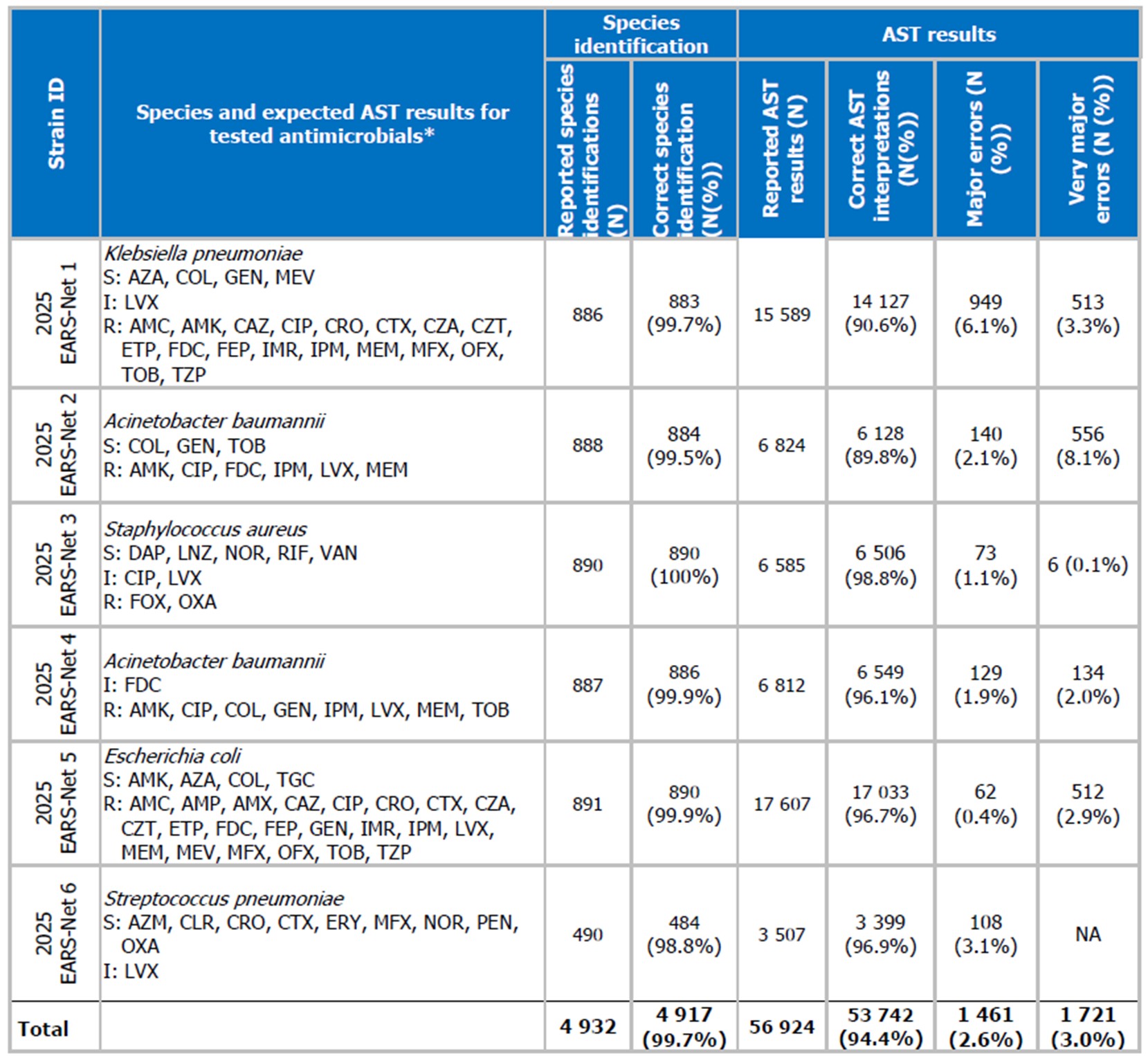
* All samples were considered to be obtained from patients with bloodstream infections. The expected SIR results were generated using EUCAST breakpoint tables v15.0. For describing the expected results of the strains included in the 2025 EARS-Net EQA, the following adaptations were made to the EUCAST reporting recommendations: breakpoints based on ECOFF values (i.e. breakpoints in brackets) were used for interpretation of results when no other relevant EUCAST clinical breakpoints existed and it was assumed that the antimicrobials would be administered in combination with other antimicrobials; for Enterobacterales it was assumed that penicillins would be administered intravenously; for cefiderocol in A. baumannii, wild-type isolates were registered as ‘S’, non-wild type isolates which may be associated with impaired clinical response were registered as ‘I’ and likely resistant isolates were registered as ‘R’; breakpoints were applied for screening antimicrobials regardless of their status as ‘screen only’; results from screening antimicrobials were not used for interpretation of other antimicrobials belonging to the same class and instead all AST were performed individually.
AST: antimicrobial susceptibility testing; S: susceptible, standard dosing regimen; I: susceptible, increased exposure; R: resistant; NA: Not applicable; AMC: Amoxicillin-clavulanic acid; AMK: Amikacin; AMP: Ampicillin; AMX: Amoxicillin; AZA: Aztreonam-avibactam; AZM: Azithromycin; CAZ: Ceftazidime; CIP: Ciprofloxacin; CLR: Clarithromycin; COL: Colistin; CRO: Ceftriaxone; CTX: Cefotaxime; CZA: Ceftazidime-avibactam; CZT: Ceftolozane-tazobactam; DAP: Daptomycin; ERY: Erythromycin; ETP: Ertapenem; FDC: Cefiderocol; FEP: Cefepime; FOX: Cefoxitin; GEN: Gentamicin; IMR: Imipenem-relebactam; IPM: Imipenem; LNZ: Linezolid; LVX: Levofloxacin; MEM: Meropenem; MEV: Meropenem-vaborbactam; MFX: Moxifloxacin; NOR: Norfloxacin; OFX: Ofloxacin; OXA: Oxacillin; PEN: Benzylpenicillin; PIP: Piperacillin; RIF: Rifampicin; TEC: Teicoplanin; TGC: Tigecycline; TOB: Tobramycin; TZP: Piperacillin-tazobactam; VAN: Vancomycin.
Read the report

External quality assessment (EQA) of the performance of laboratories participating in the European Antimicrobial Resistance Surveillance Network (EARS-Net)
Share this page